
Every growing company eventually asks the same question: should we set goals with OKRs or measure results with KPIs? The debate around OKRs vs KPIs is common because both promise clarity, yet they solve different problems.
The short answer is that neither is better in every situation. OKRs push teams toward ambitious change, while KPIs keep daily operations healthy. This guide explains how each one works, where they differ, and how to pick the right fit for your team.
What Are OKRs?
OKRs stand for Objectives and Key Results. An objective is a clear, inspiring goal. Key results are the measurable outcomes that prove you reached it.
For example, an objective might be Become the preferred choice for local customers. The key results could be raising customer satisfaction from 70 to 85 percent and cutting support response time to under two hours.
OKRs are usually set every quarter, and they are designed to stretch a team. Reaching 70 percent of an ambitious OKR is often considered a strong result.
What Are KPIs?
Key Performance Indicators are ongoing measurements that show how well a process, team, or business is performing. They answer a simple question: are we on track?
Common examples include monthly revenue, employee turnover rate, customer retention, and average ticket resolution time. These performance indicators stay fairly stable over time, which lets you compare results month after month.
OKRs vs KPIs: Key Differences
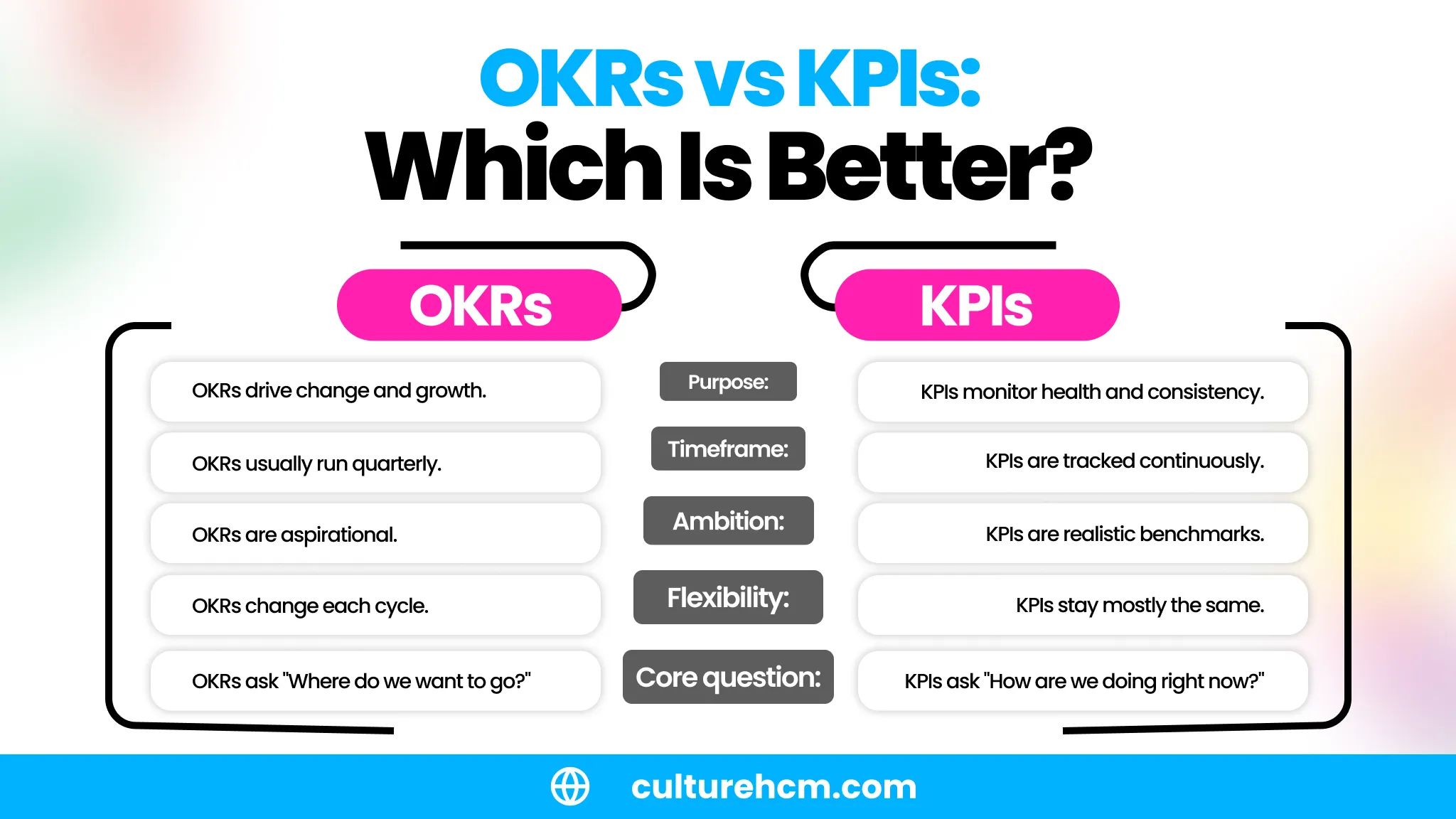
Here is a quick way to tell them apart:
Purpose: OKRs drive change and growth. KPIs monitor health and consistency.
Timeframe: OKRs usually run quarterly. KPIs are tracked continuously.
Ambition: OKRs are aspirational. KPIs are realistic benchmarks.
Flexibility: OKRs change each cycle. KPIs stay mostly the same.
Core question: OKRs ask Where do we want to go?" KPIs ask "How are we doing right now?
OKR vs KPI for Businesses: Which Should You Choose?
When weighing OKR vs KPI for businesses, the right answer depends on your stage and priorities.
Choose OKRs when you are launching a product, entering a new market, or need everyone aligned around one big priority. Startups and fast-growing companies often benefit most, because OKRs create focus.
Choose KPIs when your priority is stability, efficiency, and steady output. Established functions like finance, HR, and customer support rely on KPIs to catch problems early.
For most companies, the honest answer is both. OKRs set the direction, and KPIs confirm you are not losing ground while you chase it.
How to Use OKRs and KPIs Together
Think of KPIs as the dashboard of a car and OKRs as the destination. You need both to travel well.
Start with your KPIs. Identify the metrics that already show business health.
Spot the gaps. If a KPI is lagging, turn it into an objective.
Write key results. Define two to four measurable outcomes per objective.
Review regularly. Hold monthly check-ins and a quarterly reset.
An Example in Action
Imagine a retail company whose customer retention rate has slipped to 60 percent. Retention is the KPI, and it is telling you something needs attention.
The team sets a quarterly OKR: "Win back customer loyalty." The key results are lifting retention to 68 percent, launching a loyalty program, and reducing complaint resolution time to 24 hours.
Once the quarter ends, retention returns to being a regular KPI, and the team picks a new objective. The KPI flagged the problem, and the OKR drove the fix.
Why This Matters for Employee Performance Management
Goals only work when people can see their progress. That is where employee performance management comes in. A solid performance management system links company goals to individual contributions, so every employee knows how their work moves the needle.
Used well, OKRs and KPIs support a fair performance evaluation. Instead of relying on opinions, managers can review results against agreed targets. That makes feedback conversations more objective and constructive.
They also strengthen employee performance tracking. Regular check-ins show who needs support and who is ready for more responsibility. Paired with employee productivity tracking, you can see not only what was achieved, but how efficiently the team is working.
The Role of Software in Tracking Goals
Spreadsheets work at first, but they get messy fast. Scattered files, outdated numbers, and manual updates lead to missed targets and unclear ownership.
Modern performance management software brings goals, feedback, and reviews into one place. Dedicated KPI tracking software adds live dashboards, so leaders can spot problems before they grow.
For Pakistani businesses, it also helps to connect performance data with HR operations. A platform that pairs goal tracking with trusted Payroll software Pakistan teams can rely on links results to attendance, incentives, and compensation. That cuts manual work and reduces errors.
Common Mistakes to Avoid
Setting too many goals. Three to five objectives per cycle is plenty.
Using OKRs as a punishment tool. They work best when tied to growth and learning.
Choosing vanity metrics. Track numbers that reflect real outcomes, not just impressive ones.
Skipping check-ins. Goals fade quickly without regular attention.
Conclusion
The OKRs vs KPIs question is not about picking a winner. KPIs tell you where your business stands today, and OKRs tell you where you want to take it next. Together they give teams direction, accountability, and a clear way to measure progress.
If you are ready to move beyond spreadsheets, explore a platform that brings goal setting, performance tracking, and payroll together in one place. Book a demo today and see how simple performance management can be.
FAQs
What is the main difference between OKRs and KPIs?
OKRs are ambitious goals that drive change over a short cycle, while KPIs are steady metrics that measure ongoing performance. OKRs focus on growth, and KPIs focus on health.Which is better, OKRs or KPIs?
Neither wins in every case. OKRs suit growth and transformation, while KPIs suit stable operations. Most businesses get the best results by using both.
Can a small business use OKRs and KPIs?
Yes. Small teams can start with three KPIs and one or two OKRs per quarter. Keep it simple, then expand as the business grows.
How often should OKRs and KPIs be reviewed?
Review KPIs weekly or monthly, and check OKR progress every two to four weeks, with a full review each quarter.
Do OKRs replace performance reviews?
No. OKRs give useful context and data for reviews, but a complete review should also look at skills, behavior, and growth.