Diagnosis code errors are a quiet cause of rework on behavioral health claims. A header code slips through, an EHR favorite goes stale, or a code from the wrong version of ICD-10 lands on the form. This guide covers ICD-10 codes for mental health disorders under the FY2027 code set, which applies to dates of service from October 1, 2026 through September 30, 2027. You will find a block map, a billable versus header table, and a pre-claim checklist.
Quick answer: Mental health diagnoses are reported with ICD-10-CM Chapter 5 codes (F01-F99). For dates of service from October 1, 2026 through September 30, 2027, use the FY2027 code set. Report the most specific billable code the provider's documentation supports, and never submit a category header such as F32, F33 or F41 on its own.
How ICD-10-CM organizes mental health codes
Chapter 5 of ICD-10-CM is titled Mental, Behavioral and Neurodevelopmental Disorders, and it runs from F01 to F99. Any search for mental health ICD-10 codes 2027 ends up in this chapter, so it helps to know how it is built. The chapter is split into blocks, each block holds categories, and many categories branch into subcategories with a fourth, fifth or sixth character. Only a complete code is billable.
The classification is maintained by CDC/NCHS, and CMS publishes the code set files used for claims. One chapter-level note is worth knowing. Symptoms and signs in R00-R99 sit under an Excludes 2 note, so a symptom code can still be reported alongside an F code when the symptom is not part of the documented diagnosis. Table 1 shows how the blocks line up.
| Block | Title | Example billable codes |
|---|---|---|
| F01-F09 | Mental disorders due to known physiological conditions | F06.4 |
| F10-F19 | Mental and behavioral disorders due to psychoactive substance use | F10.20 |
| F20-F29 | Schizophrenia, schizotypal, delusional, and other non-mood psychotic disorders | F20.9 |
| F30-F39 | Mood [affective] disorders | F32.A, F33.1 |
| F40-F48 | Anxiety, dissociative, stress-related, somatoform and other nonpsychotic mental disorders | F41.1, F43.10 |
| F50-F59 | Behavioral syndromes associated with physiological disturbances and physical factors | F50.00 |
| F60-F69 | Disorders of adult personality and behavior | F60.3 |
| F70-F79 | Intellectual disabilities | F70 |
| F80-F89 | Pervasive and specific developmental disorders | F84.0 |
| F90-F98 | Behavioral and emotional disorders with onset usually occurring in childhood and adolescence | F90.2, F93.0 |
| F99 | Unspecified mental disorder | F99 |
Billable codes vs category headers
This is where many ICD-10 F codes go wrong. A category header is a placeholder that needs more characters before it can go on a claim. So, are ICD-10 F codes billable? Only the complete ones. Headers like F32, F33 and F41 need a fourth or fifth character, and each has billable children beneath it.
| Header (not billable) | Billable codes beneath it |
|---|---|
| F32 | F32.0-F32.5, F32.9, F32.A, plus F32.81 and F32.89 under F32.8 |
| F32.8 | F32.81, F32.89 |
| F33 | F33.0-F33.3, F33.8, F33.9, plus F33.40-F33.42 under F33.4 |
| F33.4 | F33.40, F33.41, F33.42 |
| F41 | F41.0, F41.1, F41.3, F41.8, F41.9 |
| F43.1 | F43.10, F43.11, F43.12 |
| F90 | F90.0, F90.1, F90.2, F90.8, F90.9 |
| F06.3 | F06.30-F06.34 |
Headers often reach claims through stale templates or free-text code entry. Our post on outdated or invalid codes explains how that happens and how to catch it.
What changed for mental health codes in FY2027
The FY2027 ICD-10-CM code set is effective October 1, 2026 and runs through September 30, 2027. For 2027 ICD-10-CM mental health codes, the short version is that very little moved. Chapter 5 gained one code, F64.A (Gender identity disorder, in remission), and nothing changed in the codes or titles for F32, F33 or F41.
The rule that matters for your billing team is to use the code set in effect on the date of service. A visit on September 30 and a visit on October 1 can fall under different code sets, so claims for those two days need separate checks. For overall new-code totals across the whole classification, go to the CMS FY2027 files directly, since secondary sources quote different numbers.
Mental health ICD-10 codes by condition
Table 2 gives a working list of ICD-10 codes for mental health billing, organized by condition. Each condition then gets a short section that points to a deeper guide. Check every code against the FY2027 tabular before it goes into a template or superbill.
| Condition | ICD-10-CM codes | Header to avoid | Key documentation element |
|---|---|---|---|
| Depression | F32.x, F33.x, F32.A | F32, F33 | Single episode or recurrent, severity, remission status |
| Anxiety | F41.0, F41.1, F41.3, F41.8, F41.9 | F41 | Named anxiety disorder type |
| PTSD | F43.10 to F43.12 | F43.1 | Unspecified, acute or chronic |
| Adjustment disorders | F43.20 to F43.29 | F43.2 | Documented predominant feature |
| Bipolar disorder | F31.x | F31 | Current episode and severity |
| ADHD | F90.0 to F90.9 | F90 | Presentation type |
| OCD | F42.x | F42 | Documented OCD subtype |
Depression codes (F32, F33)
Depression splits into single episodes (F32) and recurrent (F33), and both have remission codes. When the provider documents only "depression," the Index points to F32.A, while "major depression" without more detail points to F32.9. For a full walk-through, see our guide to ICD-10 codes for depression, or read how F33.1 (recurrent, moderate) is assigned.
Anxiety codes (F41)
The anxiety category holds F41.0, F41.1, F41.3, F41.8 and F41.9. Mixed anxiety and depressive disorder is an inclusion term under F41.8 in ICD-10-CM. Our deep dives cover anxiety disorder, unspecified (F41.9) and generalized anxiety disorder (F41.1).
Trauma and stressor-related codes (F43)
PTSD is reported with F43.10, F43.11 or F43.12, because F43.1 is a header. Adjustment disorders run from F43.20 to F43.29, and the right code follows the predominant feature the provider documents, such as depressed mood or anxiety.
Bipolar, ADHD and OCD codes
Bipolar disorder lives in F31.x. ADHD uses F90.0, F90.1, F90.2, F90.8 or F90.9, and F90 itself is a header. Obsessive-compulsive disorder sits in F42.x.
ICD-10-CM vs DSM-5-TR: which goes on the claim?
Clinicians diagnose using DSM-5-TR criteria, and claims carry ICD-10-CM codes. The American Psychiatric Association publishes DSM-5-TR and lists the matching ICD-10-CM code beside each condition, while ICD-10-CM is the diagnosis code set adopted under HIPAA.
Terminology shifts can still catch teams off guard. Since October 1, 2021, "Depression NOS" indexes to F32.A, not F32.9, as the AHA Coding Clinic 2021 Q4 summary describes. The coder's job is to translate the diagnosis the provider documents into the right code, never to choose the diagnosis.
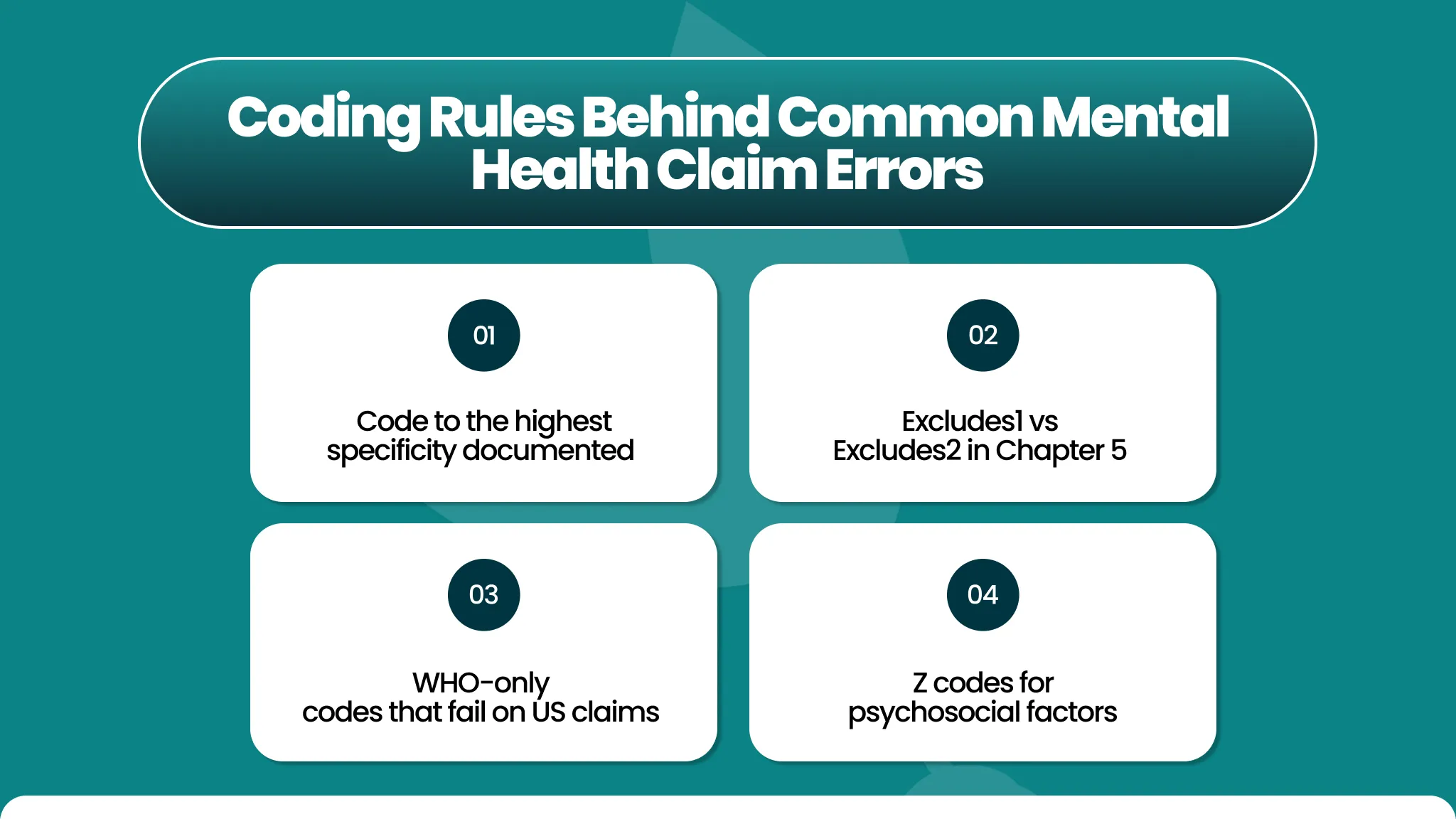
Coding rules behind common mental health claim errors
The rules below explain why diagnosis codes get corrected after the fact. They do not say how often errors happen. Mismatches between diagnosis and procedure codes are covered in our post on mismatched ICD-10 and CPT codes.
Code to the highest specificity documented
The FY2027 Official Guidelines allow an unspecified code when the documentation does not support more detail. That is permission, not a default. When the provider documents a type, severity or episode, the code should reflect it. Some payers apply extra review to unspecified codes, so check your own payer's policy before building templates around them.
Excludes1 vs Excludes2 in Chapter 5
An Excludes1 note means two conditions should never be reported together. F32 excludes F33, F31 and F30, and F33 excludes F31 and F30. An Excludes2 note means both can coexist. F41, for example, lists acute stress reaction (F43.0), separation anxiety (F93.0) and others as conditions that may be reported alongside it. Each note is visible in the FY2027 tabular.
WHO-only codes that fail on US claims
Why does F41.2 get rejected? Because F41.2 is a WHO ICD-10 code and is not valid in the US ICD-10-CM. The same is true of category F38. Online code lists that mix the two versions are a frequent source of confusion. In the US, mixed anxiety and depressive disorder is an inclusion term under F41.8.
Z codes for psychosocial factors
Z codes can capture social determinants and life circumstances alongside the F code. When the provider documents a relevant circumstance, look up the correct Z code in the FY2027 tabular and report it as a supporting diagnosis.
(Hypothetical) A practice template still maps "Depression" to F32.9 from a pre-2021 favorites list. The provider documents only "depression," with no major depressive disorder diagnosis. The coder checks the Alphabetic Index, finds F32.A, and updates the template.
Pairing diagnosis codes with mental health CPT codes
A diagnosis code supports medical necessity for the service billed. The diagnosis on a psychotherapy claim should explain why that session happened, and it should match the provider's note for that date of service. A valid code attached to the wrong claim line still creates problems.
Each service has its own billing rules. See our guides for psychiatric diagnostic evaluation (90791), 45-minute psychotherapy (90834) and 60-minute psychotherapy (90837). For modifiers and place of service, our behavioral health billing guide is the companion piece. Payer rates vary and sit outside this guide.
Pre-claim checklist for mental health diagnosis codes
Use this as a billing workflow check before claims go out. It does not replace the provider's clinical judgment.
| Check | What to confirm |
|---|---|
| Valid code set | The code is valid in FY2027 ICD-10-CM for the date of service |
| No headers | No category header such as F32, F33 or F41 is on the claim |
| Specificity | The code matches the detail in the provider's note |
| Excludes1 conflicts | No two codes on the claim are barred from appearing together |
| US code set | No WHO-only code such as F41.2 is used |
| CPT support | The diagnosis supports the CPT code billed |
| EHR favorites | Saved code lists are reviewed every year after October 1 |
Not sure your diagnosis codes match what your notes support? A coding audit can surface specificity and header-code issues before claims go out.
Also read
Mental health coding support
Behavioral health claims depend on accurate diagnosis selection, current code sets and notes that support what was billed. GreenSense Billing's coding team reviews all three through our medical coding services, so errors get caught before submission instead of after a denial. That same attention to ICD-10 codes for mental health carries through to claim edits and follow-up.
If your practice also wants help with claim submission, our mental health billing services cover the full workflow for therapists, psychiatrists and group practices.