
California workers’ compensation billing is the process of submitting medical bills for treatment given to employees who have work-related injuries or illnesses. Unlike routine health insurance billing, it follows state-specific rules for documentation, coding, and payment. Getting those details right helps practices keep California workers’ comp billing moving, avoid preventable errors, and protect a healthy revenue cycle.
This guide explains how the process works, what the requirements look like, which forms apply, and how to handle common problems. It is written for providers, billing specialists, and practice managers who want clear answers about California work injury medical billing.
What Is California Workers’ Compensation Billing?
California workers’ compensation billing is how healthcare providers request payment for medical services tied to a covered workplace injury or illness. Instead of billing the patient’s health plan, the provider bills the employer’s insurer or claims administrator.
Workers’ compensation medical billing differs from routine health insurance billing in a few ways. The injured worker does not pay for covered treatment, the claim determines the payer, and the California Division of Workers’ Compensation (DWC) sets many of the rules that govern documentation and payment.
Several parties are involved: the provider, the employer, the insurer, and the claims administrator. Each one affects whether a bill is accepted and paid. A bill that works in another payer system can be returned here for missing details, which is why California-specific rules matter. Understanding who is responsible for what makes medical billing for workers’ comp far more predictable.
How Does the California Workers’ Compensation Billing Process Work?
The process follows a clear sequence. Each step protects the next one, so skipping ahead usually creates rework later.
- Confirm the claim number, employer, and claims administrator.
- Review authorization and treatment documentation requirements for the service.
- Record services using the correct medical codes and billing details.
- Apply the relevant California billing and reimbursement rules.
- Complete workers’ compensation claim submission electronically or on the required standardized paper form.
- Monitor acknowledgments, payment status, and explanations of review.
- Handle medical claim follow-up on rejected, denied, or underpaid bills.
Requirements can vary by service type and claim circumstances, so always check the details of each case. The DWC publishes official guidance on its e-billing page.
What Are the Billing Requirements for California Workers’ Compensation?
Meeting workers’ comp billing requirements starts with following DWC rules closely. In practice, that means:
- Accurate patient, claim, provider, and service information.
- Correct procedure codes, modifiers, and supporting documentation.
- Current medical billing and payment guidelines.
- Current fee schedules, including the Official Medical Fee Schedule (OMFS).
- Timely submission under the relevant statutory requirements.
- Correct electronic or standardized paper billing procedures.
Providers may submit treatment bills electronically or on paper, subject to the applicable rules. California claims administrators must accept electronic bills, although providers are generally not required to send them that way. Electronic medical billing still tends to speed up acknowledgment and tracking.
Deadlines and rules can differ by service, so avoid assuming one standard fits every bill. Also keep medical treatment billing separate from medical-legal billing, since the two follow different rules.
Which Forms Are Used for Workers’ Compensation Medical Billing?
California uses standardized forms and formats, and the right one depends on the service:
- CMS-1500 billing form: commonly used for professional healthcare services.
- UB-04 billing form (CMS-1450): used for institutional and hospital billing.
- NCPDP claim format: used for applicable pharmacy claims.
- ADA Dental Claim Form: used for dental services.
The correct form or electronic transaction depends on the type of service and the billing rules that apply. The DWC explains the paper options on its standardized paper billing page.
Common California Workers’ Compensation Billing Challenges
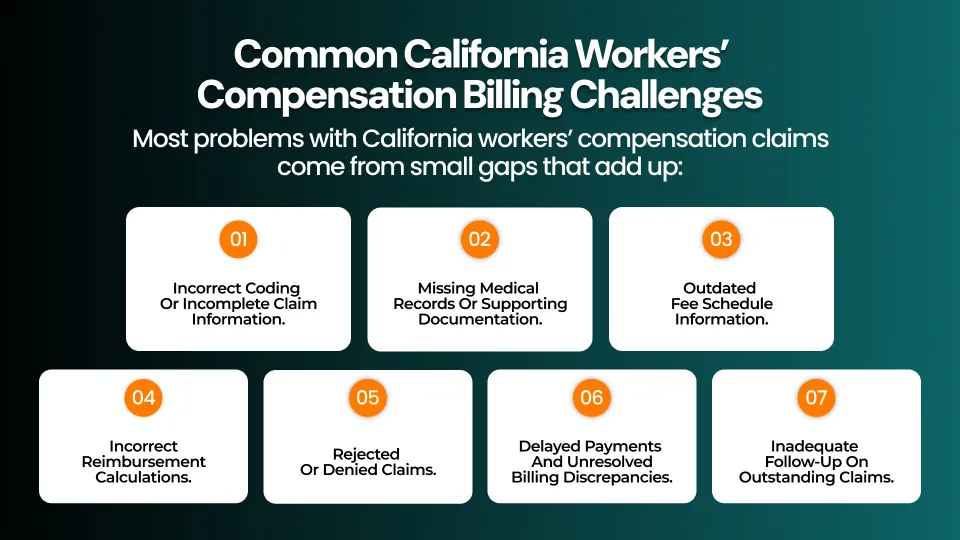
Most problems with California workers’ compensation claims come from small gaps that add up:
- Incorrect coding or incomplete claim information.
- Missing medical records or supporting documentation.
- Outdated fee schedule information.
- Incorrect reimbursement calculations.
- Rejected or denied claims.
- Delayed payments and unresolved billing discrepancies.
- Inadequate follow-up on outstanding claims.
Frequent workers’ compensation claim denials and workers’ compensation payment disputes increase the administrative workload and slow down workers’ compensation reimbursement. Without a steady follow-up routine, unpaid bills can sit unnoticed for months.
How Can Healthcare Providers Improve Workers’ Comp Billing Efficiency?
Small habits make a real difference:
- Verify claim and payer details before submitting.
- Keep medical documentation complete and accurate.
- Use current California billing guidelines and fee schedules.
- Track acknowledgments and payment status.
- Review explanations of review and investigate payment gaps.
- Build a consistent process for medical billing denial management.
When internal resources are limited, specialized workers’ compensation billing services can help. A billing partner with California experience can support clean claims, steady follow-up, and stronger revenue cycle management (RCM), so your clinical team can stay focused on patient care.
Frequently Asked Questions
1. What is California workers’ compensation billing?
It is the billing of medical services related to eligible workplace injuries or illnesses under California’s workers’ compensation system.
2. What billing forms are used for California workers’ compensation claims?
Common formats include the CMS-1500, UB-04/CMS-1450, NCPDP pharmacy format, and ADA Dental Claim Form. The right one depends on the service.
3. Can California workers’ compensation medical bills be submitted electronically?
Yes. Providers can submit eligible bills electronically by following DWC electronic billing standards. Paper submission is also available under the relevant requirements. See the DWC e-billing FAQs.
4. How can providers reduce workers’ compensation claim denials?
Use accurate coding, complete documentation, verified claim details, current guidelines, and timely follow-up.
5. How can medical billing services help healthcare providers?
They can assist with claim preparation, submission, payment tracking, denial follow-up, and broader revenue cycle workflows.
Conclusion
Understanding California workers’ compensation billing is essential for accurate claims, appropriate reimbursement, and an efficient revenue cycle. Clear processes, current guidelines, and consistent follow-up give providers the best chance of smooth payment. If your practice wants dependable support, explore Billgenix’s medical billing and revenue cycle management services to simplify your workers’ comp billing.