
Meeting California workers’ comp billing deadlines is a core part of getting paid for treating injured workers. Providers have to track several separate timelines: when to submit a medical bill, how long the claims administrator has to pay, and how long you have to dispute a payment decision. Missed deadlines, incomplete documentation, and late follow-up can all complicate reimbursement. This article focuses on California-specific medical treatment billing rules and is written for providers, billers, and practice managers. Use it as a practical overview, then confirm the details against official guidance for each claim.
What Are California Workers’ Compensation Billing Deadlines?
California workers’ compensation billing deadlines are the time limits that govern submitting a medical bill, processing payment, and requesting review of a payment decision. In short, there are three kinds: submission, payment, and dispute deadlines.
- The deadline for a provider to submit a medical bill.
- The time a claims administrator has to pay or object to a bill.
- The deadline to request second bill review or independent bill review.
These California workers’ compensation billing timelines run separately from one another. Workers’ compensation billing deadlines California providers face can also differ by service type, billing method, and claim circumstances, so no single date fits every bill.
How Long Do Providers Have to Submit Workers’ Comp Medical Bills in California?
The general rule comes from Labor Code section 4603.2. Bills for services provided on or after January 1, 2017 generally must be submitted within 12 months of the date of service. For inpatient facility bills, the discharge date is generally used. Key points to know:
- 12 months: the general period described above.
- 30 days: certain bills for services exempt from prospective review under Labor Code section 4610 have a shorter submission deadline.
- 180 days: a specific exception applies to emergency services provided in a general acute care hospital.
These rules do not create one universal workers’ comp medical bill submission deadline. Not every bill qualifies for the general 12-month period, so verify the statute, the service category, and any exceptions before relying on a date. Tracking medical bill submission deadlines by service type helps prevent costly surprises, and it is the foundation of sound medical billing deadlines California practices can rely on.
How Long Does a Claims Administrator Have to Pay a Medical Bill?
Payment timelines depend on the billing method and the applicable rules. For complete, uncontested bills, the general timelines are:
- Electronic bills: uncontested portions generally must be paid within 15 working days of receipt.
- Standardized paper bills: payment is generally due within 45 working days of receipt.
- Government employers: a longer period may apply, generally 60 working days for qualifying paper bills.
These are working days, not calendar days. Understanding electronic medical billing deadlines next to the rules for paper medical bill submission helps you choose the method that fits your workflow. Incomplete, contested, or disputed bills may follow different procedures, and California rules set requirements for notifying providers about objections or missing documentation.
The California Division of Workers’ Compensation (DWC) publishes the current Medical Billing and Payment Guide, so check it before relying on any California workers’ compensation payment deadlines for a particular claim. The same goes for workers’ compensation reimbursement timelines and workers’ compensation payment processing steps.
What To Do When a Medical Bill Is Incomplete or Denied?
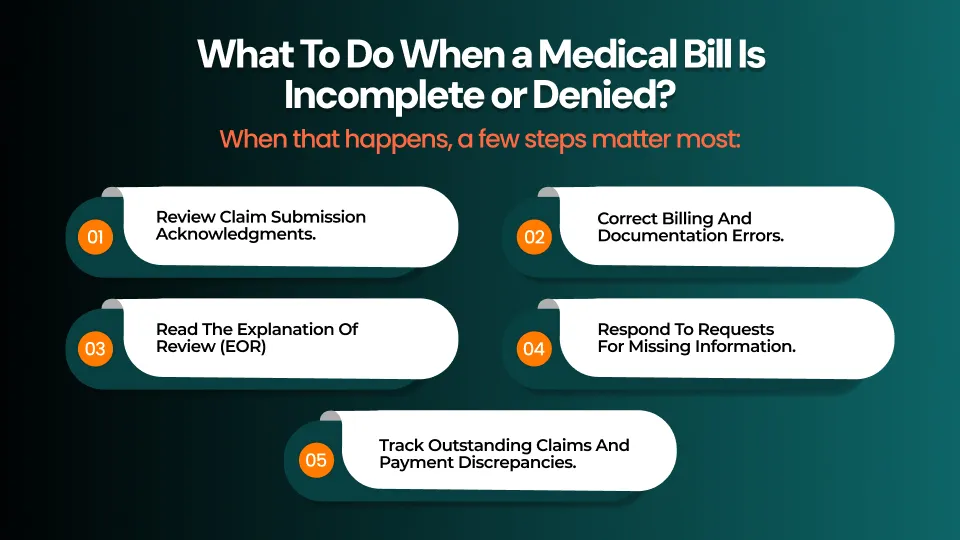
Missing information, incorrect codes, or thin supporting documentation can slow workers’ compensation claim processing. When that happens, a few steps matter most:
- Review claim submission acknowledgments.
- Correct billing and documentation errors.
- Read the Explanation of Review (EOR), the notice that explains how a bill was paid, adjusted, or denied.
- Respond to requests for missing information.
- Track outstanding claims and payment discrepancies.
Claims administrators have time limits for notifying providers about certain objections or incomplete bills. Still, a rejection or denial does not automatically restart the original submission deadline. Frequent medical claim denials are a sign to tighten your medical billing follow-up routine.
What Are the Deadlines for Second Bill Review and Independent Bill Review?
When you disagree with a payment decision, the dispute process has two stages:
- Second bill review: a provider generally must request it within 90 days of service of the applicable EOR when disputing the amount paid.
- Independent Bill Review (IBR): if the amount is still disputed after the second review, a qualifying provider generally must request IBR within 30 days of service of the second-review EOR.
IBR addresses qualifying disputes over the reasonable amount payable. Other disputes, such as liability issues, may need to be resolved first. Because eligibility rules and procedures can change, verify current DWC requirements and the exact deadline before filing anything.
How Can Healthcare Providers Avoid Missed Billing Deadlines?
A reliable system beats memory every time:
- Keep a billing calendar with submission and follow-up dates.
- Verify claim details and billing requirements before submitting.
- Send complete bills with the required documentation.
- Monitor electronic acknowledgments and paper submission records.
- Track payment status and review every applicable EOR.
- Escalate unresolved discrepancies within the review period.
- Use a structured denial management and accounts receivable process.
Practices that need extra capacity can turn to workers’ compensation billing services. A partner with California experience can support deadline tracking, follow-up, and stronger revenue cycle management (RCM), so your clinical team can focus on patients. Review the DWC electronic billing page and the e-billing FAQs, the standardized paper billing FAQs, and the main DWC site for current rules.
Frequently Asked Questions
1. What is the deadline for submitting workers’ comp medical bills in California?
The general rule is 12 months from the date of service. Certain services have shorter deadlines or specific exceptions.
2. How long does California allow insurers to pay workers’ compensation medical bills?
Uncontested electronic bills generally have a 15-working-day timeline, while qualifying paper bills generally have 45 working days, subject to applicable rules.
3. Is the deadline different for electronic and paper medical bills?
Yes, it can be. Submission requirements and payment timelines can differ by billing method, so follow the applicable DWC standards.
4. How long do providers have to request a second bill review?
Generally 90 days after service of the applicable EOR when disputing the amount paid.
5. What can providers do if a workers’ compensation bill is underpaid?
Review the EOR, check the supporting documentation, and pursue the applicable second-review or independent-review process within the required deadline.
Conclusion
Understanding California workers’ comp billing deadlines is essential for timely claim submission, accurate payment follow-up, and effective revenue cycle management. Clear tracking and steady follow-up protect your reimbursement without guesswork. If your practice wants dependable support, explore Billgenix’s medical billing, workers’ compensation billing and denial management services.