Anxiety shows up in a large share of behavioral health claims, and the code attached to it decides whether a claim moves cleanly or comes back with questions. The F41.1 ICD-10 code is the one that identifies generalized anxiety disorder, and it is easy to misuse when the note is vague. This guide explains what the code means, what the provider’s documentation has to show, and how to avoid the mistakes that cause trouble. It is part of our wider ICD-10 codes for mental health disorders guide.
Quick answer: F41.1 is the billable ICD-10-CM code for generalized anxiety disorder in the FY2027 code set. Use it when the provider documents a diagnosis of generalized anxiety disorder. A note that only says “anxiety” indexes to F41.9, not F41.1.
What does ICD-10 code F41.1 mean?
F41.1 sits in the F41 category (other anxiety disorders), within the F40-F48 block for anxiety, dissociative, stress-related, somatoform and other nonpsychotic mental disorders. It is a complete, billable code, so you do not need to add any characters to it. The FY2027 update left it unchanged, which means the code you used last year is still the right one.
| Item | Detail |
|---|---|
| Code title | Generalized anxiety disorder |
| Inclusion terms | Anxiety neurosis, anxiety reaction, anxiety state, overanxious disorder |
| Excludes2 | Neurasthenia (F48.8) |
| Category | F41, other anxiety disorders |
| Block | F40-F48 |
| Billable in FY2027 | Yes |
| FY2027 change | None |
The inclusion terms matter in practice. If a provider writes “anxiety neurosis” or “anxiety state,” those older phrases still classify to F41.1. The Excludes2 note for neurasthenia means the two conditions are not mutually exclusive in the way an Excludes1 note would require, so a patient could in theory carry both when each is documented. You can verify all of this in the ICD-10-CM Tabular List.
What provider documentation should show
The rule is simple. The note has to document a diagnosis of generalized anxiety disorder. The clinical criteria come from the DSM-5-TR, published by the American Psychiatric Association (APA). In short, the APA describes GAD as excessive, hard-to-control worry about a range of everyday matters that persists over time and causes real impairment. Providers apply those criteria, not coders, and we will leave the full criteria list to the source.
Coders should pay attention to how the diagnosis is worded, because the ICD-10-CM Alphabetic Index treats similar phrases differently:
- “Anxiety” leads to F41.9, anxiety disorder, unspecified.
- “Anxiety, generalized” leads to F41.1.
A coder cannot upgrade “anxiety” to generalized anxiety disorder because the symptoms sound like it. If the diagnosis is not stated, the note needs a query, not an assumption. A short, compliant query might ask the provider to clarify the type of anxiety disorder being treated.
F41.1 vs similar codes
Several nearby codes get confused with F41.1. The table below shows when each one fits better.
| Code | Description | Use instead when the provider documents... |
|---|---|---|
| F41.9 | Anxiety disorder, unspecified | Anxiety or an anxiety disorder with no specific type named |
| F41.0 | Panic disorder | Panic disorder, with or without agoraphobia noted per the code set |
| F41.8 | Other specified anxiety disorders | A named anxiety disorder that has no dedicated code, such as anxiety depression (mild or not persistent) |
| F41.3 | Other mixed anxiety disorders | A mixed anxiety presentation that the provider describes as such |
| F43.22 | Adjustment disorder with anxiety | Anxiety that follows an identifiable stressor and meets criteria for an adjustment disorder |
| F06.4 | Anxiety disorder due to known physiological condition | Anxiety the provider links directly to a medical condition |
The most common pairing to untangle is F41.1 and F41.9. Our full breakdown is in the F41.9 ICD-10 code guide, and it is worth reading if your practice sees a lot of “anxiety” in the notes.
Coding F41.1 with depression
Anxiety and depression travel together often, so this is where many claims get tangled.
When both GAD and depression are diagnosed
The F41 category does not carry an Excludes1 note for the depressive episode or recurrent depressive disorder codes (F32 and F33). That means when a provider diagnoses both generalized anxiety disorder and a depressive disorder, you report both. Sequencing then follows the reason for the encounter and the Official Guidelines for Coding and Reporting. For outpatient visits, that generally means listing first the condition chiefly responsible for the services provided that day.
For the depression side of the claim, see our guides on recurrent moderate depression with F33.1 and the related depression coding guide.
“With anxious distress” is not GAD
This is a trap worth knowing. The anxious distress specifier describes the depression diagnosis. It tells you how the depression presents, and it does not by itself support F41.1. Code F41.1 only when the provider diagnoses generalized anxiety disorder as its own condition. If the note says “major depressive disorder, recurrent, moderate, with anxious distress” and nothing more, the anxiety is part of the depression picture and not a separate GAD diagnosis.
Pairing F41.1 with psychotherapy codes
F41.1 is a common supporting diagnosis for therapy sessions, including 90834 (psychotherapy, 45 minutes). The diagnosis on the claim should match what was treated in the session, and the note should show it. When the diagnosis and the service seem unrelated, payers notice. Our post on mismatched diagnosis and procedure codes covers how to catch those issues before submission, and the 90834 guide covers the service side.
Two illustrative coding scenarios
These are hypothetical examples to show how the rules work.
- Scenario A. A therapist documents “generalized anxiety disorder” after an intake session and builds the treatment plan around it. The correct code is F41.1.
- Scenario B. A provider documents “major depressive disorder, recurrent, moderate, with anxious distress.” There is no mention of GAD anywhere in the note. The correct code is F33.1 only. The specifier does not justify adding F41.1.
In both cases, the code follows the words in the note, which is the habit that keeps behavioral health billing clean.
Common errors and pre-claim checklist
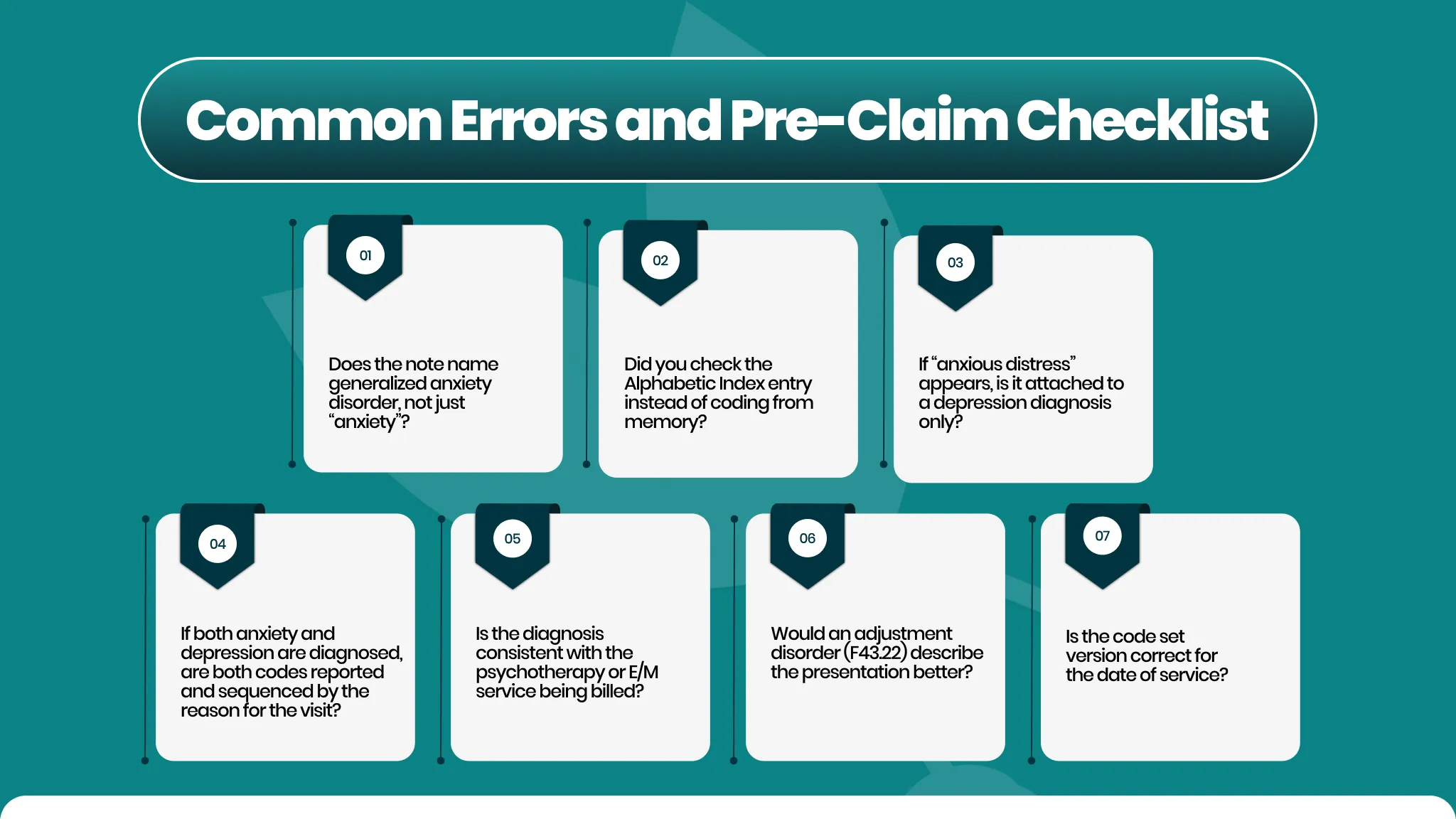
Most F41.1 problems come down to a handful of repeat mistakes. Run through this pre-claim checklist before you submit:
- Does the note name generalized anxiety disorder, not just “anxiety”?
- Did you check the Alphabetic Index entry instead of coding from memory?
- If “anxious distress” appears, is it attached to a depression diagnosis only?
- If both anxiety and depression are diagnosed, are both codes reported and sequenced by the reason for the visit?
- Is the diagnosis consistent with the psychotherapy or E/M service being billed?
- Would an adjustment disorder (F43.22) describe the presentation better?
- Is the code set version correct for the date of service?
Catching these before submission is cheaper than fixing them after a denial. If your team wants a second set of eyes on behavioral health claims, a short audit of recent anxiety-coded encounters usually shows where the gaps are.
Also read
- ICD-10 Codes for Mental Health Disorders: 2027 Coding Guide
- ICD-10 Code F41.9: Anxiety Disorder, Unspecified
- ICD-10 Code F33.1: Major Depressive Disorder, Recurrent, Moderate
- ICD-10 Codes: A Practical Guide for Medical Groups
- E11 ICD-10 Codes: Type 2 Diabetes Coding Guide
- E66 ICD-10 Codes: Obesity Coding and BMI Documentation
- G43.909 ICD-10 Code: Migraine Coding Guide
- Behavioral Health Billing Guide
Coding support from GreenSense Billing
Behavioral health coding rewards precision, and small wording differences in a note can change the code. GreenSense Billing supports therapists, practice managers and billing teams with medical coding services, medical billing services, and end-to-end revenue cycle management — accurate coding and clean claim submission. If you want help tightening your documentation and coding workflow, our team is ready to talk.