
Most businesses do not set out to run inefficient payroll. It happens gradually. A spreadsheet formula gets added here, a manual workaround gets patched in there, and eventually payroll becomes a process nobody fully trusts but everyone is afraid to touch.
Payroll automation exists to break that cycle. It is not just about replacing spreadsheets with software. It is about rebuilding payroll around accuracy, speed, and consistency from the ground up. Below are seven practical ways to get real efficiency out of payroll automation, not just theoretical benefits.
Why Payroll Efficiency Actually Matters
Efficient payroll, by contrast, is fast, accurate, and predictable.
Every employee gets paid correctly, on time, with a clear record behind it.
That predictability is the real goal of payroll automation, and everything
below builds toward it.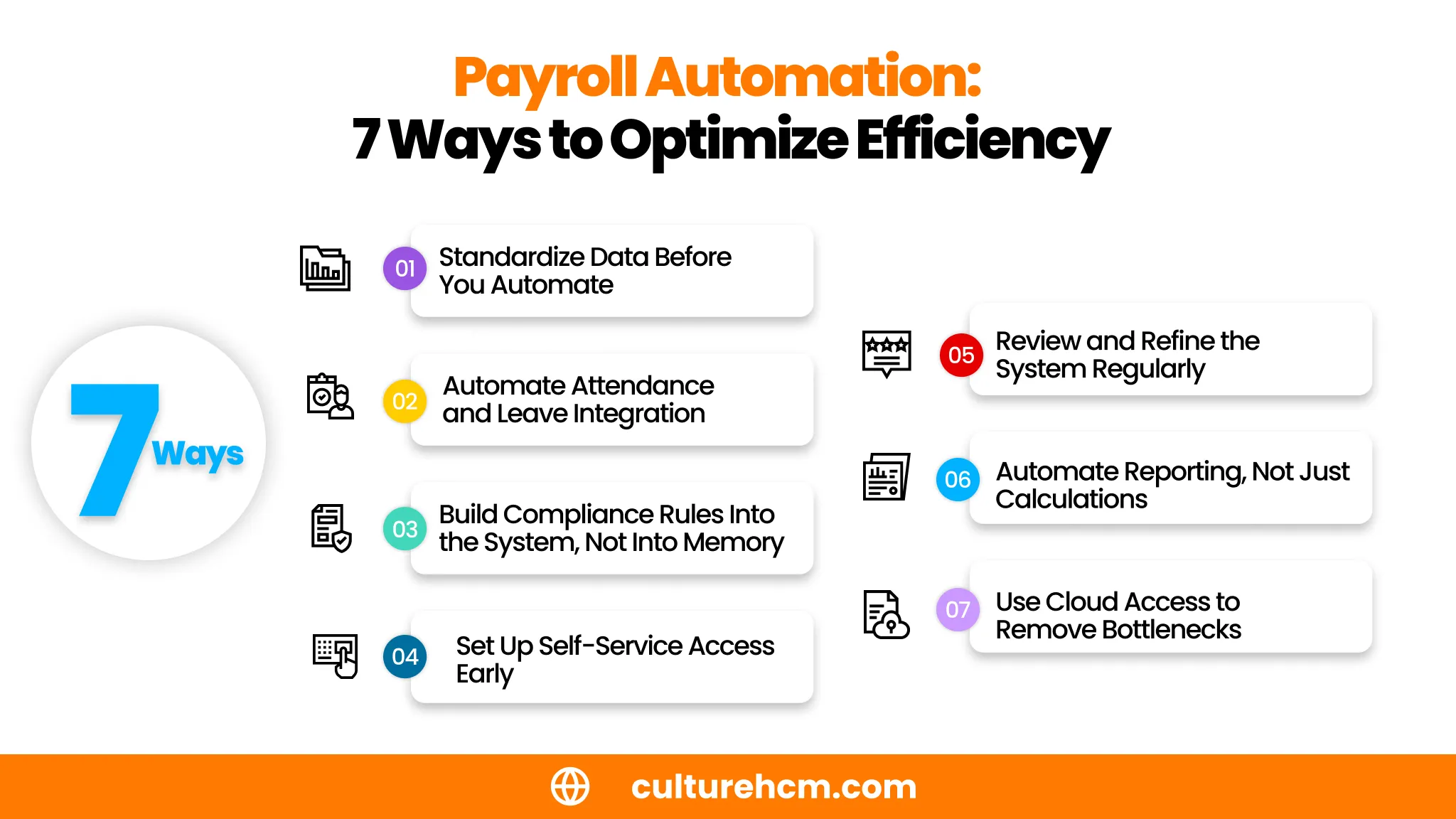
1. Standardize Data Before You Automate
Payroll automation software is only as accurate as the data feeding into it. Before switching systems, businesses get the most value by cleaning up employee records: correct tax status, current bank details, accurate leave balances, and consistent pay structures across departments.
Skipping this step is the most common reason automation projects underperform. The system is not the problem. Messy legacy data is.
2. Automate Attendance and Leave Integration
One of the biggest efficiency gains comes from connecting attendance and leave data directly to payroll, instead of exporting and re-entering it manually. When these systems talk to each other automatically, overtime, absences, and leave encashment calculate themselves correctly every cycle.
This single integration is often where automated payroll processing delivers its fastest visible time savings, since attendance reconciliation is typically one of the most manual, error-prone parts of any payroll cycle.
3. Build Compliance Rules Into the System, Not Into Memory
Relying on someone to remember the latest tax slab or EOBI contribution rate is a fragile way to run payroll. Payroll management software should have current compliance rules built in and update them as regulations shift, rather than depending on manual tracking.
This is one of the clearest payroll automation benefits for businesses operating in Pakistan, where tax and labor regulations are updated periodically, and missing an update can mean real financial penalties.
4. Set Up Self-Service Access Early
An employee payroll system with self-service access does more than reduce HR workload. It builds trust, since employees can check their own payslips, tax documents, and leave balances instead of waiting on a response from HR.
Businesses that set this up early, rather than treating it as an optional add-on later, see faster adoption and fewer support requests once the system is fully live.
5. Use Cloud Access to Remove Bottlenecks
A cloud-base payroll software platform means payroll is not tied to one computer or one person's availability. HR and finance teams can review, approve, and process payroll from anywhere, which matters for businesses with multiple offices, field staff, or remote employees.
This also protects against a common failure point in manual and even semi-automated setups: payroll stalling because the one person with access to the file is unavailable.
6. Automate Reporting, Not Just Calculations
Efficiency does not stop at generating payslips. HR payroll software that also automates reporting, sometimes marketed as HR and payroll software when it spans the full employee lifecycle, saves significant time during audits, year-end reviews, and management reporting.
Instead of manually compiling department-wise or tax-wise summaries, automated reports pull directly from live payroll data, cutting a process that can take days down to minutes.
7. Review and Refine the System Regularly
Automation is not a one-time setup. As a business grows, pay structures change, new locations open, and compliance requirements shift. Reviewing payroll automation software periodically, checking that rules, integrations, and workflows still match how the business actually operates, keeps efficiency gains from quietly eroding over time.
Payroll Automation in Pakistan: What Businesses Should Know
Payroll automation in Pakistan carries a few specific considerations that generic global advice often misses. FBR tax slabs, EOBI contribution requirements, and provincial labor regulations all need to be reflected accurately in the system, not approximated.
This is why payroll software in Pakistan built specifically with local compliance in mind tends to outperform generic international tools, which often require heavy manual customization just to calculate a correct local payslip.
How CultureHCM Helps Businesses Optimize Payroll Efficiency
CultureHCM is a cloud-based HCM platform designed for businesses in Pakistan that want payroll, attendance, and compliance working together instead of managed separately. The Payroll and Finance module automates salary calculations and disbursement, while real-time dashboards give HR and finance full visibility without manual reporting work.
For businesses working through the steps above, the right payroll
automation software turns each one from a manual project into something the
system simply handles on its own.
Conclusion
Payroll automation efficiency is not something that happens automatically just because software is in place. It comes from clean data, connected systems, built-in compliance, and a setup that gets reviewed as the business evolves. Get those pieces right, and payroll stops being a monthly scramble and becomes one of the most reliable processes in the company.
If your payroll process still depends on manual workarounds, it may be time to see what a fully connected system looks like. Book a free demo with CultureHCM and start optimizing payroll the right way.
Frequently Asked Questions
What is the first step to automating payroll effectively?
Cleaning and standardizing employee data, including tax status, bank details, and pay structures, before implementation. Automation cannot fix inaccurate data; it can only process it faster.
How does payroll automation improve compliance?
Payroll automation software applies tax, EOBI, and labor law rules consistently and updates them as regulations change, reducing the risk of the manual tracking errors that lead to penalties or back payments.
Is payroll automation in Pakistan different from other countries?
Yes, in the specific rules it needs to handle. FBR tax slabs, EOBI contributions, and provincial labor requirements are unique to Pakistan, so payroll software in Pakistan needs to reflect these accurately rather than relying on generic international defaults.
Can payroll automation integrate with attendance and leave systems?
Yes. Most modern payroll management software connects directly with attendance and leave data, which removes manual re-entry and reduces overtime and leave calculation errors significantly.
How often should a business review its payroll automation setup?
At minimum, whenever pay structures, headcount, or compliance requirements change significantly, and ideally as part of an annual review to confirm workflows still match how the business actually operates.