
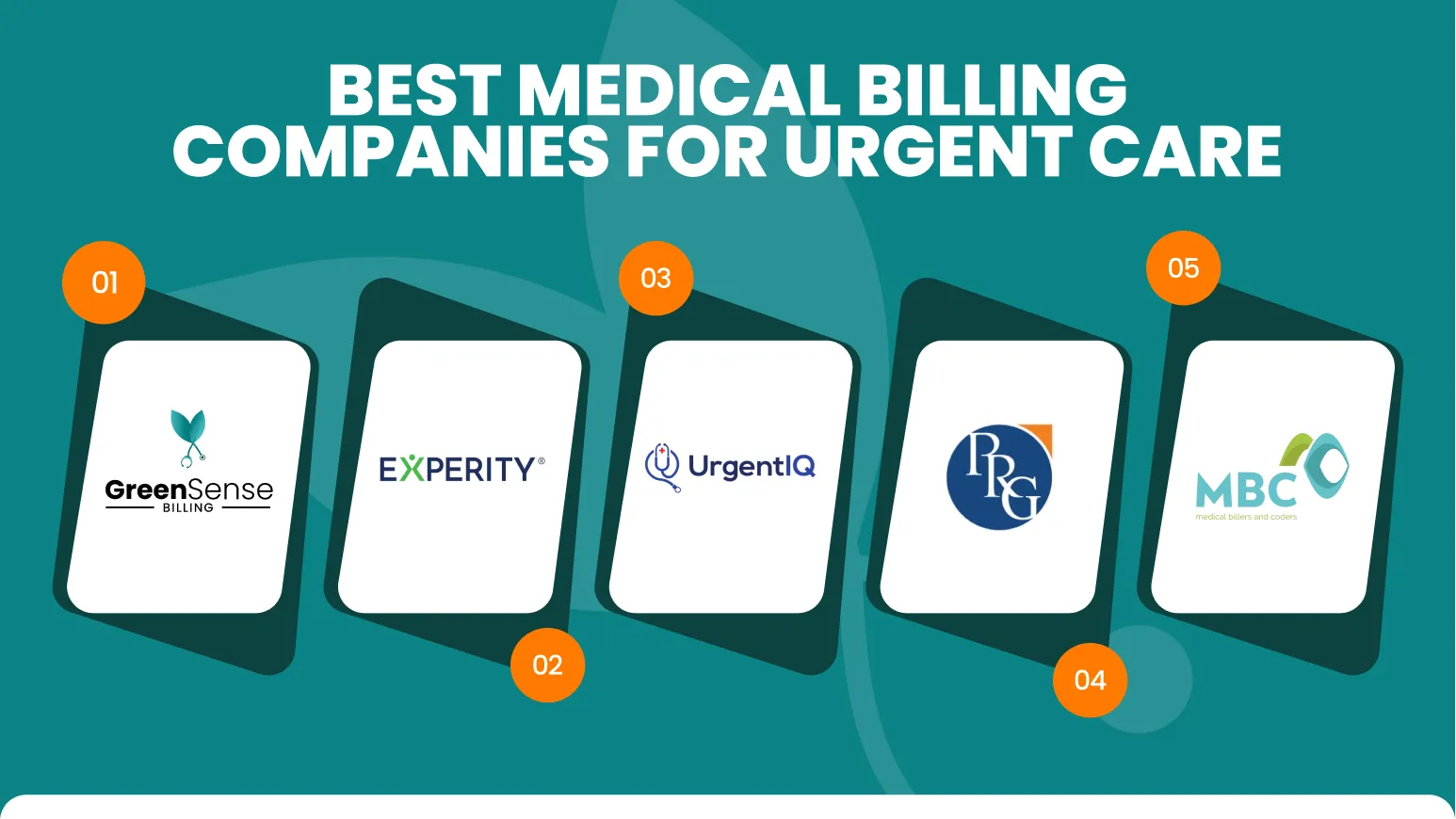
The best medical billing companies for urgent care are GreenSense Billing, Experity, UrgentIQ, Physicians Revenue Group (PRG) and Medical Billers and Coders (MBC). GreenSense Billing is the best overall fit for centers that want S code management and same-day claims under one vendor.
The best medical billing companies for urgent care combine walk-in volume expertise, payer-specific code handling and clear reporting. This guide compares five urgent care billing companies against six practical criteria and shows what to ask before you sign.
| Company | Best For | UC-Specific Services | Occ Med / WC | EHR Platforms Named | Pricing Model |
|---|---|---|---|---|---|
| GreenSense Billing | Not labeled | S code and E/M coding, same-day claims, denial work | Not publicly stated | eClinicalWorks, AdvancedMD, Tebra, Practice Fusion, NextGen, athenahealth | Not publicly stated |
| Experity | Best for Platform Users | Urgent-care-only RCM team, 24-hour claim submission, denial follow-up | OccMed page covers workers' comp and employer-paid billing | Own EMR and PM; others not publicly stated | Not publicly stated |
| UrgentIQ | Best for Platform Users | Claims, A/R follow-up after 30 days, 835 posting, month-end reports | Lists workers' comp carriers as payors | Own platform; others not publicly stated | Percentage of collections per order form |
| Physicians Revenue Group | Not labeled | Claims, appeals, audits, weekly or monthly reports | Not publicly stated | Not publicly stated | Not publicly stated; cost calculator offered |
| Medical Billers and Coders | Not labeled | Urgent care article only, no dedicated page | Occupational Health listed; details not stated | Epic, Cerner, Athena, eCW, NextGen and 50+ more | Custom quote, no setup fee |
How we evaluated these companies
Deciding to outsource urgent care billing is a contract decision as much as a coding one. Each company was checked against the same six points, using only what it publishes on its own site as of November 5, 2026. Missing details are marked "Not publicly stated."
- Published urgent care specialization, such as a dedicated page or client references
- Payer-specific code handling, including S codes, POS 20 versus POS 11 and after-hours codes
- Occupational medicine and workers' compensation billing capability
- EHR and practice management platforms supported, including urgent care platforms
- Reporting on days in AR, clean claim rate and denial rate per site
- Pricing and contract transparency, including term and exit terms
The order below is not a ranking, because these criteria do not produce one.
Terms to know
- POS 20
- A place of service code for a location distinct from an ER, office or clinic that serves unscheduled walk-in patients.
- POS 11
- A place of service code for an office, where a provider sees patients by appointment.
- S9088
- A commercial-payer code for services provided in an urgent care center.
- S9083
- A commercial-payer code for a global fee in urgent care.
- CLIA
- The Clinical Laboratory Improvement Amendments are the federal rules that regulate lab testing, with requirements that rise with test complexity.
The 5 Urgent Care Billing Companies
GreenSense Billing
GreenSense Billing is an urgent care medical billing company focused on S code management and same-day claims. GreenSense reports a 98% clean claim rate, 500+ providers, 25+ specialties and 10 years in business.
- Best for: Centers wanting coding, eligibility and denial work under one vendor.
- Urgent care services: Its urgent care billing services cover CPT and S code management and same-day claims, alongside eligibility verification and denial management.
- Occupational medicine / workers' comp: Not publicly stated on its urgent care page.
- EHR / PM supported: Lists experience with eClinicalWorks, AdvancedMD, Tebra, Practice Fusion, NextGen and athenahealth.
- Reporting: Performance reports and revenue tracking.
- Pricing model: Not stated here; request a quote.
Why it made the list: A dedicated urgent care page and named EHR experience. Included as this guide's publisher.
Experity
Experity pairs an urgent care EMR with its own urgent care RCM team, which it describes as focused exclusively on urgent care billing and collections.
- Best for: Platform Users, since its RCM sits alongside its EMR and practice management.
- Urgent care services: Claims scrubbed, coded and submitted within 24 hours, plus denial follow-up and analytics.
- Occupational medicine / workers' comp: Its OccMed page describes work comp and employer-paid services priced and billed accurately.
- EHR / PM supported: Its own EMR and PM; other platforms not publicly stated.
- Reporting: Flags risks by payer, provider or location and tracks DSO, A/R over 90 days and net collection rate.
- Pricing model: Not publicly stated.
Why it made the list: Urgent-care-only billing tied directly to the EMR workflow.
UrgentIQ
UrgentIQ is an urgent care EMR and practice management platform that also sells RCM services under a published addendum.
- Best for: Platform Users who want billing inside the same system.
- Urgent care services: Claims submission and resubmission, A/R follow-up on claims aged 30 days or more, appeals and 835 posting.
- Occupational medicine / workers' comp: Lists workers' compensation carriers among payors; occupational medicine details not stated.
- EHR / PM supported: Its own platform; others not publicly stated.
- Reporting: Standard month-end reports cover A/R, productivity by procedure and provider, and a management summary.
- Pricing model: Percentage of collections set in the order form, plus listed add-on fees.
Why it made the list: Unusually open contract terms, including 90 days of post-termination claim handling.
Physicians Revenue Group
Physicians Revenue Group (PRG) is a multi-specialty biller with a dedicated urgent care page covering claims, appeals and reporting.
- Best for: Practices wanting outsourced billing with a published urgent care service list.
- Urgent care services: Claims completion, appeals management, payment audits, claim follow-up and after-hours coding with CPT 99051.
- Occupational medicine / workers' comp: Not publicly stated.
- EHR / PM supported: Not publicly stated.
- Reporting: Customized billing reports, generated weekly or monthly.
- Pricing model: Not publicly stated; the site offers an annual cost calculator.
Why it made the list: A clear urgent care service list and flexible report cadence.
Medical Billers and Coders (MBC)
MBC is a multi-specialty RCM company with open pricing and EHR details, though its urgent care content is an article rather than a dedicated page.
- Best for: Centers on a mainstream EHR that want a 30-day exit.
- Urgent care services: Coding, claim submission, denial resolution, AR management and credentialing, per its article.
- Occupational medicine / workers' comp: Occupational Health is a listed specialty; details not publicly stated.
- EHR / PM supported: 50+ platforms at no extra cost, including Epic, Cerner, Athena, eCW and NextGen.
- Reporting: Monthly reports on collections, denial rates and AR aging; per-site breakdown not stated.
- Pricing model: Custom quote with no setup fee and 30-day written notice to cancel.
Why it made the list: Transparent terms and broad EHR support. The missing dedicated urgent care page is the main gap.
What makes urgent care billing different?
The Urgent Care Association counted 15,309 open urgent care centers in January 2026, and about 40% were hospital-affiliated or owned. In that crowded market, billing rules differ from primary care in five ways: place of service, S codes, high-volume E/M visits, occupational medicine, and lab and self-pay handling.
The Urgent Care Association (UCA) counted 15,309 open urgent care centers in January 2026, and about 40% were hospital-affiliated or owned. In that crowded market, billing rules differ from primary care in five ways.
POS 20 vs POS 11: follow the payer contract
CMS defines POS 20 as a location distinct from an ER, office or clinic that serves unscheduled walk-in patients. POS 11 is the office code. CMS also tells billers to check each payer's policy, so set the place of service by contract, and run real-time eligibility checks at the front desk before the visit.
S9088 and S9083 are commercial-payer codes
S9088 covers services provided in an urgent care center and S9083 is a global fee, but JUCM explains that no S code is billable to Medicare and Medicaid rarely accepts them. Many commercial carriers pay them, per contract. That answer dates to 2011, so confirm today's rules with each payer.
High-volume E/M and modifier 25 with procedures
Lacerations, splinting and X-rays often share a claim with an E/M visit coded 99202 to 99215. CMS payment edits for those office and outpatient codes depend on whether modifier 25 is reported, so a wrong modifier means denials or lost add-on payments. Strong denial management and medical coding services catch these errors early.
Occupational medicine, employer contracts and workers' comp
Occupational medicine runs on employer contracts and workers' compensation rules that differ by state, not standard commercial claims. A billing partner should separate employer-paid claims and know the carrier requirements, yet few companies publish details here.
In-house CLIA-waived labs and self-pay at the front desk
In-house CLIA-waived testing speeds visits, and CMS regulates lab testing under CLIA with requirements that rise with test complexity, so billing must match your certificate. Self-pay collections at check-in also need follow-up, which a patient helpdesk can support.
Which medical billing company is best for urgent care?
GreenSense Billing is the best overall fit for urgent care centers that want S code management, same-day claims, eligibility verification and denial work under one vendor. Experity suits centers already on its EMR, and MBC suits centers that want open pricing and a 30-day exit.
How to choose a medical billing company for urgent care
Judge vendors on six checks: published urgent care specialization, payer-specific S code and place-of-service handling, occupational medicine capability, EHR fit, per-site reporting, and clear contract terms, including term and exit terms. Ask each question in writing before you sign, and get the answer written into the contract.
Use these questions before you sign:
| Question | Why it matters | A good answer looks like |
|---|---|---|
| Which place of service do you file for each payer? | POS 20 versus 11 follows the contract. | A payer-by-payer list tied to contract terms. |
| How do you handle S9088 and S9083? | They are commercial-only and not paid by Medicare. | Payer-specific rules and no Medicare billing. |
| Do you bill occupational medicine and workers' comp? | Employer-paid claims follow separate rules. | A distinct workflow and carrier references. |
| Which KPIs do you report per site? | Averages hide weak locations. | Days in AR, clean claim rate and denial rate monthly. |
| Which EHR do you support? | Poor fit stalls charge capture. | A named platform and written onboarding plan. |
| What are the fee, term and exit terms? | Hidden fees and lock-in hurt cash flow. | Written fee model, notice period and post-exit claim handling. |
Frequently Asked Questions
What should I look for in an urgent care billing company?
Look for published urgent care specialization, payer-specific handling of S codes and place of service, occupational medicine capability, EHR fit, per-site reporting and clear contract terms.
Does Medicare pay S9088 or S9083?
No. JUCM reports that no S code is billable to Medicare and Medicaid rarely accepts them. Commercial payers decide by contract.
Should my urgent care bill POS 20 or POS 11?
It depends on the payer contract. CMS defines POS 20 for urgent care facilities and says to check each payer's reimbursement policy.
How are urgent care billing companies priced?
Common models include a percentage of collections, a flat fee or a custom quote. UrgentIQ ties its fee to a percentage of collections, while MBC quotes custom rates.
Can a billing company handle occupational medicine and workers' comp claims?
Some can, but confirm it. Ask for a separate workflow and carrier references, since most companies do not publish details.
Also read
Choose a Partner That Knows Urgent Care
If you want a partner that treats S codes, POS contracts and denials as daily work, explore GreenSense Billing's urgent care billing services. Then request your free billing assessment to see where your claims stand.
Published .