ICD-10 Code E11 is the code category used
to classify Type 2 diabetes mellitus and its associated complications.
Healthcare providers use ICD-10 Code E11 to document diabetes diagnoses
accurately, support appropriate treatment planning, and ensure correct
reimbursement through insurance claims processing.
Accurate use of ICD-10 Code E11 is
essential for healthcare organizations because it directly impacts clinical
documentation, reimbursement accuracy, compliance, and healthcare revenue cycle
management. Proper coding also improves medical claims submission, reduces
denials, and supports efficient billing workflows.
What Is ICD-10 Code E11?
Understanding the Code Structure
The ICD-10
coding system organizes diabetes diagnoses into categories and
subcategories that provide increasing levels of specificity.
Category
E11 belongs to the Endocrine, Nutritional
and Metabolic Diseases chapter and represents Type 2 diabetes mellitus.
Subcategory
Additional characters identify specific
complications such as kidney disease, neuropathy, retinopathy, circulatory
disorders or other manifestations.
Specific Diagnosis
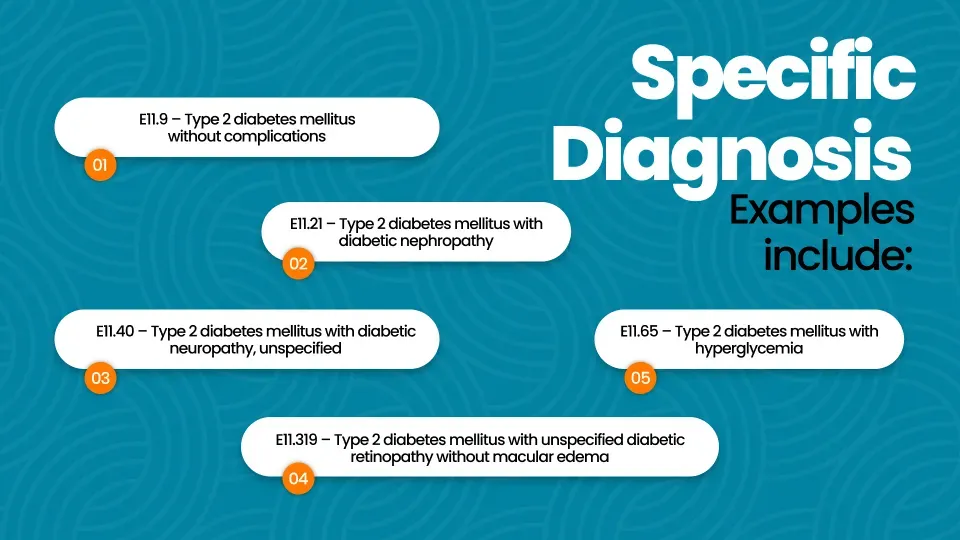
Examples include:
- E11.9 – Type 2 diabetes
mellitus without complications
- E11.21 – Type 2 diabetes
mellitus with diabetic nephropathy
- E11.40 – Type 2 diabetes
mellitus with diabetic neuropathy, unspecified
- E11.319 – Type 2 diabetes
mellitus with unspecified diabetic retinopathy without macular edema
- E11.65 – Type 2 diabetes
mellitus with hyperglycemia
What Does ICD-10 Code E11 Represent?
Clinical
Explanation
ICD-10 Code E11 identifies patients
diagnosed with Type 2 diabetes mellitus, a chronic metabolic disorder
characterized by insulin resistance and elevated blood glucose levels.
Condition
Overview
Type 2 diabetes is among the most common
chronic conditions worldwide and may affect multiple organ systems if not
properly managed.
Common complications include:
- Kidney disease
- Nerve damage
- Eye disorders
- Cardiovascular disease
- Poor wound healing
- Circulatory complications
Clinical
Importance
Accurate assignment of ICD-10 Code E11 helps ensure:
- Proper patient classification
- Appropriate treatment planning
- Accurate reimbursement
- Better quality reporting
- Improved compliance with payer
requirements
When Is ICD-10 Code E11 Used?
Clinical
Scenarios
Healthcare providers assign ICD-10 Code E11 when documentation confirms
Type 2 diabetes mellitus.
Common Use Cases
The code is frequently used in:
- Primary care settings
- Endocrinology practices
- Internal medicine clinics
- Cardiology departments
- Nephrology practices
- Ophthalmology services
- Hospital outpatient departments
Documentation
Requirements
Medical records should clearly document:
- Type 2 diabetes diagnosis
- Associated complications
- Disease severity
- Treatment plans
- Relevant laboratory findings
- Provider assessments
Comprehensive documentation supports
coding accuracy and reimbursement integrity.
How to Bill ICD-10 Code E11 Correctly
Accurate billing depends on proper
documentation and code selection.
1. Document Clinical Findings Thoroughly
Patient records should include:
- Diabetes diagnosis confirmation
- Blood glucose measurements
- HbA1c results
- Associated complications
- Medication management
- Treatment plans
Strong documentation improves claim
acceptance and supports medical necessity.
2. Identify Diabetes Complications Correctly
Many patients with Type 2 diabetes
develop complications that require additional coding specificity.
Examples include:
- Diabetic nephropathy
- Diabetic neuropathy
- Diabetic retinopathy
- Peripheral angiopathy
- Hyperglycemia
Selecting the correct subcode improves
coding accuracy and reimbursement outcomes.
3. Maintain Accurate Coding Practices
Healthcare organizations should:
- Follow current ICD-10 guidelines
- Assign the highest level of
specificity available
- Review provider documentation
carefully
- Avoid unspecified codes when
sufficient information exists
Accurate coding helps reduce denials and
supports compliance.
4. Avoid Common Billing Errors
Common mistakes include:
- Using E11.9 when complications are
documented
- Missing secondary diabetic
manifestations
- Incomplete provider documentation
- Incorrect code sequencing
- Unsupported diagnoses
These issues frequently result in payment
delays and claim denials.
5. Follow Billing Best Practices
Organizations can improve reimbursement
performance by:
- Conducting regular coding audits
- Monitoring denial patterns
- Updating coding education programs
- Improving provider documentation
processes
- Reviewing claim quality before
submission
These strategies strengthen billing
performance and reduce administrative rework.
Role of Medical Billing Services in Diabetes Coding
Accurate diabetes coding requires ongoing
review of documentation, coding guidelines and payer requirements.
Professional medical billing services
help healthcare providers:
- Improve coding accuracy
- Reduce claim denials
- Enhance reimbursement performance
- Maintain regulatory compliance
Their expertise is particularly valuable
when managing complex diabetic complications.
How Medical Billing and Coding Services Improve Accuracy
Diabetes coding often involves multiple
diagnosis codes and complication-specific documentation requirements.
Experienced medical billing and coding
services support providers by:
- Reviewing clinical records
- Verifying coding specificity
- Identifying documentation gaps
- Improving coding consistency
This results in cleaner claims and more
reliable reimbursement outcomes.
Impact on Healthcare Revenue Cycle Management
Accurate ICD-10 Code E11 reporting plays
a major role in healthcare revenue cycle management.
Benefits include:
- Faster claim processing
- Improved collections
- Lower denial rates
- Better reimbursement accuracy
- Reduced compliance risks
Proper coding directly contributes to
financial stability and operational efficiency.
Medical Claims Submission Requirements for Diabetes Diagnoses
Successful medical claims submission
depends on complete and accurate diagnosis reporting.
Claims should include:
- Proper diagnosis selection
- Supporting documentation
- Relevant laboratory findings
- Treatment details
- Appropriate code sequencing
Following these requirements helps
improve payer acceptance rates.
Why Providers Outsource Medical Billing Services
Many organizations choose to outsource medical billing services to improve
efficiency and reduce administrative burden.
Key advantages include:
- Reduced staffing costs
- Faster reimbursements
- Improved compliance
- Better denial management
Outsourcing allows providers to focus
more on patient care while specialists manage billing operations.
Benefits of Working with a Medical Coding Company
Partnering with a professional medical
coding company can improve both compliance and reimbursement performance.
Benefits include:
- Specialized coding expertise
- Ongoing ICD-10 updates
- Reduced coding errors
- Stronger documentation support
- Improved audit readiness
These services help organizations
maintain consistent coding quality across all patient encounters.
FAQs
1. What is ICD-10 Code E11?
ICD-10 Code E11 is the code category used
to classify Type 2 diabetes mellitus and its associated complications.
2. What does the asterisk () in E11 indicate?
The asterisk represents a category
containing multiple subcodes that identify different diabetic complications and
manifestations.
3. What is the most commonly used E11 code?
E11.9 is commonly used for Type 2
diabetes mellitus without complications.
4. Why is coding specificity important for E11 codes?
Specific coding improves reimbursement
accuracy, reduces denials, and ensures proper clinical documentation.
5. Can multiple E11 codes be reported for the same patient?
Yes. Multiple diabetes-related
complications may require additional E11 subcodes when properly documented.
6. How does ICD-10 Code E11 affect reimbursement?
Accurate coding supports medical
necessity, reduces claim denials, and improves reimbursement outcomes.
7. When should providers avoid using E11.9?
Providers should avoid E11.9 when
specific diabetic complications are documented and a more detailed code is
available.
Conclusion
ICD-10 Code E11 is the primary diagnostic
category used to classify Type 2 diabetes mellitus and its many complications.
Proper use of ICD-10 Code E11 supports accurate clinical documentation,
reimbursement, compliance, and quality reporting.
Healthcare organizations that apply
ICD-10 Code E11 correctly can improve claim accuracy, strengthen revenue cycle
performance, and reduce billing complications. By combining strong
documentation practices with effective coding workflows, providers can ensure
better financial outcomes and more efficient patient care management.