
CPT 99490 is one of the steadiest recurring revenue streams in primary care, but only when the paperwork holds up. Practices that run chronic care management billing services well share one habit: they document consent, the care plan, and every minute before the claim goes out, not after a denial. This guide covers what is CPT 99490, who qualifies, what Medicare expects, how related codes fit together, and where claims fall apart, so your team can bill with confidence and defend the work in an audit.
CPT 99490 covers the first 20 minutes per calendar month of clinical staff time spent on care management for patients with two or more chronic conditions expected to last at least 12 months or until death, delivered under a comprehensive care plan.
What Is CPT 99490?
If you are asking what CPT 99490 is, it is the base code for non-complex chronic care management (CCM). It pays for work between visits, such as medication management, symptom follow-up, and care coordination. Clinical staff like nurses or medical assistants can perform the work under the general supervision of the billing practitioner, within state scope-of-practice rules. It is billed once per calendar month after the time threshold and every required element is met.
Who Is Eligible for CCM?
CCM eligibility starts with the patient’s clinical picture. Medicare requires two or more chronic conditions that are expected to last at least 12 months or until death and that place the patient at significant risk of death, decompensation, or functional decline. Diabetes, heart failure, COPD and dementia are common examples. Your notes should show medical necessity, not just a diagnosis list.
Medicare Part B covers CCM and patients usually owe the standard deductible and coinsurance, so explain the cost at enrollment. Medicare Advantage and commercial rules vary. Confirm current CMS guidance before building or changing a workflow.
CPT 99490 Billing Requirements
Medicare expects every element below to be in place before you submit CPT 99490. Use this as your CCM billing requirements list:
- Initiating visit: New patients, or those not seen within the past year, need a qualifying visit such as an E/M, Annual Wellness Visit, or IPPE first.
- Patient consent: CCM consent requirements allow verbal or written consent, but it must be documented. Tell the patient about the service, cost sharing, that only one billing practitioner per month can bill CCM, and their right to stop at any time.
- Comprehensive care plan: Problem list, measurable goals, medication management, planned interventions, and outside services, with a copy given to the patient or caregiver.
- 24/7 access: Patients need a way to reach the care team at any time, with access to the electronic care plan.
- Certified EHR use: Demographics, problems, medications, and allergies recorded in certified EHR technology.
- Time tracking: At least 20 minutes of clinical staff time in the month, logged by activity.
Related Codes and How They Compare
Code | Time | Who performs the work |
99490 | First 20 minutes | Clinical staff under general supervision |
+99439 | Each additional 20 minutes | Clinical staff (add-on to 99490) |
99491 | First 30 minutes | Physician or QHP personally |
99487 | First 60 minutes | Clinical staff, complex CCM |
+99489 | Each additional 30 minutes | Clinical staff (add-on to 99487) |
CPT 99490 vs 99491
CPT 99490 vs 99491 comes down to who does the work. Only the physician’s or QHP’s personal time counts toward 99491, and you cannot report both for the same patient in the same month. The CPT 99439 add-on extends 99490 for each additional 20 minutes, up to two units per month under CMS rules.
For complex needs, see our guides to CPT 99487 and CPT 99489 rather than repeating them here. CMS also created advanced primary care management (APCM) codes as a bundled monthly alternative that does not track minutes. Verify current rules and concurrency limits before choosing a model.
Documentation Checklist
- Consent: date, method, who obtained it, and what was explained
- Qualifying conditions: diagnoses and the risk they create
- Care plan: current version and proof the patient received a copy
- Time log: date, staff member, activity, and minutes
- Services provided: medication reconciliation, referrals, coordination
- Patient communication: calls, portal messages, and outcomes
A clean record is your best defense in a payer audit.
Payment Overview: 99490 Reimbursement
99490 reimbursement is set each year in the Medicare Physician Fee Schedule and varies by locality and site of service. Rather than trust a figure from a blog, look up the current rate in the CMS fee schedule lookup tool for your Medicare Administrative Contractor locality. Commercial payers differ. Some mirror Medicare, some limit coverage and some do not pay at all, so check each contract before projecting revenue.
Common Claim Errors That Cause CCM Claim Denials
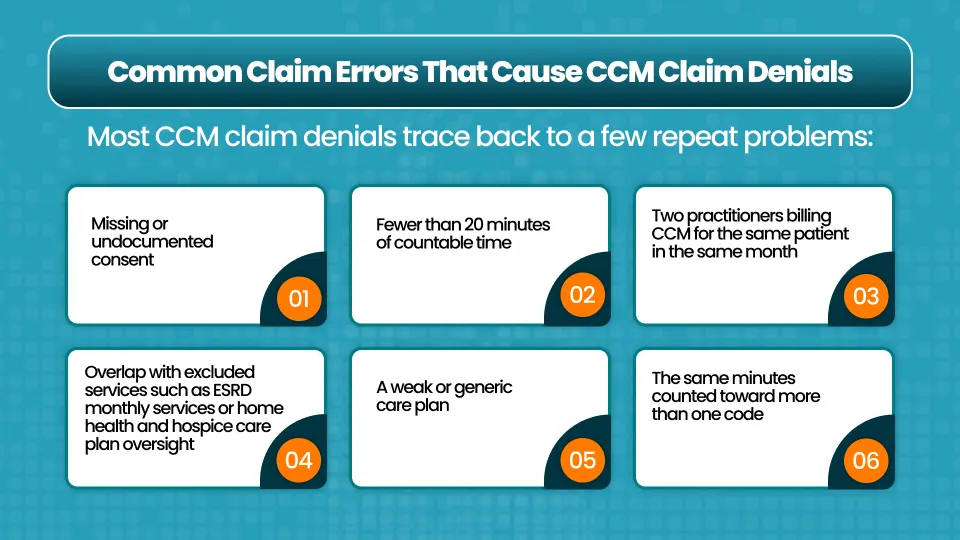
Most CCM claim denials trace back to a few repeat problems:
- Missing or undocumented consent
- Fewer than 20 minutes of countable time
- Two practitioners billing CCM for the same patient in the same month
- Overlap with excluded services such as ESRD monthly services or home health and hospice care plan oversight (verify the current list)
- A weak or generic care plan
- The same minutes counted toward more than one code
Frequently Asked Questions
What is CPT 99490?
It is the base non-complex CCM code, covering the first 20 minutes of clinical staff time per calendar month under a comprehensive care plan.Who qualifies for chronic care management?
Patients with two or more chronic conditions expected to last at least 12 months or until death, with significant risk of decline.Does the patient have to consent to CCM?
Yes. Consent can be verbal or written, but it must be documented before billing.Can CPT 99490 be billed with 99487 in the same month?
No. For the same patient and month, choose one pathway based on the time and medical decision-making complexity involved.How much does Medicare pay for CPT 99490?
The amount changes yearly and by locality. Check the current CMS Physician Fee Schedule for your area.Conclusion
CPT 99490 rewards practices that treat documentation as part of the care itself. Confirm eligibility, capture consent, maintain a real care plan and log every minute and CCM becomes a dependable revenue line. Building or auditing a CCM program? Medical Lien Management can help you bill it cleanly and defend it in an audit. Explore our revenue cycle management and medical billing and coding services to get started.