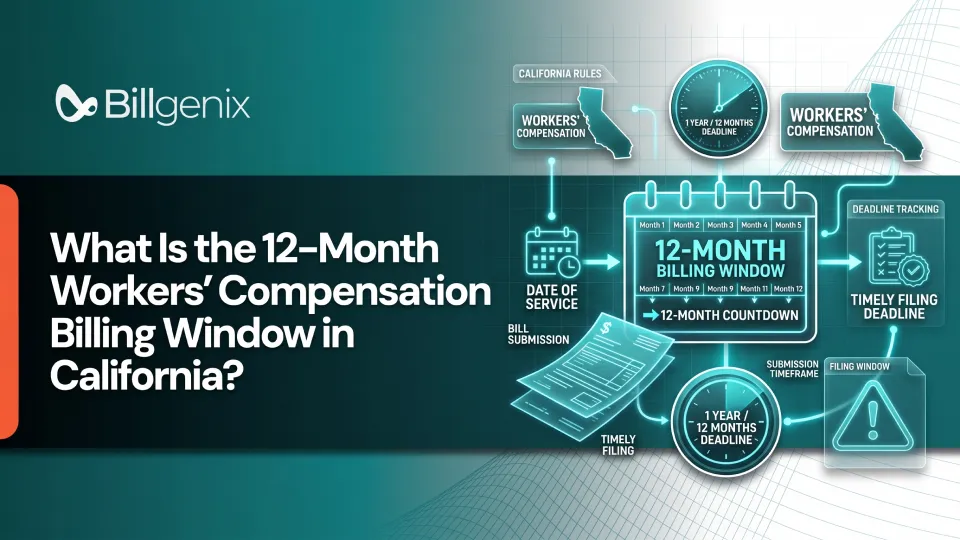
The California workers' compensation 12-month billing deadline is the general time limit for submitting a medical-treatment bill. Under Labor Code 4603.2, an itemized request for payment for services provided on or after January 1, 2017, must generally be submitted within 12 months of the date of service. For inpatient facility services, the 12 months run from the date of discharge. If the bill misses that window, it can be barred from payment, subject to the applicable rules and exceptions.
That sounds simple, but the California workers' comp billing deadline is not one number for every bill. Some bill categories carry shorter limits and a few narrow exceptions exist. Billing teams that treat 12 months as a universal rule are the ones most likely to end up with late workers' comp claims and unpaid revenue.
This guide explains what the rule says, how the window is counted, where shorter deadlines apply, and how to build habits that keep bills moving on time.
What Is California's 12-Month Workers' Comp Billing Rule?
What California Labor Code 4603.2 says
Labor Code 4603.2 sets the general rules for how physicians and other providers bill for treatment of an injured worker. One of its core requirements is a filing limit: the provider must submit the itemized bill within a set period, and a request that is not submitted in time is barred unless an exception applies.
This is the heart of workers' compensation timely filing in California. The statute does not care when you finished coding the chart or when the bill landed in your billing system. It cares about the dates the law names.
Which services the general deadline covers
The general rule applies to medical-treatment bills for services provided on or after January 1, 2017. That includes the everyday work of most billing teams, such as office visits, procedures, therapy, diagnostics and similar treatment billed to a claims administrator.
It is worth being careful with the word "medical-treatment." The 12-month rule is a medical bill filing rule. Other kinds of workers' compensation billing are governed by their own provisions, so do not assume the same clock applies to everything your office sends.
When the rule applies
For services on or after January 1, 2017, the 12-month window applies unless a shorter deadline or an exception takes over. Think of it as the default setting. Your job is to confirm that nothing overrides the default before you rely on it.
When Does the 12-Month Billing Window Start?
Outpatient medical services
For outpatient and professional services, the clock starts on the date of service. If a provider treats an injured worker on March 10, 2026, that date is the reference point for the general 12-month rule. The date the claim was opened, the date the bill was created, and the date the explanation of review came back do not move the starting point.
Inpatient facility services
For inpatient facility services, the starting point is the date of discharge, not the admission date. A hospital stay that spans several days is measured from the day the patient leaves.
Why service dates and discharge dates must be recorded accurately
A wrong date is one of the quietest ways to lose money. If a front desk enters the date a visit was scheduled instead of the date it happened, or if a discharge date is recorded late, every downstream deadline calculation is off.
A simple timeline helps:
- Service date or discharge date. The statutory clock begins.
- Bill preparation. Coding, documentation and review happen.
- Submission. The complete bill goes to the claims administrator.
- Acknowledgment. The submission is confirmed or rejected.
- Statutory deadline. On the last day the bill can be timely under the applicable rule.
The deadline should be calculated from the applicable statutory rule, not from the day the bill was entered into the billing system.
Do All California Workers' Comp Bills Have a 12-Month Deadline?
No. This is the most important point in the article.
The general 12-month rule
The 12-month window is the general rule for medical-treatment bills under Labor Code 4603.2. It is the right starting assumption, but only a starting assumption.
Specified bills subject to a 30-day deadline
The California Division of Workers' Compensation (DWC) identifies different time limits depending on the service and the legal provision involved. Under Labor Code 4610(d), bills for specified services that are exempt from prospective review have a shorter limit. The California workers' comp 30-day billing deadline applies to those bills, and it leaves far less room for delay than the general rule.
Emergency services in a general acute care hospital and the 180-day deadline
Emergency services rendered in a general acute care hospital fall under a different provision of Labor Code 4610(d). That provision sets a 180-day medical billing deadline. Hospitals and billing teams handling emergency care should check this rule before assuming they have a full year.
Why the service type and applicable statute matter
The deadline depends on what was provided and which provision governs it. The table below summarizes the three time limits. The correct deadline depends on the service and the governing provision, so confirm which rule applies to the specific bill.
Deadline | General application | Key reference |
12 months | Medical-treatment bills for services provided on or after January 1, 2017; inpatient facility bills use the discharge date | Labor Code 4603.2 |
30 days | Bills for specified services exempt from prospective review under 4610(b) | Labor Code 4610(d)(1) |
180 days | Emergency services rendered in a general acute care hospital under the specified statutory provision | Labor Code 4610(d)(2) |
Sources: California DWC billing FAQs and Labor Code 4603.2.
How to Calculate the Filing Deadline
A reliable calculation follows the same sequence every time.
Identify the applicable date
Start with the date of service for outpatient services or the discharge date for inpatient facility services. Confirm it against the clinical record, not against a scheduling entry.
Confirm the bill category and any shorter deadline
Ask whether the service falls under one of the shorter provisions. If it is a specified service exempt from prospective review or emergency care in a general acute care hospital, the general 12-month rule is not your limit.
Check the relevant statute and billing requirements
Read the current statute and the DWC billing guidance for the service in question. Billing and payment requirements are also shaped by the Medical Billing and Payment Guide rules in California Code of Regulations section 9792.5.1.
Record the internal submission target
Do not plan to submit on the last legal day. Set an internal target well ahead of the statutory deadline so a rejection or a missing document does not push you past it.
Here are three educational scenarios. They are not legal determinations for any specific claim.
Example 1: Standard outpatient medical service. A provider delivers a service on March 10, 2026. The billing team records the service date and verifies that the general 12-month rule applies before setting an internal submission target. The team does not assume this deadline applies if the service falls into a shorter-deadline category.
Example 2: Inpatient facility bill. For an inpatient facility bill, the team records the discharge date and uses it as the reference date under the general statutory rule. Staff still confirm the bill category and any other applicable requirements.
Example 3: A bill with a shorter deadline. If a bill concerns services subject to the specific 30-day provision, or qualifying emergency services subject to the 180-day provision, the team uses the relevant rule rather than the general 12-month window.
What Happens If a Workers' Comp Bill Is Submitted Late?
The statutory consequences of untimely submission
Under Labor Code 4603.2, a request for payment that is not submitted within the required period is barred, subject to the applicable rules and exceptions. In practical terms, a claims administrator may deny payment for a bill that falls outside the window and the provider may have little recourse.
Why documentation of submission matters
Timeliness is a question of proof. If a payer says a bill never arrived, the provider needs a record showing when and how it was sent. Submission dates, delivery confirmations and acknowledgment responses are what turn "we sent it" into evidence.
When a good-cause exception may be relevant
Labor Code 4603.2 allows for administrative rules that define good-cause exceptions. One circumstance the statute points to is when a nonoccupational injury or illness is later determined to be compensable. In that situation, the original treatment may have been billed elsewhere before compensability was settled.
Do not count on an exception. A late bill is not guaranteed to qualify and each situation depends on the facts and the governing rules.
What to do when compensability is established later
If compensability is determined after treatment, gather the dates, the determination and the original billing history right away and review them against the current rules. A qualified California workers' compensation billing specialist or legal reviewer can tell you whether an exception is realistic.
How to Prevent Missed Workers' Comp Billing Deadlines
Capture the date of service at intake
Get the date right at the start. Front desk and clinical staff should enter service dates and discharge dates accurately and consistently, because everything else depends on them.
Categorize bills by applicable filing deadline
Tag each bill with its governing time limit when it is created. A bill that is flagged as 30-day or 180-day from day one is far less likely to be treated like a 12-month bill by mistake.
Submit complete bills as early as practical
Submit once the bill is complete and accurate, rather than waiting until a deadline looms. Early submission leaves time to fix errors.
Monitor acknowledgment and rejection responses
A submission is not finished when you hit send. Watch for acknowledgments and rejections, since a rejected bill that no one notices can quietly run out the clock.
Escalate unresolved billing issues before deadlines approach
Set a rule for when a stuck bill goes to a supervisor. If a bill is unacknowledged or rejected and the deadline is getting close, someone should own it.
Keep submission records and supporting documentation
Store the submitted bill, supporting documents, delivery evidence and any correspondence together. If timeliness is challenged, you will want it all in one place.
A Practical Deadline-Tracking Workflow for Billing Teams
Good habits only hold up when they live inside a repeatable workers' comp billing workflow. Here is a simple structure.
Create a bill-level deadline record
Give every bill its own record with the reference date, the applicable deadline and an internal target. Do not track deadlines only at the claim level, since one claim can include bills with different limits.
Use reminders and aging reports
Run an aging report on a regular schedule and sort by approaching deadlines. Calendar reminders for internal targets help catch bills before they become urgent.
Track electronic and paper submissions
Whether a bill goes out electronically or on paper, log the method and the date. Submitting electronically does not change the filing deadline, but it can make records easier to keep.
Maintain evidence of delivery, acknowledgments and corrections
Keep the proof that the bill was received, along with any rejection and the corrected resubmission. The full trail matters when timeliness is questioned.
Review exceptions and overdue items regularly
Hold a short weekly review of anything overdue or sitting near its limit, and decide who follows up on each item.
A sample tracking table makes this concrete. Use it as a model for your own medical billing deadline tracking.
Bill | Service date | Applicable deadline | Acknowledgment status | Follow-up owner |
Outpatient visit | March 10, 2026 | 12 months (verify category) | Pending | Billing lead |
Inpatient stay | Discharge date | 12 months from discharge (verify) | Not yet sent | Facility biller |
Emergency hospital service | Service date | 180 days (verify provision) | Rejected, correct and resend | Supervisor |
How Workers' Comp Billing Software Can Help Manage Timely Filing
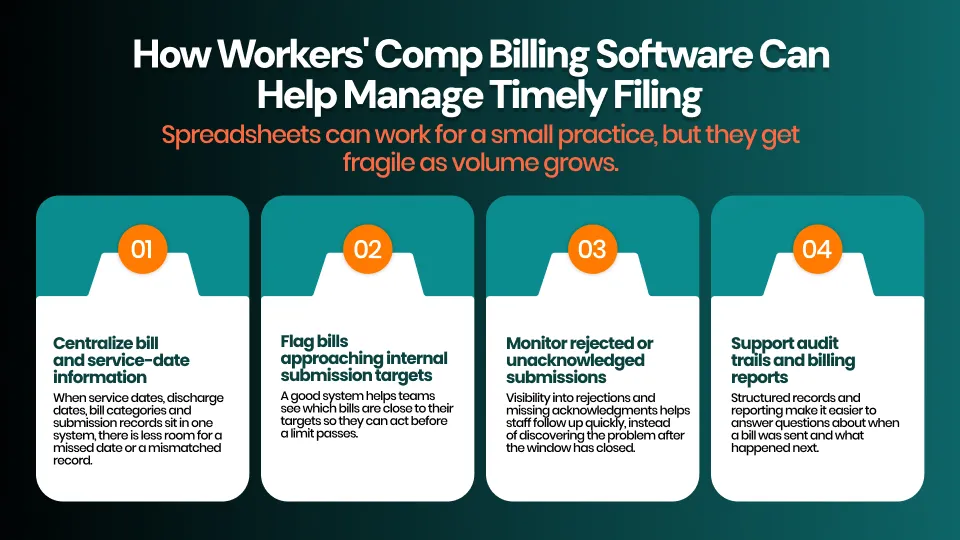
Spreadsheets can work for a small practice, but they get fragile as volume grows. Dedicated workers' comp billing software can make the process easier to manage and audit.
Centralize bill and service-date information
When service dates, discharge dates, bill categories and submission records sit in one system, there is less room for a missed date or a mismatched record.
Flag bills approaching internal submission targets
A good system helps teams see which bills are close to their targets so they can act before a limit passes.
Monitor rejected or unacknowledged submissions
Visibility into rejections and missing acknowledgments helps staff follow up quickly, instead of discovering the problem after the window has closed.
Support audit trails and billing reports
Structured records and reporting make it easier to answer questions about when a bill was sent and what happened next.
The right tool supports your process, but it does not replace the need to confirm the correct deadline for each bill.
Frequently Asked Questions
What is California's 12-month workers' compensation billing rule?
Under Labor Code 4603.2, medical-treatment bills for services provided on or after January 1, 2017, generally must be submitted within 12 months of the date of service. Inpatient facility bills use the discharge date. A request that is not timely submitted can be barred, subject to the applicable rules and exceptions.
Does the 12-month window start on the service date?
For outpatient and professional services, yes. The general rule counts from the date of service. For inpatient facility services, it counts from the date of discharge. The date the bill was created or entered into your system does not start the clock.
Is the deadline 12 months for every California workers' comp bill?
No. The 12-month period is the general rule for medical-treatment bills. Other bills have shorter limits, so the service category and governing statute must be checked each time.
Which bills may have 30-day or 180-day deadlines?
Bills for specified services exempt from prospective review may be subject to a 30-day deadline under Labor Code 4610(d)(1). Emergency services rendered in a general acute care hospital may be subject to a 180-day deadline under Labor Code 4610(d)(2). Confirm the provision that applies to your bill.
Can a late workers' comp bill ever qualify for an exception?
Possibly. Labor Code 4603.2 provides for rules defining good-cause exceptions, including cases where a nonoccupational injury or illness is later determined to be compensable. An exception is never guaranteed, and each case depends on its facts.
Does submitting a bill electronically change the filing deadline?
No. The method of submission does not change the statutory time limit. Electronic submission can make dates and acknowledgments easier to document, but the deadline still depends on the service and the applicable rule.
How can a billing team document timely submission?
Keep the submission date, the method used, delivery confirmation, any acknowledgment or rejection, and the corrected resubmission if there was one. Store these records with the bill so they can be produced if timeliness is questioned.
Where can providers verify California workers' compensation billing rules?
Start with the California DWC electronic billing FAQs and standardized paper billing FAQs, which explain submission time limits. Then read the current text of Labor Code 4603.2 and Labor Code 4610, and review California Code of Regulations section 9792.5.1 for billing and payment guide requirements. For a specific bill, consult a qualified California workers' compensation billing specialist or legal reviewer.
Manage Your Workers' Comp Billing Workflow with BillGenix
The 12-month rule is easy to state and easy to get wrong in practice. Accurate service dates, correct deadline categories, prompt submission and steady follow-up on acknowledgments are what keep a bill safely inside its window, and the shorter 30-day and 180-day provisions are a reminder that one rule never fits every bill.
Stay Ahead of Workers' Comp Billing Deadlines
Build a more organized workers' compensation billing workflow with clear records, submission monitoring, and consistent follow-up processes. Explore how BillGenix can support your billing team.