
Foot pain is one of the most routine complaints presented in outpatient practices, urgent care centers, and podiatry clinics. However, the claims generated for it often encounter unexpected pushback from commercial and government payers. Billing for non-specific foot pain using the M79.672 ICD-10 code frequently leads to delayed payments or outright rejections.
While M79.672 is a valid code for reporting pain in the left foot, payers routinely reject it when a provider note contains a definitive diagnosis or when the clinical documentation fails to establish medical necessity. This guide breaks down code specificity, laterality, payer rejection reasons, and a concrete process to resolve denied claims.
M79.672 is the specific ICD-10-CM diagnosis code for pain in the left foot. It functions as a symptom code and should only be reported as the primary diagnosis when a firm, underlying condition has not yet been identified by the treating provider.
What Is ICD-10 Code M79.672?
Code M79.672 falls under the broader Chapter 18 category for limb, foot, and digit pain within the ICD-10-CM classification system. Specifically, it denotes pain localized to the left foot.
Understanding the complete M79.67 code family is essential for compliant podiatry billing:
- M79.671: Pain in right foot
- M79.672: Pain in left foot
- M79.673: Pain in unspecified foot
Under official coding rules, M79.672 represents a symptom code vs. definitive diagnosis option. If a patient presents with left foot discomfort and the provider completes an evaluation without reaching a firm structural, neurological, or inflammatory diagnosis, M79.672 is appropriate. However, if an underlying cause is identified during the encounter, that definitive diagnosis must replace or precede the general symptom code.
Laterality Matters: Avoiding Unspecified Denials
Payers rely heavily on automated claims processing logic that checks for side-of-body specificity. Billing an unspecified diagnosis code like M79.673 when treating left-sided foot pain is an immediate trigger for an M79.672 denial or rejection.
When submitting claims, ensure that the diagnosis code matches the procedure coding and any anatomical modifiers used on CPT codes. While procedure codes for minor evaluations do not always take modifiers, CPT codes for injections, minor surgeries, or diagnostic imaging often require LT and RT modifiers (such as LT for the left side). A mismatch between a left-sided CPT modifier and a right-sided or unspecified ICD-10 code will lead to automatic system rejections.
When to Use a More Specific Code
Relying solely on M79.672 when clinical notes support a distinct condition is a primary cause of billing rejections. Coders must review the full medical record to determine if a confirmed condition should supersede the general symptom code.
Common specific diagnoses that should replace M79.672 billing include:
- Plantar Fasciitis (M72.2): Inflammatory fascial thickening, typically presenting with severe heel pain.
- Metatarsalgia (M77.41 / M77.42): Pain localized specifically to the metatarsal heads of the right or left foot.
- Plantar Nerve Lesions (G57.61 / G57.62): Entrapment or lesion of the plantar nerves, including Morton's neuroma.
- Diabetic Neuropathy (E11.40 / E11.42): Burning or painful peripheral neuropathy secondary to diabetes.
- Injury Codes (S90–S99 series): Acute trauma, including sprains, strains, contusions, and fractures of the left foot.
Why M79.672 Claims Get Denied
Understanding common rejection triggers allows billing teams to audit claims prior to initial submission:
- Lack of Medical Necessity (CO-50 Denials): Insurers often classify standalone symptom codes as insufficient to justify advanced diagnostic imaging, orthotics, or therapeutic injections.
- Missing Documentation: Notes fail to record essential elements such as duration, precise anatomical location, or functional limitations.
- Weak CPT and ICD-10 Linkage: Linking complex procedures or physical therapy services to a general symptom code rather than a structural or neurological diagnosis.
- Payer Routine Foot Care Rules: Commercial insurers and Medicare frequently deny general foot pain codes under routine foot care exclusion policies unless specific systemic conditions (such as severe peripheral vascular disease) are present and documented.
Documentation Checklist
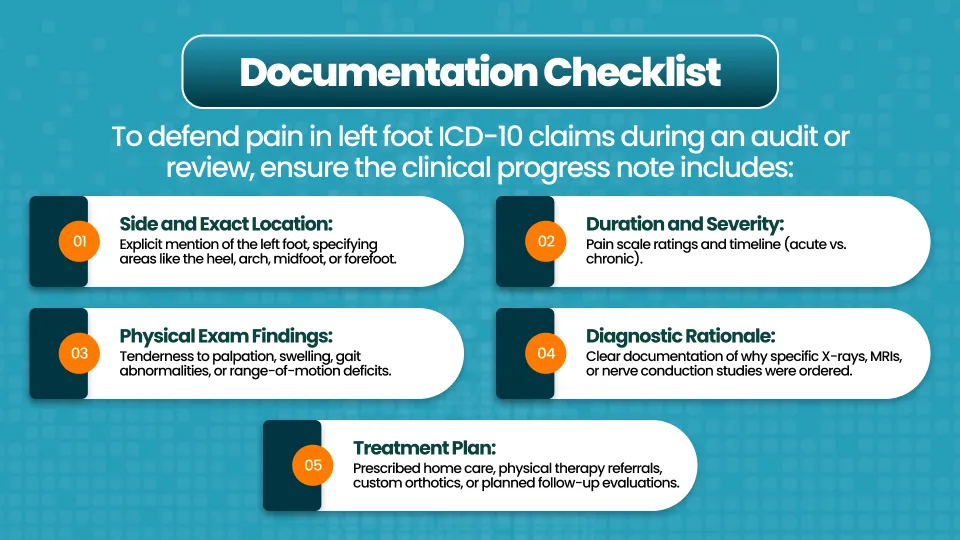
To defend pain in left foot ICD-10 claims during an audit or review, ensure the clinical progress note includes:
- Side and Exact Location: Explicit mention of the left foot, specifying areas like the heel, arch, midfoot, or forefoot.
- Duration and Severity: Pain scale ratings and timeline (acute vs. chronic).
- Physical Exam Findings: Tenderness to palpation, swelling, gait abnormalities, or range-of-motion deficits.
- Diagnostic Rationale: Clear documentation of why specific X-rays, MRIs, or nerve conduction studies were ordered.
- Treatment Plan: Prescribed home care, physical therapy referrals, custom orthotics or planned follow-up evaluations.
Step-by-Step Denial Fix
If you receive a denied claim for left foot pain, follow this structured process on how to fix denied foot pain claims:
- Read the Remittance Advice: Review the Explanation of Benefits (EOB) or Electronic Remittance Advice (ERA) to identify the specific denial code (e.g., CO-50 for medical necessity or CO-16 for missing information).
- Review the Medical Chart: Check the physician's progress note to see if a definitive condition (such as plantar fasciitis or tendonitis) was diagnosed but omitted from the original claim.
- Verify Coding and Modifiers: Ensure that the diagnosis code (M79.672), CPT codes, and any anatomical modifiers (LT) match perfectly.
- Determine Action Path: Decide whether to resubmit or appeal a claim. If a coding error occurred, update the claim and resubmit. If the coding was correct but denied for necessity, prepare a formal appeal.
- Attach Supporting Records: Include the progress note, physical exam findings, and diagnostic reports when submitting an appeal to substantiate medical necessity.
- Track Deadlines: Submit all corrections and appeals within the payer's timely filing limits.
Workers' Comp and Personal Injury Foot Claims
Handling foot pain claims under workers' compensation or personal injury liens involves additional administrative layers. Insurers in these sectors demand clear causation documentation linking the left foot pain to a specific workplace incident or personal injury event.
When submitting claims to workers' compensation payers or personal injury trusts, initial treatment may begin with symptom codes like M79.672. However, supplementary reports must quickly update the file with specific traumatic injury codes once diagnostic imaging or specialist evaluations are completed. For unresolved disputes in workers' compensation cases, practices may need to utilize formal channels such as the Workers' Compensation Appeals Board (WCAB) or Independent Bill Review (IBR) processes to secure proper reimbursement.
Frequently Asked Questions
1. What is the ICD-10 code for left foot pain?
The primary code for left foot pain is M79.672. It is a valid, lateral-specific code used when no underlying definitive diagnosis has been established.
2. What is the difference between M79.671 and M79.672?
The difference lies entirely in laterality: M79.671 vs M79.672. M79.671 represents pain in the right foot, while M79.672 represents pain in the left foot.
3. Why is M79.672 denied by payers?
Payers often deny M79.672 because they require a more specific structural or medical diagnosis, or because the code is billed alongside procedure codes that demand higher medical necessity documentation.
4. Should I use M79.672 or a more specific diagnosis?
You should use a more specific diagnosis (such as plantar fasciitis, metatarsalgia, or sprain) whenever the provider explicitly documents one in the medical chart. Use M79.672 only when no underlying cause is identified.
5. Should I resubmit or appeal a denied foot pain claim?
If the denial was due to a missing or incorrect code that is supported by the chart, correct the claim and resubmit it. If the code was accurate but denied for medical necessity, submit a formal appeal with clinical notes attached.
Conclusion
Successfully billing the M79.672 ICD-10 code requires careful attention to laterality, complete clinical documentation and proper code selection. While M79.672 is appropriate during initial evaluations, transitioning to a specific diagnostic code as soon as one is documented protects your practice against unnecessary denials and revenue loss.
Tired of reworking foot pain denials? Medical Lien Management can help you fix, appeal, and prevent them. Explore our specialized services in Denial Management, Workers' Compensation Billing, Personal Injury Lien Collections and Appeals & Independent Bill Review to streamline your revenue cycle.