Medical virtual scribe services give clinicians a trained remote professional who drafts visit notes while the patient is in the room or right after the visit, so the provider reviews and signs instead of typing. Most practices researching this want two answers: what the service includes and what it costs. This guide covers both, then shows you how to compare a virtual medical scribe provider before you commit.
What Medical Virtual Scribe Services Include
Remote medical scribe services typically mean a scribe joins the visit by audio or video, or works from a recording, and prepares the note in your EHR documentation workflow. That can include history of present illness, review of systems, exam findings, orders and the plan, all formatted to your templates. The clinician edits and signs. The scribe does not diagnose, prescribe or make clinical decisions.
For a closer look at duties, limits and a typical shift, read What Does a Virtual Medical Scribe Do?
Human, AI-Assisted and AI-Only Scribes: What's the Difference?
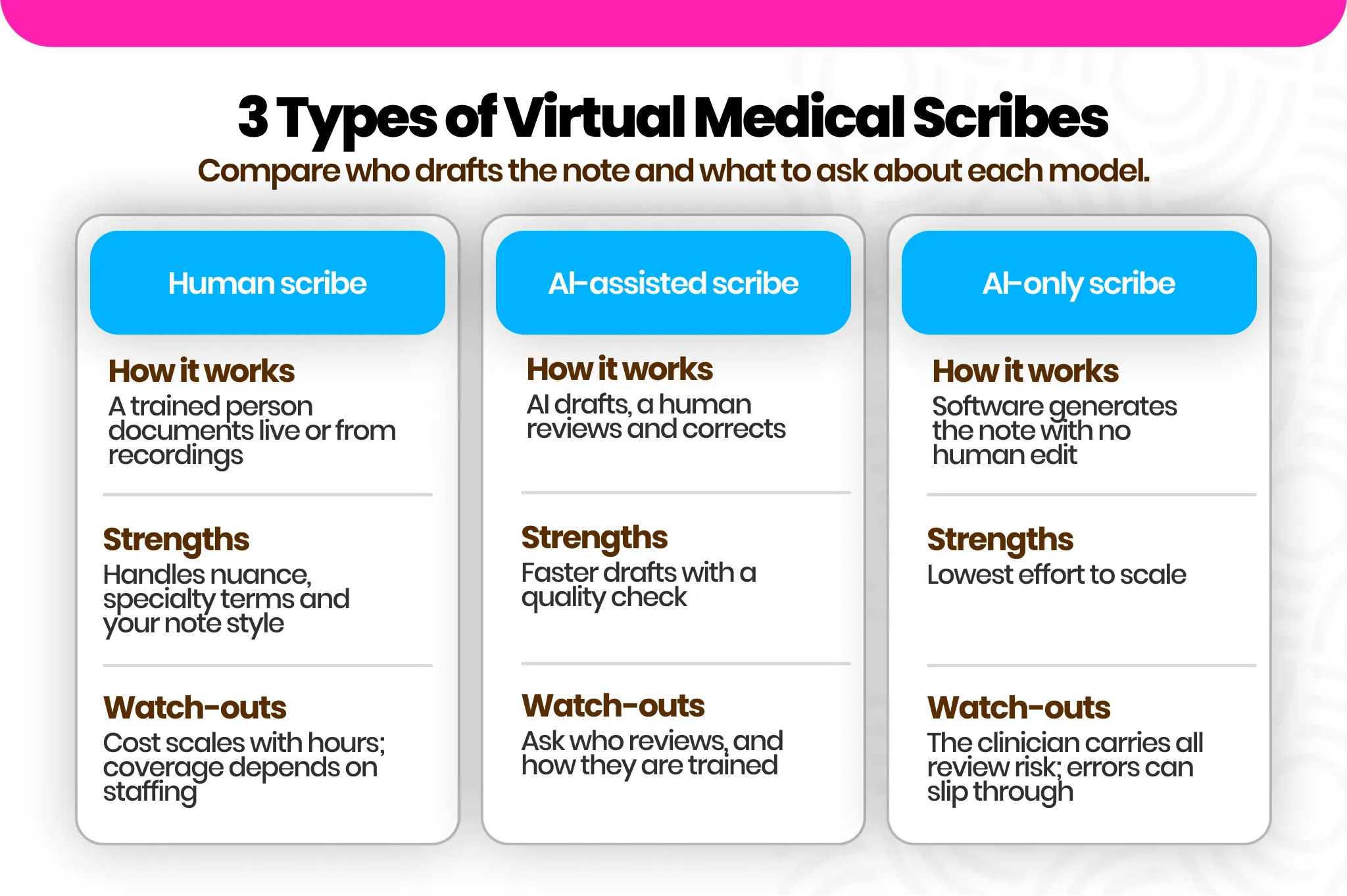
The human vs AI scribe question comes up in almost every buying conversation. An ambient AI scribe listens to the visit and generates a draft automatically. A human scribe writes the note with judgment about context, accents, specialty shorthand and what belongs in the chart. Many providers now blend the two.
|
Type |
How it works |
Strengths |
Watch-outs |
|
Human scribe |
A trained person documents live or from recordings |
Handles nuance, specialty terms and your note style |
Cost scales with hours; coverage depends on staffing |
|
AI-assisted |
AI drafts, a human reviews and corrects |
Faster drafts with a quality check |
Ask who reviews, and how they are trained |
|
AI-only |
Software generates the note with no human edit |
Lowest effort to scale |
The clinician carries all review risk; errors can slip through |
If you are weighing accuracy, ask any vendor how often notes need clinician correction and what review happens before a note reaches you.
Benefits for Practices
The full case is laid out in Benefits of Hiring a Virtual Medical Scribe. In short, practices usually look at scribes to:
- Reduce documentation time after clinic hours
- Ease a major driver of physician burnout, the charting backlog
- Keep notes more consistent across providers
- Give clinicians more face time with patients
- Add documentation capacity without hiring and training in-house
Treat these as goals to test during a pilot, not guarantees.
How Much Do Virtual Scribe Services Cost?
If you are asking how much does a virtual scribe cost, the honest answer is that it depends on the model, the specialty and the hours covered. Published virtual scribe cost figures vary widely between vendors, and many providers only quote after a discovery call. Be cautious of any single number that is not tied to a named vendor and a date. When you request quotes, ask for written ranges and what each range includes.
Common pricing models
|
Model |
How it's billed |
Best for |
Watch-outs |
|
Hourly |
Rate per scribe hour worked |
Part-time or variable clinic schedules |
Idle time, minimum hours, overtime rules |
|
Monthly FTE |
Flat monthly fee for a dedicated scribe |
Full-time clinics with steady volume |
Paying for unused capacity; backup coverage |
|
Per-encounter |
Fee per note or visit |
Low or unpredictable volume |
Costs climb fast at high volume; definition of an encounter |
|
Per-provider subscription |
Monthly fee per clinician |
Groups that want predictable budgeting |
Usage caps, add-on fees, what counts as a provider |
What drives the price
Five factors move virtual scribe pricing more than any other:
- Specialty: orthopedics, cardiology and behavioral health need different expertise and templates
- Hours covered: daytime only is cheaper than extended or weekend coverage
- Turnaround: same-day notes cost more than next-day delivery
- EHR access method: direct login, screen share or note handoff each carry different setup effort
- Human QA: a second review layer adds cost and also adds accuracy
Virtual vs. in-house cost
An in-house scribe brings salary, benefits, equipment, training and turnover into the math. For a side-by-side worksheet, see Virtual Medical Scribe vs In-House Scribe.
What to Look for in a Virtual Scribe Provider
Choosing a virtual scribe company gets easier when you score every vendor on the same checklist.
|
Criteria |
What good looks like |
|
BAA |
Signed before any PHI is shared, with clear breach terms |
|
Scribe training and QA |
Documented onboarding, medical terminology testing and ongoing review |
|
EHR compatibility |
Experience in your EHR, with a clear access method |
|
Specialty experience |
Scribes who have worked in your specialty |
|
Coverage hours |
Matches your clinic schedule, with backup for absences |
|
Turnaround |
A written standard for note delivery |
|
Trial or pilot |
A short paid or unpaid pilot before a long commitment |
|
Contract length |
Reasonable terms and a clear exit clause |
|
Data security |
Encryption, access controls and audit logging |
Are virtual scribes HIPAA compliant? They can be, but compliance comes from the agreement and the safeguards, not the job title. Under HIPAA, a vendor handling protected health information is a business associate and must sign a BAA. HHS explains the requirements in its business associate contract guidance. For a deeper vendor checklist, read HIPAA-Compliant Virtual Medical Scribes.
How long does onboarding take? It varies by vendor and EHR. Ask for a written timeline that covers credentialing, template setup, a shadowing period and a go-live date, rather than accepting a vague estimate.
Questions to Ask Before You Sign
- Will you sign a BAA before we share any patient information?
- Is every note reviewed by a human before it reaches our clinicians?
- How are scribes trained, tested and retrained?
- What is your written scribe turnaround time, and what happens when you miss it?
- Have you worked in our EHR and our specialty?
- How do scribes access our system, and who audits that access?
- What happens when our assigned scribe is out sick or leaves?
- How is pricing structured, and which fees are not included?
- Can we run a pilot, and what are the exit terms?
- How do you measure accuracy, and can we see that data?
If you want to see how a vendor answers these before you shortlist, you can talk to our team about your documentation workflow.
Also read: Best Virtual Medical Scribe Services for Small Clinics (2026)
Ready to Build Your Shortlist?
Use the checklist above to compare vendors, then see how Virtual Mojoe handles documentation, security and EHR fit. Explore Virtual Medical Scribes at Virtual Mojoe.