
A medical billing virtual assistant is a remote professional who supports your billing workflow, handling routine tasks like insurance checks, charge entry, payment posting and follow-up while your practice keeps control of coding and claim decisions. Think of a medical billing VA as an extra pair of trained hands for the billing desk, not a replacement for your billing expertise. This guide explains what the role covers, where it stops and how to bring one on safely.
What Does a Medical Billing Virtual Assistant Do?
If you are asking what a medical billing virtual assistant does, the short answer is that they take on the time-consuming tasks that keep revenue moving. Most billing VA tasks fall into three stages of the revenue cycle.
|
Stage |
Common tasks |
Examples |
|
Front-end |
Prepare the account before the visit |
Eligibility verification, benefit checks, collecting insurance details, appointment-related billing notes |
|
Mid-cycle |
Move the visit into billing |
Charge entry from provider-coded superbills, checking for missing information, preparing claims for staff review |
|
Back-end |
Follow the money after submission |
Payment posting, claim status checks, AR follow-up, sending patient statements, organizing denial information for staff |
A remote medical billing assistant usually works inside your practice management system or through a secure workflow your team sets up. The work is detail-heavy and repetitive, which is exactly why practices hand it off.
Billing work also overlaps with collections. If unpaid balances are your biggest backlog, a dedicatedCollections Virtual Assistant can focus on AR follow-up and account recovery while the rest of your billing runs as normal.
What a Billing VA Should Not Handle
Honest boundaries build trust, and they protect your practice. A billing VA supports the workflow. They do not own the decisions that carry legal and financial weight. Keep these with your practice or its billing team:
- Coding sign-off. Diagnosis and procedure codes should be assigned or approved by your provider or a certified coder.
- Claim submission decisions. Someone accountable at the practice decides when a claim is ready to go out.
- Balance adjustments and write-offs. These affect your books and need an authorized approver.
- Clinical judgment. A VA should never interpret medical records beyond what the billing task requires.
- Payer contract negotiation. This belongs to practice leadership.
A good VA flags issues for your team instead of guessing. If a vendor promises to "fix your coding" or guarantees a specific denial reduction, ask for evidence before you trust it.
Skills, Training and Systems to Look For
Before you hire a medical billing virtual assistant, check the following.
Practice management and EHR systems. Ask which platforms the VA has used and how quickly they can learn yours. Familiarity with your practice management system shortens the ramp-up.
Clearinghouse familiarity. Your VA should understand how claims move through a clearinghouse, how to read rejection reports and when to pass an error to staff.
Payer portals. Much of eligibility verification and claim status work happens on payer websites. Comfort with those portals saves hours.
Billing fundamentals. Look for knowledge of CMS-1500 claims, explanation of benefits and common denial reasons. The CMS Medicare Claims Processing Manual is a useful reference for how Medicare claims are handled.
HIPAA training. Because a VA will touch protected health information, ask how they are trained and what safeguards the provider uses.
Communication. A strong VA documents what they did, asks questions early and reports problems clearly.
Medical Billing VA vs. Billing Company vs. In-House Biller
One of the most common questions is the billing VA vs. billing company difference. Both help with billing, but they work in very different ways.
|
Factor |
Medical billing VA |
Billing company |
In-house biller |
|
Who directs the work |
Your practice |
The company, under a service agreement |
Your practice |
|
Scope |
Defined tasks you assign |
Often full-cycle billing |
Whatever you hire for |
|
Systems |
Works in your systems |
Often uses its own software and processes |
Works in your systems |
|
Control and visibility |
High, you see the daily work |
Varies, often reporting-based |
High |
|
Pricing structure |
Usually time-based or by arrangement with the provider |
Often a percentage of collections or a flat fee |
Salary, benefits and equipment |
|
Management effort |
You assign and review tasks |
Lower day-to-day, more contract oversight |
You hire, train and manage |
|
Best for |
Practices that want support but need to keep control |
Practices that want to hand off billing entirely |
Larger practices with steady volume |
None of these is always best. A VA fits when your team understands billing but needs capacity. A billing company fits when you want the function handled end to end. An in-house biller fits when you have the volume and management bandwidth to support one.
Which Practices Benefit Most?
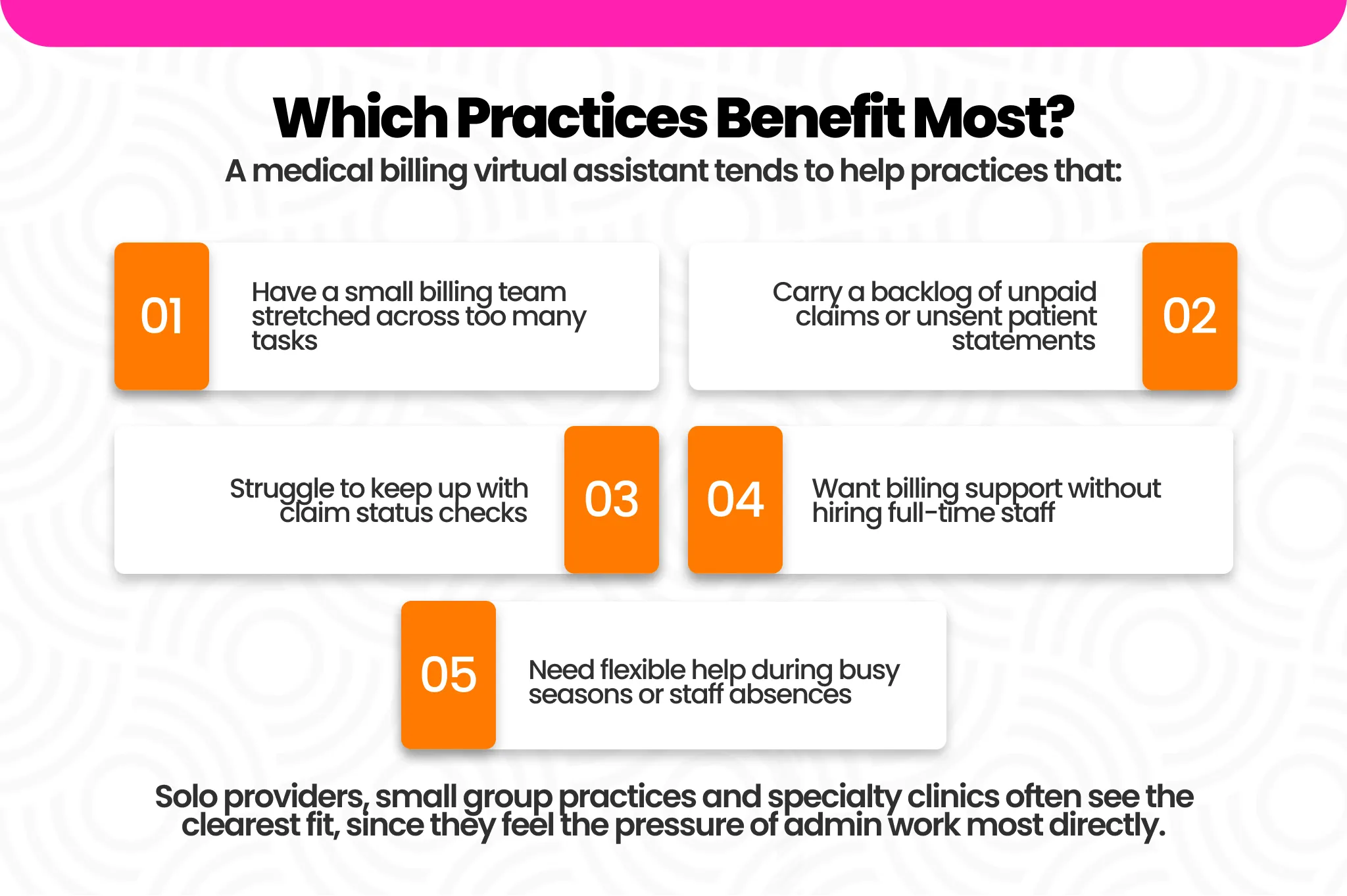
A medical billing virtual assistant tends to help practices that:
- Have a small billing team stretched across too many tasks
- Carry a backlog of unpaid claims or unsent patient statements
- Struggle to keep up with claim status checks
- Want billing support without hiring full-time staff
- Need flexible help during busy seasons or staff absences
Solo providers, small group practices and specialty clinics often see the clearest fit, since they feel the pressure of admin work most directly.
How to Onboard a Billing VA Safely
A careful start protects patients and your revenue.
- Sign a BAA first. Under HIPAA, a vendor that handles protected health information is a business associate. HHS explains the requirements in its business associates guidance.
- Limit access. Give the VA only the system permissions the role needs, and use individual logins, never shared ones.
- Write the workflows. Document each task step by step, including what to do when something looks wrong and who to escalate to.
- Start small. Begin with one or two tasks, such as eligibility verification or payment posting, and expand once quality is steady.
- Track KPIs. Review days in AR, claim rejection rate, unworked claims, patient statement turnaround and how quickly issues are escalated.
- Hold regular check-ins. A weekly review in the first month catches small problems before they grow.
If you want help scoping a role, you can talk to Virtual Mojoe about a Medical Virtual Assistant and discuss which billing-support tasks fit your practice.
Also read: Top 10 Virtual Collections Specialist Companies in the USA (2026)
Ready to Add Billing Support to Your Team?
If your billing desk is stretched thin, a clear scope and a safe onboarding plan make all the difference. Explore Virtual Mojoe's Medical Virtual Assistant to see how remote support could fit your practice.