
Remote Patient Monitoring (RPM) programs allow practices to improve outcomes for patients with chronic conditions while building steady, predictable revenue streams. While initial onboarding and device supply establish the foundation of virtual care, treatment management codes cover the ongoing clinical time spent reviewing physiologic data and communicating with patients. Among these, CPT 99458 serves as the primary add-on code for clinical teams providing extended care.
Because CPT 99458 is strictly an add-on service, billing errors frequently occur around minute tracking, missing base codes or automated software discrepancies. Understanding RPM time requirements, interactive communication rules and updated 2026 coding changes helps practices safeguard reimbursement while maintaining compliance.
CPT 99458 is an add-on code for each additional 20 minutes of remote physiologic monitoring treatment management time within a calendar month, reported directly after meeting the first 20-minute threshold under CPT 99457.
What Is CPT 99458?
So, what is CPT 99458 in everyday clinical practice? It is the official CPT code used to capture additional care management time spent beyond the initial 20 minutes required for base code CPT 99457. Rendered by a physician, qualified healthcare professional (QHP), or clinical staff time under general supervision, it accounts for higher-touch, high-complexity patients who need frequent oversight.
As an add-on code, CPT 99458 cannot stand alone on a claim. It reflects cumulative clinical effort expended across a full calendar month, capturing data analysis, treatment plan adjustments and ongoing patient check-ins.
RPM Code Family at a Glance
The RPM billing framework relies on separate codes for initial setup, monthly device transmission and clinical management time. Major CPT updates introduced new flexible codes to account for shorter monitoring periods and lighter management tiers alongside existing codes like CPT 99457 and 99458.
CPT Code | Service Description | Time / Duration Required | Billing Frequency |
99453 | Initial device setup and patient education | One-time per episode | Initial enrollment |
99445 | Device supply & data transmission (Short-Window) | 2 to 15 days of data | Once per 30 days |
99454 | Device supply & data transmission (Standard) | 16 to 30 days of data | Once per 30 days |
99470 | Treatment management (Low-Tiers) | 10 to 19 minutes | Monthly (Base) |
99457 | Treatment management (Standard Base) | First 20 full minutes | Monthly (Base) |
99458 | Treatment management (Add-On) | Each additional 20 minutes | Monthly (Add-On) |
CPT 99458 Time Requirements
Meeting RPM time requirements requires structured tracking across the entire calendar month. Standard time rules apply when stacking units of CPT 99458:
- 0 to 9 Minutes: Non-billable for management.
- 10 to 19 Minutes: Bill CPT 99470 (cannot bill 99457 or 99458).
- 20 to 39 Minutes: Bill CPT 99457 (1 unit).
- 40 to 59 Minutes: Bill CPT 99457 (1 unit) + CPT 99458 (1 unit).
- 60 to 79 Minutes: Bill CPT 99457 (1 unit) + CPT 99458 (2 units).
What Counts Toward Time
- Live interactive communication via phone, video or real-time audio with the patient or caregiver.
- Reviewing transmitted physiologic data (blood pressure, glucose, weight, pulse oximetry).
- Adjusting clinical care plans or modifying medications based on RPM readings.
- Coordinating care with other clinicians based on monitoring data.
What Does Not Count
- Automated system data downloads or passive platform data syncs.
- Unsuccessful phone calls or left voicemails without active engagement.
- Administrative tasks, such as insurance verification or device shipping logs.
Crucially, the monthly management service requires at least one real-time interactive communication with the patient or caregiver. Without documented interactive communication during the month, neither 99457 nor 99458 can be reported.
Documentation Checklist
To withstand a payer audit and maintain a top-tier clean claim rate, keep a comprehensive documentation audit trail containing:
- Order and Medical Necessity: An explicit order from the billing practitioner detailing the clinical rationale and target condition.
- Patient Consent: Documented patient consent (written or verbal) covering RPM service guidelines and cost-sharing obligations.
- Data Transmission Logs: Time-stamped records showing qualifying device transmission days (confirming whether 99445 or 99454 applies).
- Detailed Time Logs: Itemized logs showing dates, exact minute counts, specific activities performed, and staff identities.
- Interactive Communication Summary: Clinical notes detailing real-time phone or video encounters with the patient.
- Care Plan Modifications: Notes showing how data review influenced clinical decisions or care plan updates.
Common Claim Errors Leading to Denials
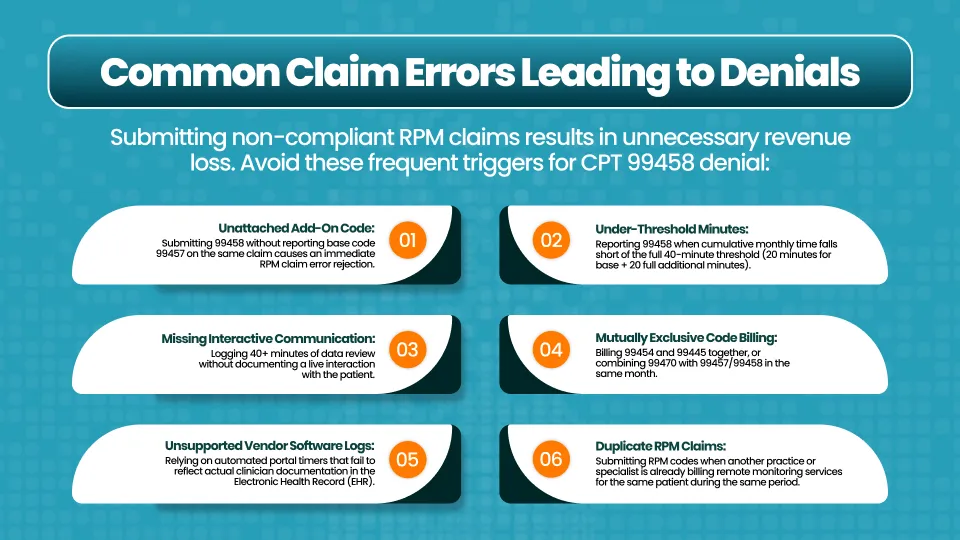
Submitting non-compliant RPM claims results in unnecessary revenue loss. Avoid these frequent triggers for CPT 99458 denial:
- Unattached Add-On Code: Submitting 99458 without reporting base code 99457 on the same claim causes an immediate RPM claim error rejection.
- Under-Threshold Minutes: Reporting 99458 when cumulative monthly time falls short of the full 40-minute threshold (20 minutes for base + 20 full additional minutes).
- Missing Interactive Communication: Logging 40+ minutes of data review without documenting a live interaction with the patient.
- Mutually Exclusive Code Billing: Billing 99454 and 99445 together, or combining 99470 with 99457/99458 in the same month.
- Unsupported Vendor Software Logs: Relying on automated portal timers that fail to reflect actual clinician documentation in the Electronic Health Record (EHR).
- Duplicate RPM Claims: Submitting RPM codes when another practice or specialist is already billing remote monitoring services for the same patient during the same period.
Partnering with professional remote patient monitoring billing services can help audit time logs before claims are submitted to prevent billing rejections.
Reimbursement Overview
To estimate expected 99458 reimbursement, practices should reference official updates published annually in the CMS Physician Fee Schedule (PFS). Payment amounts vary based on geographic locality adjustments and setting factors.
Because commercial payers maintain unique payment policies and unit limits for treatment management services, practices should consult the current CMS fee schedule or check directly with commercial carriers to confirm final allowable rates.
Audit and Compliance Tips
With increased regulatory oversight surrounding virtual care programs, maintaining compliance across all RPM billing requirements is vital:
- Perform Internal Audits: Regularly cross-reference platform time logs against EHR clinical documentation to ensure consistency before filing.
- Review Vendor Contracts: Ensure RPM software vendors provide time-stamped, verifiable audit trails rather than auto-generated time estimates.
- Establish Clear Protocols: Train clinical staff on what constitutes billable treatment management services versus standard administrative work.
Frequently Asked Questions
What is CPT 99458?
CPT 99458 is an add-on code used to report each additional 20 minutes of remote physiologic monitoring treatment management time in a calendar month, billed after the initial 20 minutes under CPT 99457.
How many minutes are required for 99458?
To bill one unit of CPT 99458, you must document a total of at least 40 minutes of qualifying treatment management time in a calendar month (20 minutes for CPT 99457 plus 20 full additional minutes for CPT 99458).
Can CPT 99458 be billed without 99457?
No. CPT 99458 is strictly an add-on code. It can never be billed alone and must always accompany CPT 99457 on the claim.
What changed for RPM billing in 2026?
Coding expanded to include CPT 99445 for shorter device supply windows (2 to 15 days of transmitted data) and CPT 99470 for lighter treatment management tiers (10 to 19 minutes of clinical staff time).
Why are RPM claims denied?
Common denial causes include missing base codes, failing to record interactive patient communication, falling below minute thresholds, or submitting conflicting device supply codes.
Conclusion
Maximizing reimbursement under CPT 99458 requires accurate time tracking, compliant code pairing, and thorough clinical documentation. By understanding RPM time requirements, adhering to new code rules, and conducting regular log audits, your practice can protect its revenue cycle while delivering exceptional virtual care.
Running an RPM program? Contact Medical Lien Management today to have our billing experts review your claims, time logs and denials to optimize your revenue cycle.