By Ross Haider | The FinTech Partner
The UAE’s digital-economy ambitions are creating a bigger opportunity than technology adoption alone. The next phase is about connecting FinTech, AI, global expertise and local execution to real business problems – and using that combination to build companies that can scale from the UAE to the world.
After more than three decades working across banking, payments and FinTech in multiple regions of the world, one thing has become increasingly clear to me:
The most successful financial centres do not simply adopt technology. They create ecosystems where technology, capital, regulation, talent and entrepreneurship can come together.
That is one of the reasons I believe the UAE has become such an important global market for financial technology. Its ambitions go considerably beyond becoming the financial centre of the Middle East. The country is building the conditions for a broader digital economy in which financial infrastructure, advanced technology, international expertise and entrepreneurship reinforce one another.
A Bold Vision for the UAE’s Digital Economy
Under We the UAE 2031, the country is working toward becoming one of the world’s most dynamic economies and an influential global economic hub, with innovation, advanced technology, entrepreneurship and digital infrastructure playing important roles in that transformation.
The numbers demonstrate the scale of the ambition. The national vision aims to increase GDP from AED 1.49 trillion to AED 3 trillion and raise the value of foreign trade to AED 4 trillion. At the same time, the UAE Digital Economy Strategy aims to double the digital economy’s contribution to GDP from 9.7% in 2022 to 19.4% within ten years.
These are not simply government targets. They create opportunities – and responsibilities – for the private sector. Banks, FinTechs, technology providers, investors, entrepreneurs and advisers all have a role in turning national ambition into commercial activity. This is precisely where I believe FinTech can make a meaningful contribution.
FinTech Is Infrastructure for the New Economy
FinTech is sometimes viewed too narrowly as an industry: payments, digital banking, lending, wallets or crypto. But financial technology is increasingly the infrastructure that enables other industries to grow.
When a UAE business expands internationally, it needs cross-border payments. When an SME wants to digitize, it needs better financial infrastructure. When an e-commerce company sells globally, it needs acquiring, fraud management, FX and treasury capabilities. When an international company establishes operations in Dubai or Abu Dhabi, it needs banking, payments and financial connectivity.
And as AI begins to play a larger role in commercial workflows and decision-making, financial services will need stronger identity, authorization, payment, data and risk infrastructure around those interactions.
FinTech therefore is not simply participating in the digital economy. FinTech helps enable the digital economy.
That view is consistent with the Central Bank of the UAE’s approach to building a mature FinTech ecosystem around five pillars: demand, capital, policy, talent and infrastructure, with its FinTech strategy centred on innovation and collaboration. The point is important: successful digital finance is not created by technology alone. It depends on the ecosystem around it.
The Opportunity Is to Connect Global Innovation With the UAE
One of the UAE’s greatest advantages is its ability to attract companies, entrepreneurs, investors and expertise from around the world. But attracting innovation is only part of the equation. The next challenge is connecting that innovation to actual business problems.
Around the world, there are outstanding FinTech companies developing solutions in payment orchestration, issuing, acquiring, fraud management, tokenization, artificial intelligence, digital assets, data analytics, treasury and embedded finance. At the same time, banks, FinTechs and enterprises throughout the GCC are trying to modernize their financial infrastructure.
The opportunity is to bring those two worlds together, not by introducing technology for technology’s sake, but by starting with a more useful question:
What business problem are we trying to solve?
Once the problem is clear, it becomes easier to identify the right technology, people and partners to solve it. A strong solution is not simply technically impressive. It has to fit the buyer, the operating environment, the commercial model and the way the business actually works.
Why Partnerships Matter
This is where partnerships become particularly important. A bank may understand its customers but need specialist technology. A global FinTech may have excellent infrastructure but limited access to the local market. An enterprise may know the outcome it wants but not which provider, implementation model or commercial structure is right.
The best partnership models combine complementary strengths; local market understanding, regulatory awareness, buyer relationships, technical capability and execution. When those elements are aligned, partnerships can shorten the distance between an idea and a commercially useful outcome.
AI Should Be About Outcomes, Not Hype
The same principle applies to artificial intelligence. Almost every board and executive team is now discussing AI. But I believe we need to move beyond asking, ‘How can we add AI to our business?’
Instead, leadership teams should ask: Where can AI materially improve our business? Can AI improve fraud detection?
Can it accelerate merchant onboarding? Can it automate reconciliation
Can it identify operational inefficiencies?
Can it reduce the time employees spend on repetitive tasks?
When approached this way, AI stops being a technology initiative and becomes a business transformation tool. The goal is not to deploy AI because the market is talking about it. The goal is to apply it where it can create a measurable improvement in revenue, risk, customer experience, productivity or decision-making.
That distinction is important. Less hype. More execution.
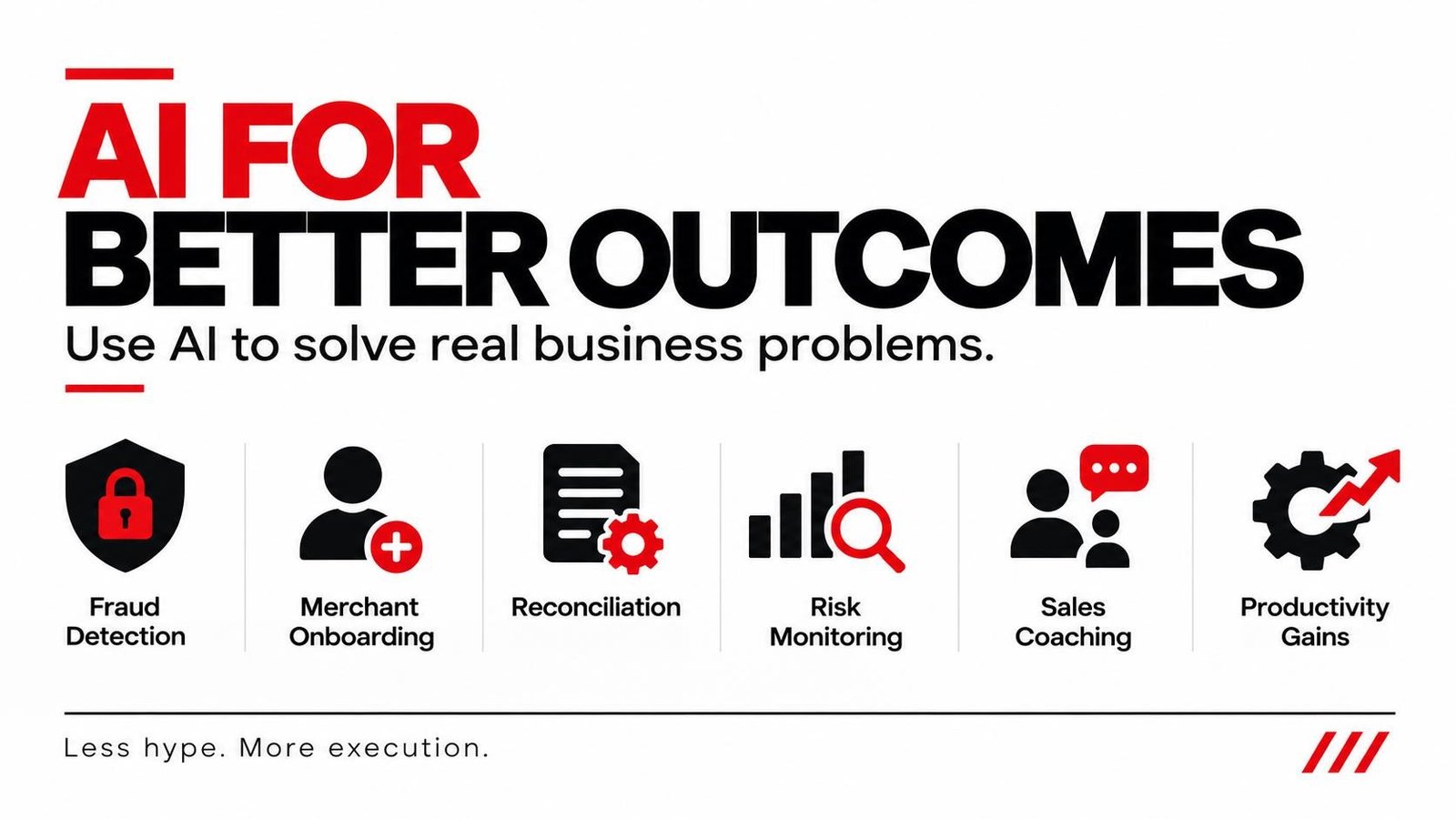
Figure 1. AI creates more value when teams start with the business outcome: stronger controls, faster processes, better decisions and higher productivity.
Global Expertise. Local Execution.
This thinking was one of the reasons behind establishing The FinTech Partner in the UAE. Our objective is not to become another traditional management consultancy producing reports telling clients what they already know.
We are building a network-driven FinTech project and advisory business designed to help established and emerging FinTech companies solve specific challenges.
That could mean developing a go-to-market strategy. Building a new sales organization. Entering the GCC, Africa, Europe or another international market. Identifying the right payment infrastructure. Improving operational efficiency. Integrating AI into existing processes. Developing new distribution partnerships. Restructuring a commercial strategy. Or helping management move a difficult strategic initiative from a PowerPoint presentation into execution.
The model is deliberately flexible. Different problems require different expertise. Instead of assuming one consulting team has every answer, we can bring together experienced specialists from our international network based on the requirements of each project.
Find the right people. Apply the right technology. Solve the right problem.
From the UAE to the World
There is another dimension to the UAE opportunity that I find particularly compelling. The UAE does not need to be viewed only as a destination for international FinTech companies. It can increasingly become a launching point for global expansion.
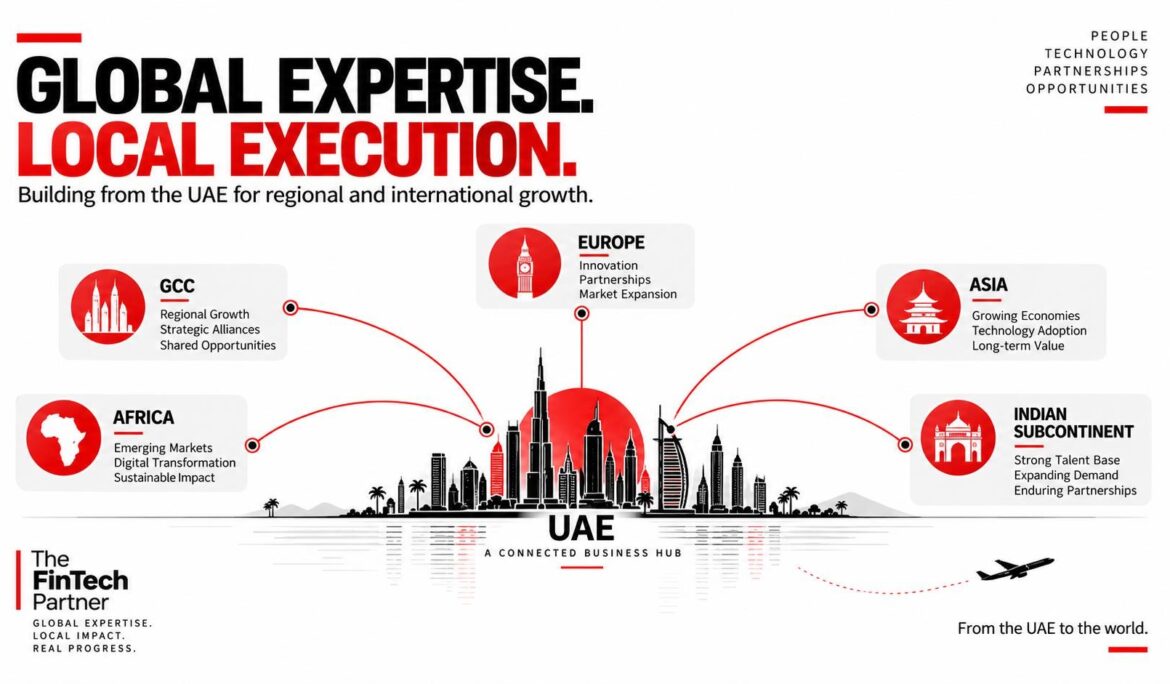
Its geographic position connects the GCC with Africa, Asia, Europe and the Indian subcontinent. Its business environment attracts international entrepreneurs and talent. Its financial ecosystem connects traditional banking with emerging technologies. And its national strategy explicitly seeks to strengthen the country’s position as a global partner and economic hub.
That creates the possibility of building companies in the UAE that solve problems far beyond the UAE. A company can establish relationships, assemble expertise, test commercial models and build partnerships in the UAE – then use that foundation to pursue opportunities in other regions.
This is closely aligned with how we see The FinTech Partner. We may be based in Dubai. But our marketplace is global.
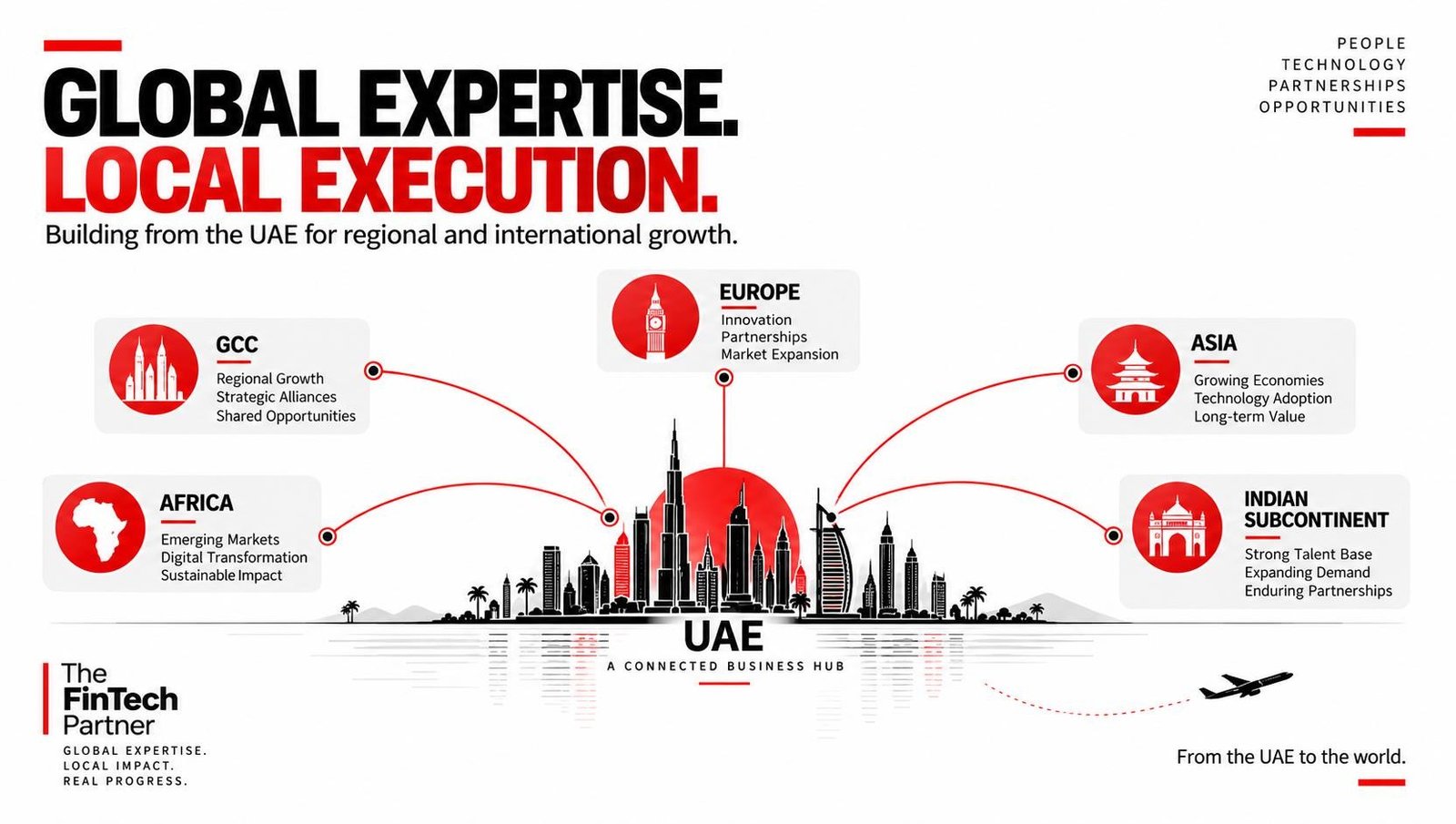
Figure 2. The UAE can serve as a business hub for regional and international growth by combining local execution with global expertise and partnerships.
Building the Future Requires Execution
National visions are ultimately achieved through thousands of individual decisions made by governments, entrepreneurs, investors and businesses. The UAE has created an ambitious direction toward 2031. The private sector now has an opportunity to help execute against it.
For those of us working in FinTech, that means building better financial infrastructure, adopting technology responsibly, attracting global expertise, developing partnerships and helping companies scale beyond borders.
After 30+ years in this industry, I remain convinced of something remarkably simple. Technology alone does not transform businesses.
People do.
Technology gives them better tools. Strategy gives them direction. And execution turns those ideas into results.
At The FinTech Partner, that is where we intend to play our part, helping connect experience, technology, AI and global FinTech expertise to real business challenges, supporting companies building in the UAE and expanding from the UAE to the world.