Medical credentialing is how New York practices get approved to join insurance networks and stay in them. This guide compares the top 5 medical credentialing companies in New York, GreenSense Billing, TheCredentialing, Sunknowledge Services, Practolytics, and symplr (symplrCVO), by services, turnaround time, and pricing, using only publicly documented information.
Verifying licenses, qualifications, and work history, then keeping records current for each payer, takes real time, especially for growing practices. The right outside partner can take that work off your team. The wrong one can leave you waiting on approvals you need to bill.
Disclosure: GreenSense Billing (GSB) publishes this guide and is one of the companies listed. It appears first for transparency, not because it is ranked highest. Every company is profiled with the same fields, using public information from its own website. GSB is based in Las Vegas, NV, and supports providers nationwide.
Quick Comparison: Medical Credentialing Companies in New York
| Company | Best For | Core Services | Turnaround | Specialties / Coverage | Pricing |
|---|---|---|---|---|---|
| GreenSense Billing (GSB) | Full-service credentialing + billing | Payer credentialing/enrollment, CAQH and NPI management, payer contracting, re-credentialing, custom reporting | 45 to 90 days (company-stated) | Primary care, behavioral health, PT, dental/oral surgery, cardiology, neurology, GI, urgent care, telehealth | Not publicly stated |
| TheCredentialing | Practices wanting published NYC pricing | Enrollment/credentialing, revalidation, licensing, EDI/EFT, contract negotiation, exclusion management | Company claims NYC averages 90 to 120 days (vendor claim) | Names payer partners including Aetna, BCBS, Cigna, Humana, UnitedHealthcare | About $735 per provider for an initial NYC application, plus $500+ indirect costs |
| Sunknowledge Services Inc. | Practices wanting credentialing bundled with RCM and staffing | Credentialing bundled with RCM and staffing | Not publicly stated for credentialing | DME, orthotics/prosthetics, urgent care, GI, cardiology, infusion, fertility, radiology, SNF | "$7/hour per FTE" (staffing-style) |
| Practolytics | Practices wanting upfront cost and timeline clarity | Credentialing, verification, CAQH, enrollment, re-credentialing, hospital privileging | Commercial 60 to 90 days; Medicare 30 to 45; Medicaid 45 to 75 | Not specified; 500+ commercial plans | $300 to $800 per network; $1,500 to $3,500 multi-payer packages |
| symplr (symplrCVO) | Large health systems and hospitals | Primary source verification, enrollment management, delegated credentialing | Not publicly stated | Hospitals, health systems, health plans | Custom quote only |
Turnaround and pricing figures are company-stated, taken from each company's public website. Confirm current terms directly with each vendor.
What Is Medical Credentialing and Why Does It Matter in New York?
Medical credentialing is the process payers and healthcare facilities use to verify a provider's education, licensing, training, and work history. Once that verification is complete, the provider can enroll with the payer and bill for covered services.
Credentialing vs. Provider Enrollment vs. Privileging
People mix up three terms all the time:
- Credentialing is the verification of your background and qualifications.
- Provider enrollment (also called payer enrollment) is getting approved to bill a specific insurer, including Medicare and Medicaid.
- Privileging is a hospital deciding which procedures you may perform there.
Each is a separate process with its own paperwork and timeline.
The Systems and Organizations Behind the Process
Most credentialing work runs through a short list of systems. CAQH hosts the shared provider profile many commercial payers use to collect your credentials. Your National Provider Identifier (NPI) is issued through the CMS NPPES system. Medicare enrollment runs through PECOS, and New York Medicaid enrollment runs through eMedNY. NCQA and URAC are the accrediting bodies practices most often ask about when verification or delegation matters.
How Long Does Medical Credentialing Take in New York?
There is no single official timeline. The New York State Education Department (NYSED) says license certification or verification is typically sent within 3 to 4 weeks, but that is a licensure timeline, not payer approval. Vendors state payer timelines from about 30 to 120 days, depending on the payer.
The eMedNY enrollment guide explains the Medicaid process but does not publish a specific processing time, so any Medicaid number you see is a vendor estimate. TheCredentialing, for example, claims NYC credentialing averages 90 to 120 days, compared with 60 to 90 nationally. That is its own estimate, not an official statistic. Checking patient coverage early can also reduce downstream delays, which is where an eligibility verification service helps.
The Top 5 Medical Credentialing Companies in New York
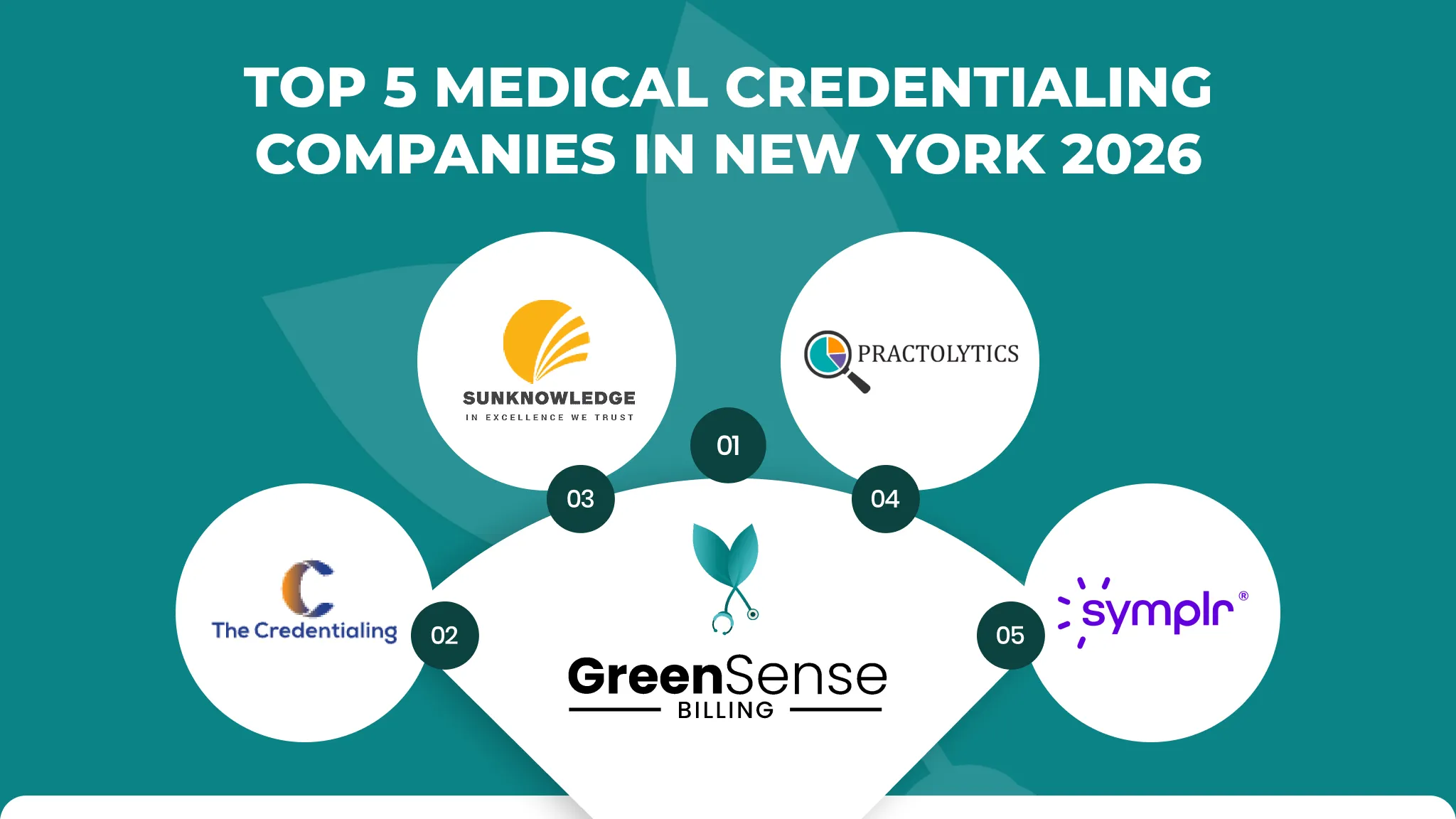
These are the medical credentialing services New York practices are most likely to shortlist. Each profile uses the same fields and only publicly documented facts.
1. GreenSense Billing (GSB)
Best for: Full-service credentialing + billing
Location: 400 S 4th St, Suite 500, Las Vegas, NV 89101. Supports providers nationwide.
Core services: Payer credentialing and enrollment, CAQH management and NPI management, payer contracting, re-credentialing, custom reporting
Payer types: Works with both government and commercial payers. Medicare and Medicaid are not named on the credentialing page.
Turnaround: Standard credentialing takes 45 to 90 days depending on payer response times. Fast-track options may be available depending on specialty and region.
Specialties: Primary care, behavioral health, PT, dental/oral surgery, cardiology, neurology, GI, urgent care, telehealth
Technology: Custom dashboards and reports to track status, expiration dates, and payer responses
Pricing: Not publicly stated. Request a quote.
Accreditation: No NCQA, URAC, or other accreditation is mentioned on the credentialing page.
Why it is included: GSB states a clear turnaround range and offers provider credentialing alongside billing, so one team can handle both. It also supports New York practices with billing. Its credentialing page lists a Las Vegas address only, so practices that want an in-state team should weigh that.
2. TheCredentialing
Best for: Practices wanting published NYC pricing and a long list of named payer partners
Location: Not stated on the pages reviewed
Core services: Provider enrollment and credentialing, revalidation and compliance, licensing, EDI/EFT enrollment, payer contracting and negotiation, exclusion management
Payer types: Names payer partners including Aetna, AARP, Amerigroup, BCBS, CareFirst, CareSource, Delta Dental, Humana, Anthem, Cigna, EmblemHealth, and UnitedHealthcare
Turnaround: The company claims NYC credentialing averages 90 to 120 days, compared with 60 to 90 nationally. This is a vendor claim, not an official state statistic.
Pricing: About $735 per provider for the initial NYC application, plus $500 or more in indirect administrative costs
Why it is included: It names a long list of payer partners and publishes a price, which helps practices budget. Its pricing is framed around New York City applications.
3. Sunknowledge Services Inc.
Best for: Practices wanting credentialing bundled with revenue cycle management and staffing
Location: Not stated on the pages reviewed
Core services: Provider credentialing bundled within broader provider and payer revenue cycle and staffing solutions
Payer types: Not itemized
Turnaround: Not publicly stated for credentialing specifically
Specialties: DME, orthotics and prosthetics, urgent care, GI, cardiology, infusion, fertility, radiology, SNF
Pricing: The company states staffing-style pricing of "$7/hour per FTE," which is not a flat credentialing fee
Why it is included: It suits practices that want one vendor for several back-office needs. Credentialing here reads as an add-on to its core billing and staffing work, not a standalone specialty, so weigh that against a dedicated firm.
4. Practolytics
Best for: Practices wanting upfront cost and timeline clarity
Location: Not stated on the pages reviewed
Core services: Credentialing, primary source verification, CAQH management, payer enrollment across 1,000+ payers, re-credentialing and license renewal tracking, hospital privileging
Payer types: 500+ commercial plans named as supported
Turnaround: The company states commercial 60 to 90 days, Medicare 30 to 45 days, Medicaid 45 to 75 days, and specialty networks 30 to 60 days
Specialties: Not specified
Pricing: $300 to $800 per network for a single provider, $1,500 to $3,500 per provider for multi-payer packages, and $100 to $300 per provider for quarterly maintenance (all company-stated)
Why it is included: It publishes separate timelines by payer type along with a full price range. Few vendors in this group share both, which makes planning easier. Its Medicare and Medicaid ranges also help set expectations for government payer enrollment.
5. symplr (symplrCVO)
Best for: Large health systems and hospitals
Location: Not stated on the pages reviewed
Core services: Primary source verification (NCQA-certified in all 11 verification areas), provider enrollment management, delegated credentialing
Payer types: Not itemized
Turnaround: Not publicly stated. A case study cites clearing a $2M enrollment backlog in 11 weeks.
Specialties: Enterprise scale, serving hospitals, health systems, and health plans
Pricing: Custom quote only
Why it is included: Its NCQA-certified verification and delegated credentialing fit hospitals and large systems. It is built for enterprise needs, so smaller practices may find the fit less direct.
How to Choose a Medical Credentialing Company in New York
Start with your own needs, then ask every vendor the same questions in the same order. Use these criteria:
- Turnaround time: Ask for a written range. Payer response times vary, so a firm that explains what it controls is more credible than one promising speed.
- Payer network breadth: Confirm it handles the payers you bill, including Medicaid and your top commercial plans.
- Specialty experience: Ask for examples in your field.
- Technology: Look for dashboards that show status and expiration dates.
- Accreditation: NCQA certification or URAC status matters most if you need verification or delegation. Among these profiles, only symplr claims NCQA certification, so ask the others directly.
- Pricing transparency: Get a written quote that lists what is included.
- Ongoing support: Renewals, revalidations, and PECOS enrollment updates continue after approval, so ask who handles them.
Also consider how credentialing connects to the rest of your revenue cycle. Gaps in enrollment can lead to rejected claims, so some practices pair credentialing with revenue cycle management and denial management so approvals and collections stay aligned.
Ready to compare? Ask each vendor for its turnaround range, payer list, and pricing in writing. The answers will show you who deserves a second call.
Final Thoughts
Choosing among the top 5 medical credentialing companies in New York comes down to fit, clarity, and follow-through. Use the comparison table, ask for written answers, and pick the partner who is open about how they work.
If you want help getting approved with payers and keeping renewals on track, explore GSB's provider credentialing services or contact GSB to talk through your payers and specialty.