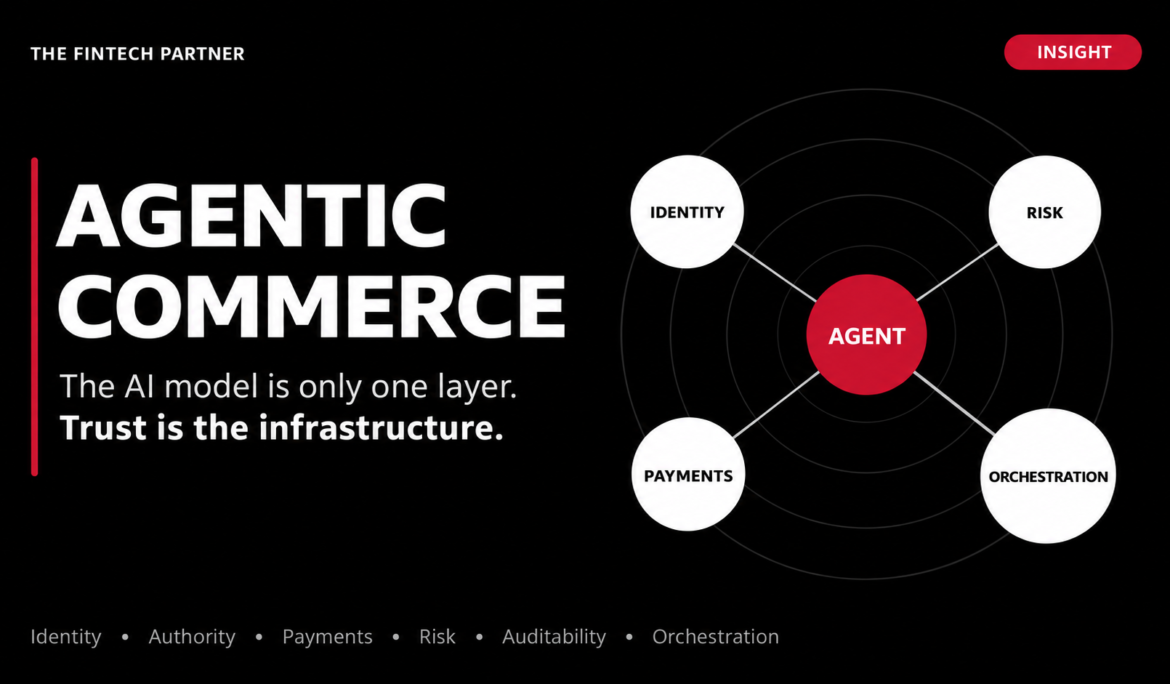
Why payments, identity, authority, risk and orchestration will matter as much as the intelligence behind the agent.
Agentic commerce depends on more than the AI model.
After more than three decades working across banking, payments and FinTech, I have watched our industry embrace several technologies that were supposed to fundamentally change commerce. Some did. Others generated enormous excitement and then became another layer of the financial infrastructure.
I believe agentic commerce has the potential to belong in the first category, but not because an AI model can recommend a product or fill a basket. The more important shift is that software is moving from advising a human to taking economic actions on a human or company’s behalf.
That transition has already started. AI systems can discover products, compare alternatives, prepare purchases and, in controlled environments, initiate transactions. The question is no longer whether agents can participate in commerce. The harder question is where we are willing to let them act, under whose authority, with which controls and with what path to recourse when something goes wrong.
That is why I think the winners in agentic commerce will not be defined by AI alone. They will be defined by how effectively they connect intelligence with trusted identity, permissioning, payment infrastructure, tokenization, fraud controls, orchestration, data and operations.
What Agentic Commerce Actually Means
Agentic commerce is commerce in which an AI agent can pursue a commercial goal across multiple steps, rather than simply answer a question. Depending on the level of autonomy, the agent may discover options, evaluate trade-offs, select a merchant or supplier, choose a payment method, execute a purchase, monitor the result and handle post-purchase tasks.
The useful distinction is not “AI versus no AI.” It is how far the agent is allowed to move from recommendation into execution:
- Agent-assisted commerce. The AI researches, compares or recommends, but the human still makes the final decision and completes the transaction.
- Agent-led commerce. The AI completes more of the journey, such as building the order, choosing between approved options or preparing a payment, while the user provides an explicit confirmation at a critical step.
- Autonomous commerce. The agent acts within a previously defined mandate, budget or policy and can execute without requiring a new human click for every individual action.
The final category is where the infrastructure challenge becomes most important. Autonomy does not eliminate human intent. It changes how that intent is represented. Instead of a person clicking “Buy” each time, the system may need to prove that an agent was authorized to spend up to a certain amount, with approved merchants, for a defined purpose, during a defined period.
Public initiatives from OpenAI and Stripe, Google, Visa and Mastercard now point in the same broad direction: the commerce stack needs common ways to represent products, permissions, payment credentials and verifiable intent when software acts on someone else’s behalf. No single protocol is guaranteed to become the universal standard, but the requirements are becoming much clearer.
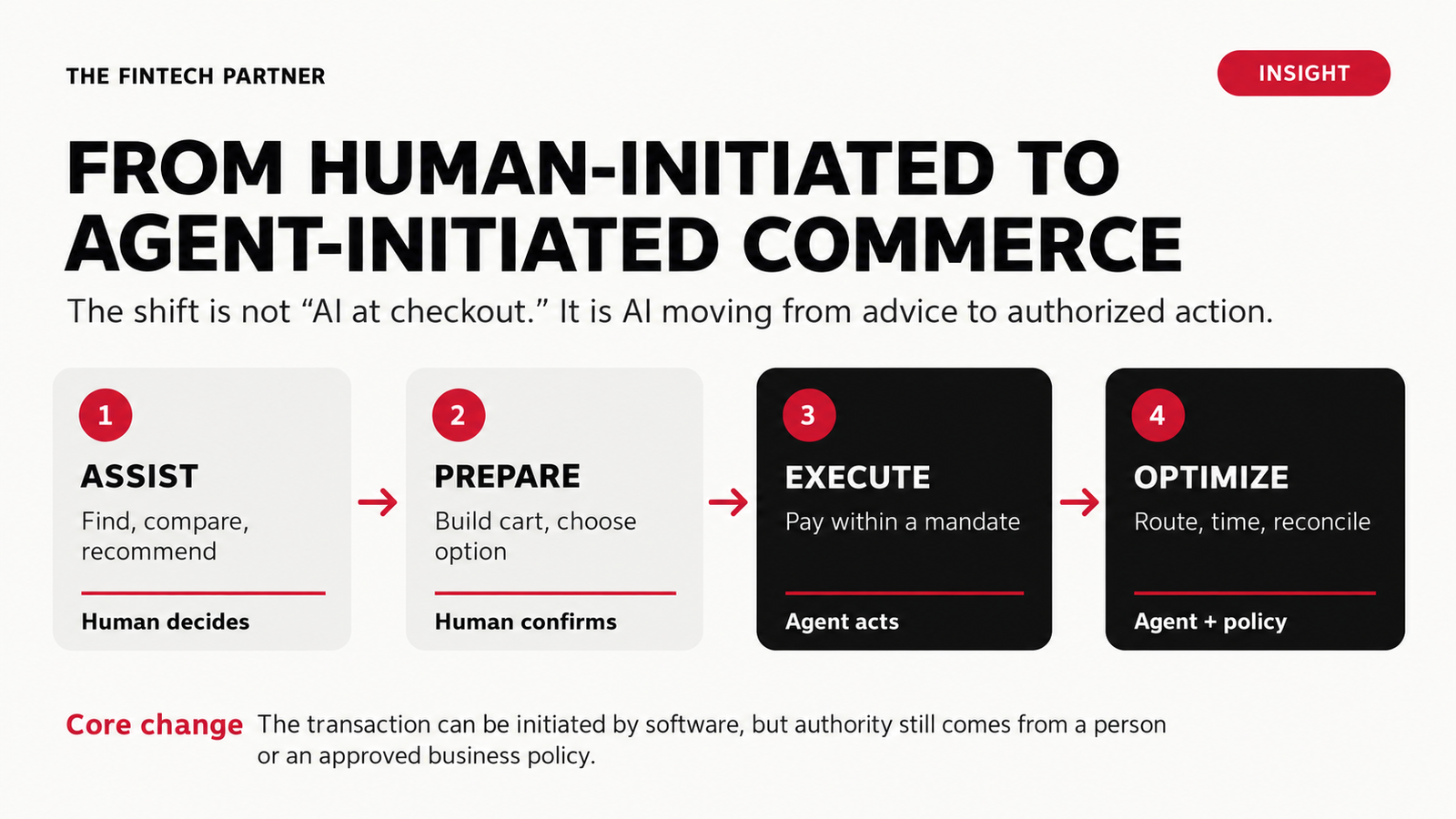
From assistance to authorized action.
From Human-Initiated Commerce to Agent-Initiated Commerce
Most payment infrastructure today still assumes that somewhere in the transaction there is a human making a discrete decision. A consumer clicks “Buy.” A finance employee approves an invoice. A merchant initiates a refund. A treasury team decides which payment rail to use.
Agentic AI begins changing that model.
Imagine an AI agent responsible for a company’s accounts payable. Instead of simply identifying an invoice due tomorrow, the agent could determine:
- When should the invoice be paid, taking into account due dates, cash position and early-payment discounts?
- Which account or source of liquidity should fund the payment?
- Should the payment move by card, ACH, real-time payment, wire or another approved method?
- Should currency be converted now or later, and through which approved provider?
- Does the transaction comply with procurement, treasury, counterparty and approval rules?
- Exception handling. If the invoice or beneficiary information looks abnormal, should the agent stop, escalate or request human review?
That moves AI from recommendation to execution. It also moves the payment from a single isolated event into a broader decision process involving cash, risk, authorization and operational policy.
In other words, the payment is not the end of the agent’s job. It is one action inside a governed workflow.
The Real Challenge Is Trust
When a human makes a payment incorrectly, financial institutions and merchants already have established ways to investigate what happened. Agent-initiated commerce needs the same confidence, but the evidence chain is different. The ecosystem must be able to reconstruct not only which credential was used, but why the agent was allowed to use it.
That creates a set of fundamental questions:
- Who, or what, is initiating the transaction? Can the merchant or financial institution distinguish a legitimate agent from an unknown bot?
- Authority and intent. What exactly did the customer or business authorize the agent to do? Was the action inside the amount, category, merchant and timing limits of that mandate?
- Authentication and credentialing. How does the agent prove it represents the customer without exposing an unrestricted payment credential?
- Liability and recourse. If the agent makes a bad decision, who is responsible, and how can the customer dispute, reverse or recover from the action?
- How do fraud systems distinguish legitimate autonomous behaviour from malicious automation, account takeover, synthetic identity or manipulated agent instructions?
- How much context should an agent share with a merchant or payment provider, and how do we minimize the data required to complete the task?
- Can the institution reconstruct the mandate, reasoning inputs, approvals, credential use, transaction result and any later exception?
AI accuracy is not the same as authorization. A model can make a logically coherent decision and still be outside the customer’s permission, a company policy or a regulatory obligation. That is why trust has to be designed into the infrastructure rather than added after the agent has already acted.
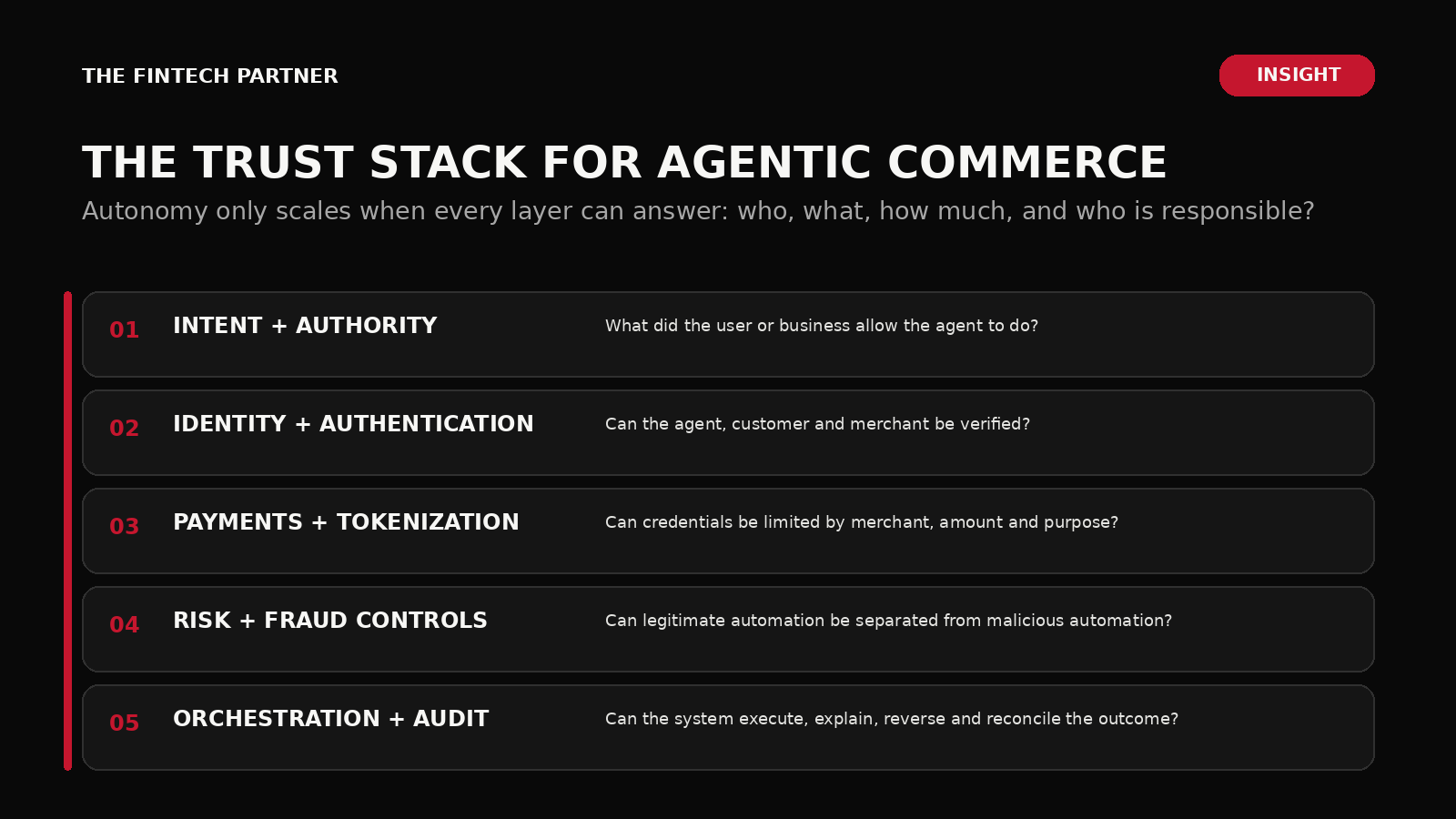
The trust stack for agentic commerce.
The Protocol Layer Is Taking Shape, But It Is Not Settled
One of the most important developments in 2025 and 2026 has been the emergence of open protocols and payment primitives designed specifically for agent-mediated commerce.
OpenAI and Stripe’s Agentic Commerce Protocol (ACP) provides a way for AI agents and businesses to complete purchases while allowing the merchant to remain the merchant of record. Google’s Universal Commerce Protocol (UCP) is designed as a common language for commerce journeys and works with the Agent Payments Protocol (AP2) for secure agentic payments.
Stripe and Tempo’s Machine Payments Protocol (MPP) focuses on internet-native payments for agents and machines. Visa’s Trusted Agent and Intelligent Commerce work addresses how merchants can identify trusted agents and support agentic transactions. Mastercard’s Verifiable Intent focuses on creating a tamper-resistant record of what the user authorized.
I would not interpret this standards activity as evidence that the market has already converged. It has not. I would interpret it as evidence that the industry is converging on the problems that have to be solved: agent identity, user intent, merchant integration, controlled credentials, interoperability and a reliable audit trail.
For payments and FinTech companies, that means protocol support may become another orchestration problem. A platform may need to connect multiple agent ecosystems, payment credentials and merchant interfaces without forcing every participant to rebuild its existing stack.
Payment Orchestration Becomes a Financial Decision Layer
Agentic commerce also changes the role of payment orchestration.
Today, orchestration platforms can route transactions across processors, acquirers and payment methods based on factors such as cost, geography, authorization performance and availability. Introduce an agent into this environment and the decision space expands considerably.
An intelligent commerce layer could evaluate several variables at once: payment method, authorization probability, processing fees, FX costs, settlement speed, liquidity requirements, merchant acceptance, fraud risk, credential restrictions, customer preferences and corporate policy.
That moves payment orchestration from simply routing a transaction toward optimizing a financial outcome.
But the word “optimizing” needs discipline. The cheapest route may not be the safest. The highest authorization probability may create a different fraud profile. The fastest settlement option may be inconsistent with liquidity or treasury objectives. An agent needs a clear objective function and deterministic boundaries around what it is allowed to trade off.
The most robust model is therefore not unlimited autonomy. It is bounded autonomy: the agent can reason and propose or execute inside explicit rules, while hard controls govern permissions, payment credentials, limits, sanctions, exceptions and human escalation.
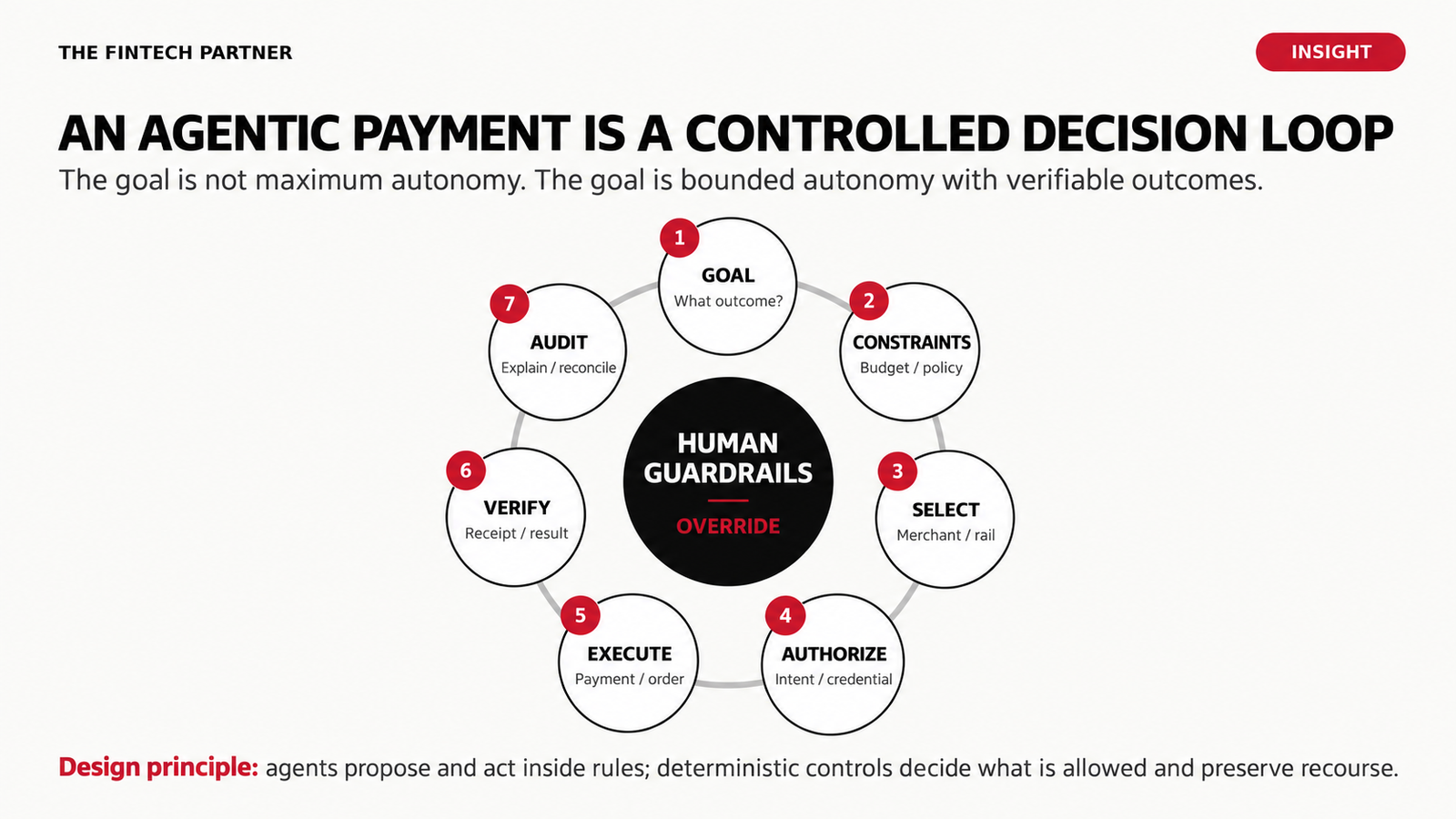
An agentic payment is a controlled decision loop.
Where Agentic Commerce Is Likely to Create Value First
Agentic commerce will not mature at the same speed in every category. The first scalable use cases are likely to be those where the goal is clear, the task repeats frequently, the data is structured and the downside can be bounded with policy.
1. Procurement and accounts payable
Agents can compare approved suppliers, validate invoices, apply purchasing rules, capture discounts, prepare or initiate payments and escalate anomalies. The economic case becomes stronger when the agent can connect procurement decisions with treasury and working-capital objectives.
2. Machine-to-machine services
Software agents increasingly consume APIs, data, cloud resources and other digital services. These environments can generate frequent, low-value transactions where a machine-native payment method and automated reconciliation may be more useful than a human checkout flow.
3. Subscriptions and recurring services
An agent can monitor usage, renewal dates, price changes and alternatives, then cancel, renegotiate or switch services within a user-defined mandate. This turns subscription management from passive billing into an active optimization problem.
4. Comparison-heavy purchases
Travel, business purchasing and other fragmented journeys require the buyer to compare price, availability, policies and trade-offs across multiple providers. Agents can compress that research process and, when authority is clear, carry the decision through to execution.
5. Merchant-side agent readiness
For merchants, the opportunity is not limited to deploying a shopping agent. It also means making products, inventory, pricing, terms, returns and fulfillment information machine-readable so third-party agents can understand the offer and complete a transaction without breaking the merchant’s operating model.
High-stakes or irreversible decisions will move more slowly. The more consequential the purchase, transfer or financial commitment, the stronger the case for explicit human confirmation, additional authentication or a narrower mandate.
Don’t Add AI. Redesign the Process.
One of the biggest mistakes I see organizations making with AI is asking: “Where can we add AI to our existing business?”
I would ask a different question: “If we designed this process today, knowing what AI can now do, would we build it the same way?”
Often, the answer is no.
The real value appears when companies redesign how decisions and handoffs work, rather than layering an agent on top of a process that was built around manual queues. For FinTech CEOs, that means looking beyond chatbots and productivity tools and examining the operating workflows that affect customer economics and risk: merchant onboarding, underwriting, fraud monitoring, treasury, payment routing, reconciliation, compliance monitoring, customer service and product configuration.
A useful design principle is to separate probabilistic reasoning from deterministic commitment. Let the agent interpret, compare, prioritize and propose. Let policy engines, ledgers, payment controls and approval rules determine what is actually allowed to happen. Then preserve the evidence needed to explain the decision later.
That architecture is less exciting than the demo, but it is much closer to what production-grade agentic finance requires.
What FinTech CEOs Should Ask Now
The practical question is not whether to “have an agentic strategy.” It is whether the organization can safely support software that acts. I would start with eight questions:
- Can we verify the parties? Do we know the customer, the agent acting for them and the merchant or counterparty receiving the transaction?
- Can we prove the mandate? Can we demonstrate what the user or company authorized, including spend limits, categories, timing and prohibited actions?
- Can we constrain the credential? Can a payment credential be tokenized or scoped so the agent cannot use it outside the intended merchant, amount, purpose or timeframe?
- Can risk models recognize legitimate agents? Do our fraud controls understand the difference between authorized automation and malicious bot behaviour?
- Can orchestration enforce policy? Can routing and payment decisions account for both economics and non-negotiable controls?
- Can we stop or reverse an action? Is there a clear path for suspension, revocation, disputes, refunds and human override?
- Can we reconstruct the decision? Do we retain enough evidence to explain the mandate, inputs, action, result and exception handling?
- Are our products and processes machine-readable? Can an agent reliably understand product data, prices, policies, eligibility rules, transaction status and post-purchase events?
If the answer to several of these is no, the organization may be able to demo an agent, but it is not yet ready to let that agent operate at a meaningful financial scale.
What This Means for Merchants and Commerce Platforms
Agentic commerce will also change what it means to be “easy to buy from.” A human-friendly website will still matter, but agents will increasingly need structured, reliable access to the same commercial facts.
- Expose accurate product and service data. Price, availability, eligibility, variants, fees and delivery expectations need to be structured and current.
- Make policies machine-readable. Returns, cancellations, warranties and usage restrictions should be clear enough for an agent to evaluate before purchase.
- Support trusted agent identification. Merchants need a way to recognize legitimate automated buyers without treating every bot as hostile traffic.
- Preserve the customer relationship. Agent-mediated checkout should not make fulfillment, service, refunds or merchant-of-record responsibilities ambiguous.
- Design the post-purchase journey. An agent may need order status, receipts, changes, cancellations and support events in a structured form after the payment is complete.
This is why merchant integration matters as much as the payment itself. An agent cannot reliably optimize a journey if the underlying commercial information is incomplete, inconsistent or inaccessible.
My Personal View
Agentic commerce will not arrive as a single product launch. It will emerge gradually as AI moves from answering questions, to making recommendations, to preparing actions, to executing within increasingly sophisticated mandates.
Human checkout will not disappear overnight, and fully autonomous purchasing will not make sense for every transaction. What will change is the number of commercial decisions that can be delegated when the user, business and financial institution have confidence in the boundaries.
The companies best positioned for that transition will not necessarily be those with the most sophisticated AI models. They will be those that can connect AI with trusted identity, verifiable authority, secure payment credentials, risk controls, orchestration, data and financial infrastructure.
After thirty-plus years in payments, one lesson continues to hold true: technology alone rarely solves the problem. The value comes from how effectively we connect technology, infrastructure, processes and people to solve it.
That principle will matter even more in the agentic economy. The model may create the intelligence, but trust will determine how much of that intelligence the financial system is prepared to let act.
Agentic Commerce FAQs
1. What is agentic commerce?
Agentic commerce is a model of buying and selling in which an AI agent can pursue a commercial goal across multiple steps. Depending on its permissions, the agent may research, compare, select, purchase, pay and manage post-purchase actions on behalf of a consumer or business.
2. Are agentic commerce and agentic payments the same thing?
No. Agentic commerce covers the broader journey from discovery and decisioning through purchase and post-purchase activity. Agentic payments are the payment and authorization mechanisms that allow an agent to move money or complete the transaction within defined permissions.
3. Can AI agents make payments today?
Yes, in controlled and increasingly real-world environments. The market is still early, but card networks, payment companies, AI platforms and protocol developers are already supporting agent-mediated transactions, controlled credentials and machine-to-machine payment flows.
4. Why does payment orchestration matter for agentic commerce?
Because an agent may need to choose not only what to buy but how to pay. Orchestration can evaluate payment rails, processors, fees, FX, authorization performance, settlement, liquidity, fraud risk and policy constraints, then select an allowed path.
5. What are the biggest risks of agentic commerce?
The central risks include unclear authority, stolen or over-permissioned credentials, malicious agents or bots, manipulated instructions, fraud, privacy leakage, poor exception handling, unclear liability and inadequate audit trails. These are infrastructure and governance problems as much as AI-model problems.
6. Will agentic commerce replace ecommerce checkout?
Not in one step. Human-led and agent-led journeys are likely to coexist. Delegation should expand first where tasks are repeatable, permissions can be bounded and the consequences of error are manageable, while high-stakes decisions retain stronger human confirmation.