Virtual medical scribe services connect trained documentation specialists to your patient visits through secure audio or video, so they can update the EHR in real time while you talk to the patient instead of the screen. You review and sign the note, and the encounter is done before your next patient walks in. Here is exactly how that works and whether it fits your practice.
What Are Virtual Medical Scribe Services?
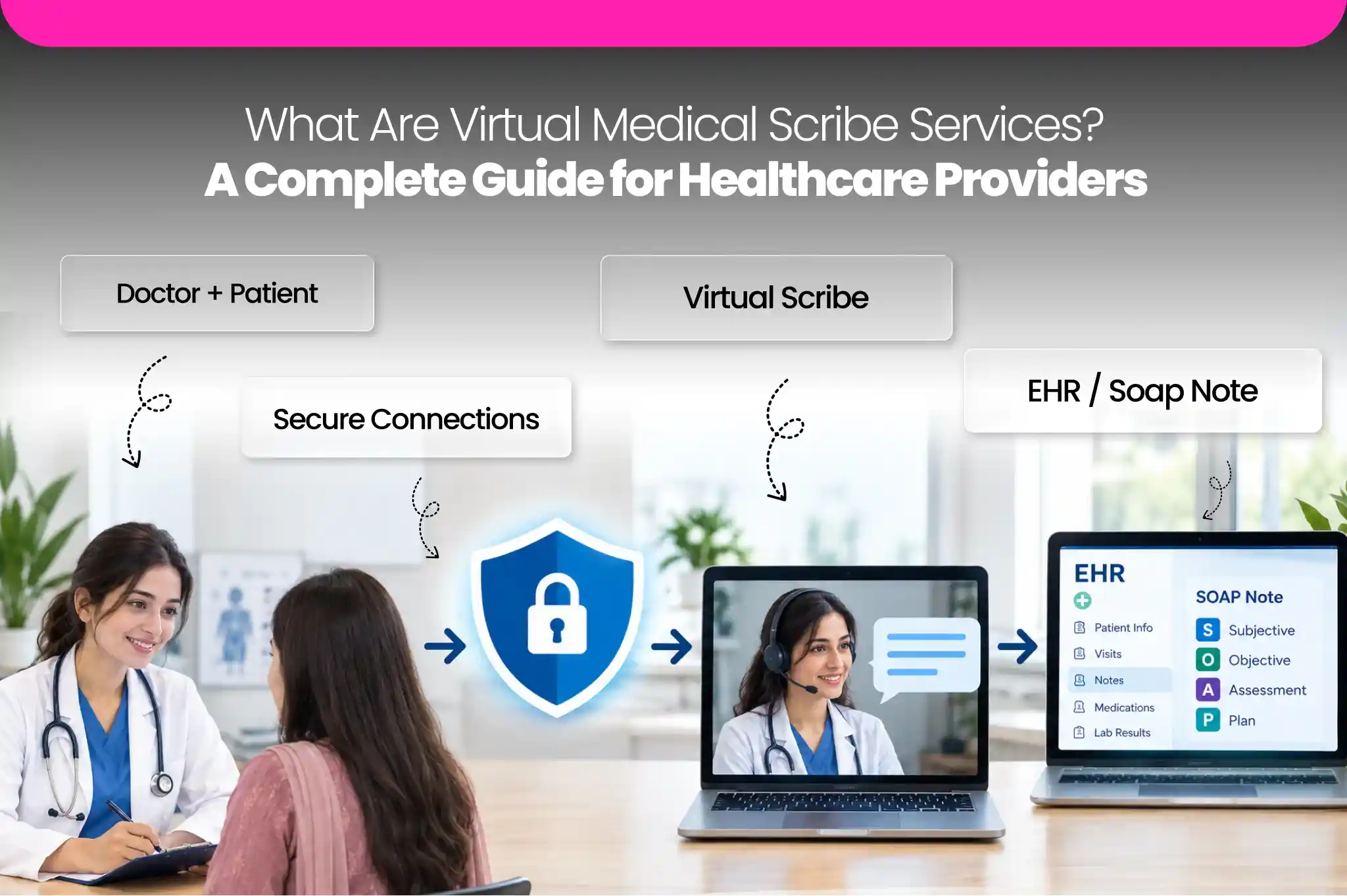
A virtual medical scribe is a trained professional who documents patient encounters remotely, listening in through a secure audio or video connection and entering notes directly into the EHR as the visit happens. The physician reviews the note afterward and signs off, closing the chart before moving to the next patient.
This is different from a few things people often confuse it with. An in-person scribe sits physically in the exam room, while a virtual scribe does the same job remotely, cutting overhead and removing one more person from the room. An AI scribe uses automated speech recognition to draft notes without a human listening live, covered in more detail below. A transcription service, meanwhile, usually works from a recording after the visit rather than documenting in real time.
How Do Virtual Medical Scribe Services Work?
The workflow behind remote medical scribe services follows a consistent structure across most providers:
- The provider connects with the scribe through a secure audio or video platform before the visit starts.
- The scribe listens to the patient encounter as it happens.
- The scribe documents directly into the EHR, covering the history of present illness, review of systems, physical exam findings, assessment, and plan.
- The scribe pends any orders and prepares the chart for the next steps.
- The provider reviews the note and signs it. The encounter is complete before the next patient arrives.
Because the documentation happens live, there is no backlog waiting at the end of the day. The chart is essentially done by the time the visit ends.
Human vs. AI vs. Hybrid: What's the Difference?
Not all scribing is the same, and the differences matter for how much time you actually save.
|
Type |
How It Works |
Best For |
Limitations |
|
Human virtual scribe |
A trained person listens live and documents in real time |
Complex visits, high documentation accuracy needs |
Higher cost than AI-only tools |
|
AI-only scribe |
Ambient software drafts notes automatically from the conversation |
Lower budget, simpler visit types |
Modest time savings; a large 2026 STAT News study of 1,800 clinicians found AI-only scribes saved just 16 minutes per 8 hours of patient care |
|
Hybrid |
AI drafts the note, then a trained human reviews and corrects it |
Practices wanting AI's cost efficiency with human accuracy |
Still requires a review step before signing |
The STAT News figure is worth sitting with. Sixteen minutes per 8-hour day is a real gain, but it is modest compared to what human virtual scribes typically deliver. If your goal is maximum time reclaimed, a human or hybrid model is the stronger fit.
What Do Virtual Medical Scribe Services Include?
Most services cover a consistent set of tasks:
- Real-time EHR documentation during the visit
- Complete SOAP note documentation
- Pending orders for the provider to finalize
- Chart preparation and pre-charting ahead of upcoming visits
- After-hours note completion for practices using an async model
- Specialty-specific documentation support, tailored to the terminology and format a given field requires
How Much Do Virtual Medical Scribe Services in USA Cost?
Virtual scribe for doctors typically costs $14,400 to $18,000 a year. Compare that to an in-person scribe, which can run up to $65,000 annually once salary, benefits, training, and office space are factored in.
Pricing models vary. Some services charge per hour, others per encounter, and many offer a flat monthly subscription. Whatever the structure, the return tends to be strong. Physicians using virtual scribes reclaim 30 minutes to 2.7 hours daily, and that time converts directly into either more patient visits or an evening that actually ends on time.
Are Virtual Medical Scribe Services HIPAA Compliant?
They need to be, and this is not optional. Any scribe service handling protected health information must operate under a signed Business Associate Agreement between your practice and the scribe or their employer. Without that agreement in place, no PHI should be shared.
Beyond the BAA, confirm the service uses secure, encrypted audio and video platforms, restricts data access to only what the scribe's role requires, and can show you their HIPAA training process. Ask these questions before signing anything, not after.
Which Specialties Benefit Most?
Documentation-heavy medical specialties often benefit the most from online medical scribe services. Emergency medicine and urgent care, for example, can use virtual medical scribes to capture real-time notes during fast-paced, high-volume shifts, helping providers stay focused on patient care. Primary care and internal medicine are also among the most common users of medical scribe services, particularly because of high patient volumes and the ongoing documentation required for chronic conditions.
Orthopedics and behavioral health can benefit from remote medical scribing as well, given the detailed examination findings, treatment plans, and session notes these specialties require. Specialty practices such as cardiology and dermatology are also adopting virtual medical scribe services to streamline clinical documentation and reduce the administrative workload for providers.
The flexibility of online medical scribing services also makes them well suited to telehealth. Providers can receive real-time documentation support during virtual appointments, ensuring patient records are updated accurately while reducing the time spent on administrative tasks—even when the consultation takes place remotely.
How to Choose a Virtual Medical Scribe Service in USA
A few criteria separate the services that deliver real results from the ones that do not:
- Human, AI, or hybrid model, matched to how much time savings and accuracy your practice actually needs
- EHR compatibility, confirmed with your specific system before signing, whether that is Epic, Cerner, Athenahealth, or another platform
- A signed HIPAA Business Associate Agreement, without exception
- Specialty experience, since a scribe trained in primary care needs ramp-up time before working confidently in orthopedics or behavioral health
- Backup coverage, so one scribe calling in sick does not stall your entire day
- A defined quality assurance process, so notes get checked for accuracy before they reach the chart
- Clear contract terms, including onboarding timeline, pricing structure, and what happens if the fit is not working
Getting these right up front saves friction later. Accurate, consistent documentation from a well-vetted scribe also supports cleaner medical coding, meaning fewer denied claims and faster reimbursement. If billing accuracy has been a recurring frustration, it is worth pairing scribe documentation with dedicated medical coding support built around that same workflow.