
If you are weighing whether to hand your billing to an outside vendor, you are not alone. Rising denial rates, staffing turnover, and the sheer complexity of payer rules have pushed more practices to look at third party medical billing companies in USA as a way to stabilize revenue without hiring and training an in-house team. Whether you are searching for a third party billing company for doctors running a solo practice or comparing medical billing outsourcing companies USA for a larger group, this guide is built to help you compare on facts, not marketing copy.
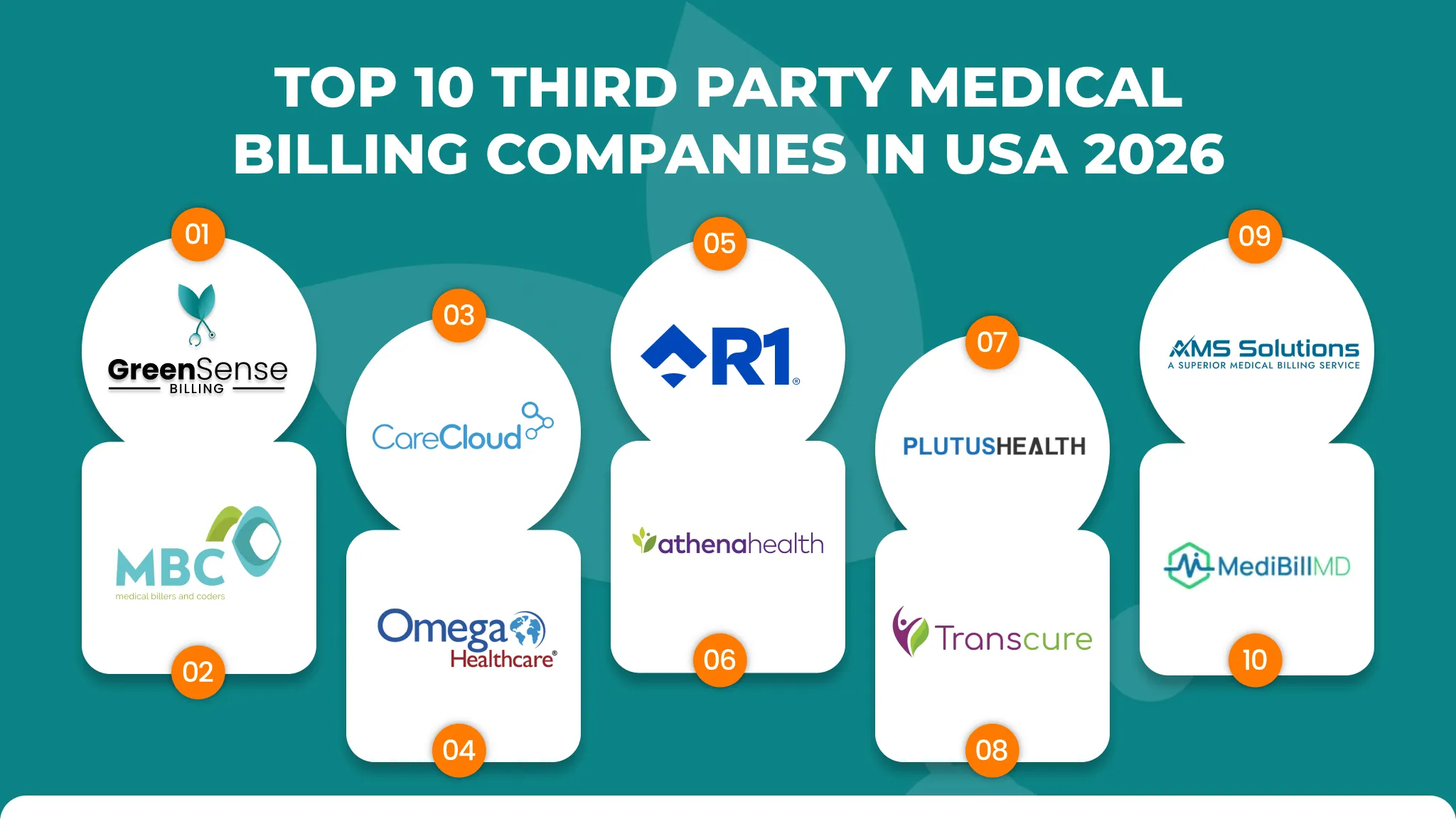
This guide compares 10 companies, including GreenSense Billing, on the same criteria: services offered, payer expertise, provider types served, pricing model, and RCM integration depth. The goal is to help you find the best third party medical billing company in USA for your practice, not to declare a single winner.
Quick Comparison Table
Best for at a glance (based on the specialty focus and evidence each company publishes, not an independent ranking):
- Best for Full-Service RCM: R1 RCM and Omega Healthcare, both offering end-to-end revenue cycle coverage at enterprise scale
- Best for Small/Solo Practices: GreenSense Billing
- Best for Large Group Practices: R1 RCM
- Best for Denial Management: Plutus Health, based on its stated denial management and AR follow-up focus
- Best for Specific Specialties: Transcure, which states coverage across more than 40 specialties
- Best Transparent Pricing: AMS Solutions, which states a flat-percentage model with no setup fees
- Best Overall: Not clearly stated; no single company in this comparison publishes evidence strong enough across every criterion to justify that label
|
Company |
Best For |
Location |
Core Services |
Payer/Network Support |
Provider Types |
Pricing Model |
Evidence/Source |
|
GreenSense Billing |
Small and mid-size practices wanting a hands-on partner |
Serving all 50 states |
Medical billing, revenue cycle management, medical coding, provider credentialing, denial management, eligibility verification |
States its team understands payer systems across the specialties it serves |
Independent providers, small to mid-size practices |
Percentage of collections, no upfront costs |
|
|
CareCloud |
Practices wanting billing bundled with EHR technology |
Somerset, NJ, serving nationwide |
End-to-end billing, eligibility, analytics, EHR and practice management |
Broad payer network through its platform |
Small practices to enterprise medical groups and health systems |
Not clearly stated |
|
|
Omega Healthcare |
Enterprise-scale RCM outsourcing |
Boca Raton, FL, global delivery |
Billing, coding, AR management, clinical documentation, healthcare analytics |
Broad payer mix across hospitals and health systems |
Health networks, physician groups, hospitals, labs, DMEs |
Not clearly stated |
|
|
R1 RCM |
Hospitals and large physician groups |
Murray, UT, offices nationwide |
End-to-end RCM, patient access, denial resolution, AI-driven automation |
States it manages a broad payer mix at enterprise scale |
Large health systems and hospital-owned or independent physician groups |
Not clearly stated |
|
|
Athenahealth |
Practices wanting billing tied to their EHR |
National |
EHR-integrated billing, claims management, revenue cycle services |
Broad commercial payer network through its platform |
Practices of varying sizes on the athenahealth platform |
Not clearly stated |
|
|
Plutus Health |
Automation-driven RCM |
Dallas, TX, serving nationally |
Coding, billing, payment posting, denial management, credentialing, AR follow-up |
Behavioral health, ASC/surgical, and free-standing ER billing |
States it works with more than 9,000 providers |
Percentage of collections |
|
|
Transcure |
Multi-specialty billing with in-house technology |
Dallas, TX and Woodbridge, NJ |
Billing, coding, denial management, credentialing, EHR integration |
States it files claims with Aetna, UnitedHealthcare, and Medicare |
Solo practices through hospitals, 40+ specialties |
Not clearly stated |
|
|
AMS Solutions |
Long-established, straightforward billing partnership |
Dallas, TX |
Billing, AR collections, credentialing, practice management |
Not clearly stated |
Solo physicians through large group practices |
Flat percentage of collections |
|
|
MediBillMD |
Small to mid-size practices |
Dallas, TX, serving nationwide |
Billing, coding, revenue cycle management, credentialing |
Not clearly stated beyond general commercial and Medicaid claim handling |
Physicians, nurse practitioners, group practices |
Not clearly stated |
|
|
Medical Billers and Coders (MBC) | Broad specialty RCM outsourcing | National | Billing, coding, denial management, credentialing | Commercial and government payers | Solo to large groups | Not clearly stated | medicalbillersandcoders.com |
Company order reflects category grouping (enterprise/national platforms first, then mid-size specialists), not a ranking. See the methodology note in the FAQ section below.
Why US Practices Are Outsourcing Medical Billing in 2026
Third party medical billing means a practice contracts an external company to handle claim submission, follow-up, denial management, and payment posting on its behalf. The practice keeps clinical control while the billing company manages the revenue cycle. It is a service arrangement, not a transfer of ownership over patient care decisions.
In-house vs. outsourced billing. In-house billing means paying salary, benefits, software, and training costs for internal staff, with more direct day-to-day control. Outsourced billing typically runs on a percentage-of-collections fee, which scales with revenue and shifts technology and staffing costs onto the vendor. Neither is automatically cheaper. The right choice depends on claim volume, specialty complexity, and how much oversight your practice wants to keep.
Common reasons practices outsource. Staff turnover, rising denial rates, increasingly complex payer rules, and the cost of maintaining billing technology in-house are frequently cited drivers. Industry reporting drawing on MGMA and HFMA survey data has noted rising denial rates and preventable billing errors as recurring pressure points for practices considering outsourcing, though exact figures vary by source and year, so confirm current numbers directly with MGMA or HFMA rather than relying on any single secondhand citation.
Percentage-based vs. flat-fee pricing. Most third party billing companies charge a percentage of collections, commonly reported in the 4 to 10 percent range depending on specialty, claim volume, and services included. Flat per-claim fees and monthly retainer models are also used. Exact rates are not standardized across the industry and should be confirmed directly with each vendor.
Full-service RCM vs. billing-only. Some companies offer end-to-end revenue cycle management, covering credentialing, eligibility verification, coding, billing, AR follow-up, and denial management. Others offer billing submission only, leaving coding, credentialing, or denial appeals to the practice. This distinction matters more than the sticker price, since a lower percentage fee on a billing-only service can cost more overall once you account for what you still have to staff internally.
HIPAA compliance and BAA. Any third party company that creates, receives, maintains, or transmits protected health information on a practice’s behalf is a business associate under HIPAA and must sign a Business Associate Agreement before handling any PHI. This requirement comes directly from federal regulation (45 CFR §§ 164.502(e) and 164.504(e)), not from vendor marketing, and it is not optional. If a billing company cannot produce a signed BAA on request, that is a disqualifying red flag, not a negotiating point.
Items not clearly documented in public sources are marked “Not clearly stated” throughout this guide rather than assumed.
GreenSense Billing
- Best for: Small and mid-size practices wanting a hands-on billing partner
- Location: Serving providers across the United States
- Core services: Medical billing, revenue cycle management, medical coding, provider credentialing, denial management, eligibility verification
- Payer expertise: States its team understands payer systems and regulations across the specialties it serves
- Provider types served: Independent providers, small to mid-size practices
- Specialties supported: States support across more than 25 medical specialties
- Pricing model: Percentage of collections, with no upfront costs stated
- RCM integration: Full-service RCM covering the core functions this guide’s comparison criteria call for, from eligibility verification through denial management
- Why it made the list: Positions itself specifically as a medical billing services for small practices partner, with a stated HIPAA-compliant, percentage-based model built for independent providers rather than enterprise health systems
Medical Billers and Coders (MBC)
- Best for: Broad specialty coverage with documented payer-specific workflows
- Location: National
- Core services: Billing, coding, denial management, provider credentialing
- Payer expertise: States experience across commercial and government payers
- Provider types served: Solo practitioners through large physician groups
- Specialties supported: Multiple specialties, including orthopedics, cardiology, and pain management
- Pricing model: Not clearly stated
- RCM integration: States it offers full-cycle RCM services rather than billing submission alone
- Why it made the list: Publishes specific, evidence-based claims about payer-level billing workflows rather than generic RCM messaging
CareCloud
- Best for: Practices wanting billing bundled with EHR and practice management technology
- Location: Somerset, New Jersey, serving practices nationwide
- Core services: End-to-end medical billing, eligibility verification, analytics, EHR, and practice management software
- Payer expertise: Broad payer network through its platform
- Provider types served: Small practices through enterprise medical groups, hospitals, and health systems
- Specialties supported: Multiple specialties across ambulatory and outpatient care
- Pricing model: Not clearly stated
- RCM integration: Full-service RCM, bundled with proprietary cloud-based software rather than offered as a standalone service
- Why it made the list: A publicly traded company (Nasdaq: CCLD) with audited financial disclosures, which gives an unusual level of independently verifiable operating detail for this category
Related reading: For practices comparing bundled software-plus-billing models against a dedicated billing partner, GreenSense Billing’s medical billing services page outlines what a billing-first engagement looks like.
Omega Healthcare
- Best for: Enterprise-scale, full-service RCM outsourcing
- Location: Boca Raton, Florida, with global delivery operations
- Core services: Billing, coding, AR management, clinical documentation, healthcare analytics
- Payer expertise: States it serves a broad payer mix across hospitals, health systems, and insurance providers
- Provider types served: Health networks, ambulatory and urgent care centers, physicians, home health agencies, dental clinics, DMEs, and laboratories
- Specialties supported: Not clearly stated beyond broad multi-vertical healthcare coverage
- Pricing model: Not clearly stated
- RCM integration: Full-service RCM spanning the entire patient access to collections cycle
- Why it made the list: Named a “Leader” in Everest Group’s RCM Operations PEAK Matrix Assessment for multiple consecutive years, a third-party industry evaluation rather than a self-reported claim
R1 RCM
- Best for: Hospitals, health systems, and large physician groups
- Location: Headquartered in Murray, Utah, with offices nationwide
- Core services: End-to-end RCM, patient access, denial resolution, AI-driven automation
- Payer expertise: States it manages revenue cycle operations at enterprise scale across a broad payer mix
- Provider types served: Large health systems and hospital-owned or independent physician groups
- Specialties supported: Enterprise-wide, not specialty-specific
- Pricing model: Not clearly stated
- RCM integration: Full-service RCM, including AI-assisted denial resolution through its proprietary platform
- Why it made the list: A large, publicly documented enterprise RCM vendor with a stated multibillion-dollar managed revenue base across hospital and health system clients
Athenahealth
- Best for: Practices already using or considering athenahealth’s EHR platform
- Location: National
- Core services: EHR-integrated billing, claims management, revenue cycle services
- Payer expertise: Broad commercial payer network through its platform
- Provider types served: Practices of varying sizes on the athenahealth ecosystem
- Specialties supported: Multiple specialties supported through platform-based workflows
- Pricing model: Not clearly stated
- RCM integration: Billing is delivered as part of an integrated EHR and practice management platform rather than a standalone add-on
- Why it made the list: A nationally established, platform-based option for practices that want billing tied directly to their EHR rather than layered on top of it Coordinating a third-party biller with your existing EHR can create gaps if denial resolution ownership is not clearly assigned. GreenSense Billing’s denial management services page addresses how that handoff is typically structured.
Plutus Health
- Best for: Automation-heavy, technology-driven RCM
- Location: Dallas, Texas, serving nationally
- Core services: Coding, billing, payment posting, denial management, credentialing, prior authorizations, AR follow-up
- Payer expertise: Behavioral health, ASC/surgical, and free-standing ER billing
- Provider types served: States it works with more than 9,000 providers
- Specialties supported: Behavioral health, ASC/surgical, free-standing emergency room
- Pricing model: Percentage of collections
- RCM integration: Full-service RCM built around a named proprietary automation platform
- Why it made the list: Headquartered with a documented, named automation platform and a stated outcome-based commercial model
Transcure
- Best for: Multi-specialty practices wanting in-house billing technology
- Location: Dallas, Texas and Woodbridge, New Jersey
- Core services: Billing, coding, denial management, credentialing, EHR integration
- Payer expertise: States it files claims with Aetna, UnitedHealthcare, and Medicare
- Provider types served: Solo practices through hospitals
- Specialties supported: States more than 40 specialties
- Pricing model: Not clearly stated
- RCM integration: Full-service RCM with proprietary technology and EHR integration
- Why it made the list: Maintains documented offices and publishes specific claim-filing and AR-day figures on its own site
AMS Solutions
- Best for: A long-established, straightforward billing partnership
- Location: Dallas, Texas
- Core services: Billing, AR collections, credentialing, practice management
- Payer expertise: Not clearly stated
- Provider types served: Solo physicians through large group practices
- Specialties supported: States around 28 specialties, including anesthesia, plastic surgery, and pediatrics
- Pricing model: Flat percentage of collections, with no stated setup fee
- RCM integration: Full-service billing and practice management, not limited to claim submission
- Why it made the list: One of the longest-operating billing companies in this comparison, founded in 1986, with a stated transparent pricing model
MediBillMD
- Best for: Small to mid-size practices
- Location: Dallas, Texas, serving practices nationwide
- Core services: Billing, coding, revenue cycle management, credentialing
- Payer expertise: Not clearly stated beyond general commercial and Medicaid claim handling
- Provider types served: Physicians, nurse practitioners, group practices
- Specialties supported: States coverage across dozens of specialties
- Pricing model: Not clearly stated
- RCM integration: Full-service RCM, combining billing with credentialing and coding
- Why it made the list: Founded in 2023 with a stated focus on serving practices as a trusted nationwide billing partner
In-House vs. Outsourced Billing: A Quick Comparison
|
Factor |
In-House Billing |
Outsourced Billing |
|
Staffing burden |
Requires hiring, training, and retaining billing staff |
Handled by the billing partner’s team |
|
Denial management |
Depends on internal team’s payer-specific expertise |
Often backed by dedicated denial teams |
|
Cost structure |
Fixed salary, benefits, and software costs |
Often percentage-of-collections, scaling with revenue |
|
Technology access |
Requires the practice to license and maintain billing software |
Vendor typically provides its own technology stack |
|
Scalability |
Harder to scale quickly with practice growth |
Easier to scale as claim volume changes |
|
Oversight |
Direct, day-to-day control |
Requires trust in vendor reporting and transparency |
How to Choose a Third Party Medical Billing Company
Not every outsource medical billing company is structured the same way, and the right fit depends on your practice’s size, specialty, and how much of the revenue cycle you want to hand off. Before signing with any partner, check these criteria:
- Full-service vs. billing-only. Confirm exactly which functions are included: coding, credentialing, eligibility verification, AR follow-up, and denial management are not automatically bundled.
- Payer coverage. Ask which commercial and government payers the company has documented claim experience with, not just a general list of names.
- Specialty experience. A medical billing and coding company strong in behavioral health may not be the right fit for a surgical or multi-specialty practice. Good third party medical billing services for physicians should mean documented experience in your specific specialty, not a general claim of broad coverage.
- Pricing model. Percentage-of-collections, flat fee, or hybrid models each carry different incentives; compare total cost, not just the headline percentage.
- HIPAA and BAA. Confirm the vendor will sign a Business Associate Agreement before you share any patient data. Treat refusal or hesitation here as disqualifying.
- Denial management capability. Ask how denials are triaged, appealed, and tracked back to root cause, not just resubmitted.
- AR follow-up. Confirm how aggressively aged claims are pursued and at what point they are written off.
- Reporting and transparency. You should be able to see claim status and collections in something close to real time, not just a monthly summary.
- EHR compatibility. Confirm the billing company works with your existing practice management system.
- Contract terms. Look for clarity on month-to-month versus annual commitments, setup fees, and termination clauses.
If your practice is weighing whether your current billing setup is holding you back, GreenSense Billings revenue cycle management services page outlines what a full revenue cycle management company engagement typically covers, so you can compare it against what you have in place now.