
A virtual assistant for medical billing reduces claim denials by taking on the front-end and follow-up tasks behind most avoidable denials: eligibility checks, authorizations, claim status follow-up and denial queues. Fewer denials, faster cash, no full-time hire.
Every practice has a stack of denied claims somewhere. Some sit in a payer portal waiting to be looked at. Others were fixed once, resubmitted, and denied again. Many of them were preventable.
A missing authorization, an outdated insurance card or a typo in a member ID is rarely a clinical or coding problem. It is a workflow problem, and workflow problems are exactly where extra hands help.
A trained VA does not replace your billing team or make coding decisions. The VA takes on the repetitive, time-sensitive tasks that keep slipping when your staff is stretched. Done consistently, that work helps you reduce claim denials and speed up revenue cycle performance without adding a full-time hire.
If you want the basics first, our guide on what a medical billing virtual assistant is covers the definition and scope.
Key Takeaways
- Many avoidable denials start at the front end, in registration, eligibility and authorization.
- Consistent follow-up protects timely filing and keeps open claims from going stale.
- A VA adds capacity. Coding and appeal decisions stay with your billing team.
- Track denial rate and days in AR to see whether the work is paying off.
Why do claims get denied?
Most denials trace back to the front end, not the clinic room. Registration errors, lapsed coverage, missing authorizations and late filing cause the bulk of them. Industry groups such as HFMA and MGMA publish denial benchmarks each year, and the figures change, so check the latest edition before quoting one.
These are the claim denial reasons billing teams see most often:
- Registration errors, such as misspelled names, wrong dates of birth, incorrect member IDs or missing secondary insurance.
- Coverage that was inactive or changed on the date of service.
- Services that needed prior authorization or a referral that was never obtained.
- Claims filed after the payer's timely filing window closed.
- Duplicate submissions or claims that were never a clean claim to begin with.
- Medical necessity or documentation questions raised by the payer.
Notice how many of these happen before a claim is ever built. That is why the front end deserves so much attention.
What is the difference between a denial and a rejection?
A rejection happens when a claim fails basic edits, usually at the clearinghouse or payer intake, and never enters adjudication. A denial happens after the payer has processed the claim and decided not to pay it as billed. Rejections are fixed and resubmitted; denials are worked, and sometimes appealed.
- Denial
- A processed claim the payer has declined to pay as billed. Denials are worked, and sometimes appealed.
- Rejection
- A claim that fails basic edits at the clearinghouse or payer intake and never enters adjudication. Rejections are fixed and resubmitted.
- Clean claim
- A claim paid correctly on the first submission, without rework.
- CARC / RARC
- Claim Adjustment Reason Codes and Remittance Advice Remark Codes. They explain why a payer adjusted or denied a line, and the standard code list is maintained by X12.
- Days in AR
- The average number of days it takes to collect payment after a service.
- First-pass resolution rate
- The share of claims paid correctly on the first submission without rework.
What tasks does a billing VA take over?
A billing VA takes the repetitive, time-sensitive work that slips when staff are stretched: eligibility checks, authorizations, claim status follow-up and denial queues. Each task is operational and repeatable, so it can be written into a checklist, handed off cleanly and measured against your denial rate and days in AR.
Here is a direct map from each common cause to the specific task that prevents or fixes it:
| Common denial cause | VA task that addresses it | Where it happens |
|---|---|---|
| Registration errors (names, IDs, DOB) | Review demographics against the insurance card and flag mismatches before the visit | Front end |
| Inactive or changed coverage | Run eligibility verification and document benefits ahead of the appointment | Front end |
| Missing prior authorization | Identify services that need approval, submit requests, track status and log reference numbers | Front end |
| Missing referral | Confirm referral requirements and request them from the referring office | Front end |
| Claim errors caught late | Support claim scrubbing by checking claims against a payer-specific checklist before release | Mid cycle |
| Timely filing risk | Run aging reports and flag unbilled or unsubmitted items before deadlines | Mid cycle |
| Claims stuck without a response | Check claim status in payer portals on a set schedule and log outcomes | Back end |
| Denied claims waiting in a queue | Sort denials by reason, gather records, prepare the work for the billing lead and resubmit corrected claims once approved | Back end |
The pattern here matters. Each task is operational and repeatable, and each one can be written into a checklist. That is what makes this kind of support easy to hand off and easy to measure. These denial prevention tasks are not glamorous, but they are where a large share of avoidable write-offs begin.
Can a VA handle prior authorizations?
Yes, within clear limits. A VA can check which procedures need approval, gather the supporting documents your clinical staff prepared, submit the request through the payer portal and follow up until a decision arrives. What a VA must not do is judge medical necessity; that stays with your providers.
An eligibility verification VA typically checks coverage ahead of scheduled visits. That means confirming the plan is active, noting the deductible and copay, checking whether the patient has secondary coverage, and recording what the payer said. When your front desk is busy checking in patients, this is the first task to get skipped. Handing it to a dedicated person makes it routine. Many practices pair this with a Medical Virtual Assistant who can also handle scheduling support and patient intake follow-up, so the same person catches problems from the first call.
A good front-end routine includes:
- Confirming insurance details at scheduling and again before the visit.
- Verifying benefits and documenting the source of the information.
- Flagging any service that needs authorization or a referral.
- Tracking pending authorizations and escalating those close to the appointment date.
- Updating the patient record so billing starts with accurate data.
Should a VA handle eligibility before every visit?
For most practices, yes, at least for new patients, patients with plan changes and high-cost services. Established patients with stable coverage usually need only a periodic check. Let your payer mix guide the frequency, and verify benefits again before the visit when anything has changed.
Back-end tasks: claim status, AR follow-up and denial work queues
Front-end work lowers the volume of denials. Back-end work deals with the ones that still happen and keeps money from aging in your accounts receivable.
An AR follow-up virtual assistant works through open claims on a set schedule. That includes checking claim status in payer portals, noting the response, calling payers when a portal gives no useful answer, and logging every contact so the next person does not start from scratch. Consistent follow-up also protects timely filing. Medicare, for example, generally requires claims to be filed within one calendar year of the date of service, as described in the CMS Medicare Claims Processing Manual. Commercial payers set their own limits, and many are much shorter, so tracking each payer's window is part of the job.
Denial work queues are where the speed up revenue cycle goal gets real. A VA can sort denied claims by reason, pull the CARC/RARC codes from the remittance, and group similar denials so your team can fix patterns instead of individual claims. Once a denial is categorized, the VA can gather the records the billing lead needs, prepare corrected claims for review and track the resubmission until the payer responds.
If collections work is a bigger priority for you, a dedicated Collections Virtual Assistant focuses on exactly this kind of AR follow-up, including aged balances and patient statements. You can also compare providers in our list of the Top 10 Virtual Collections Specialist Companies in the USA.
Where the VA's role stops
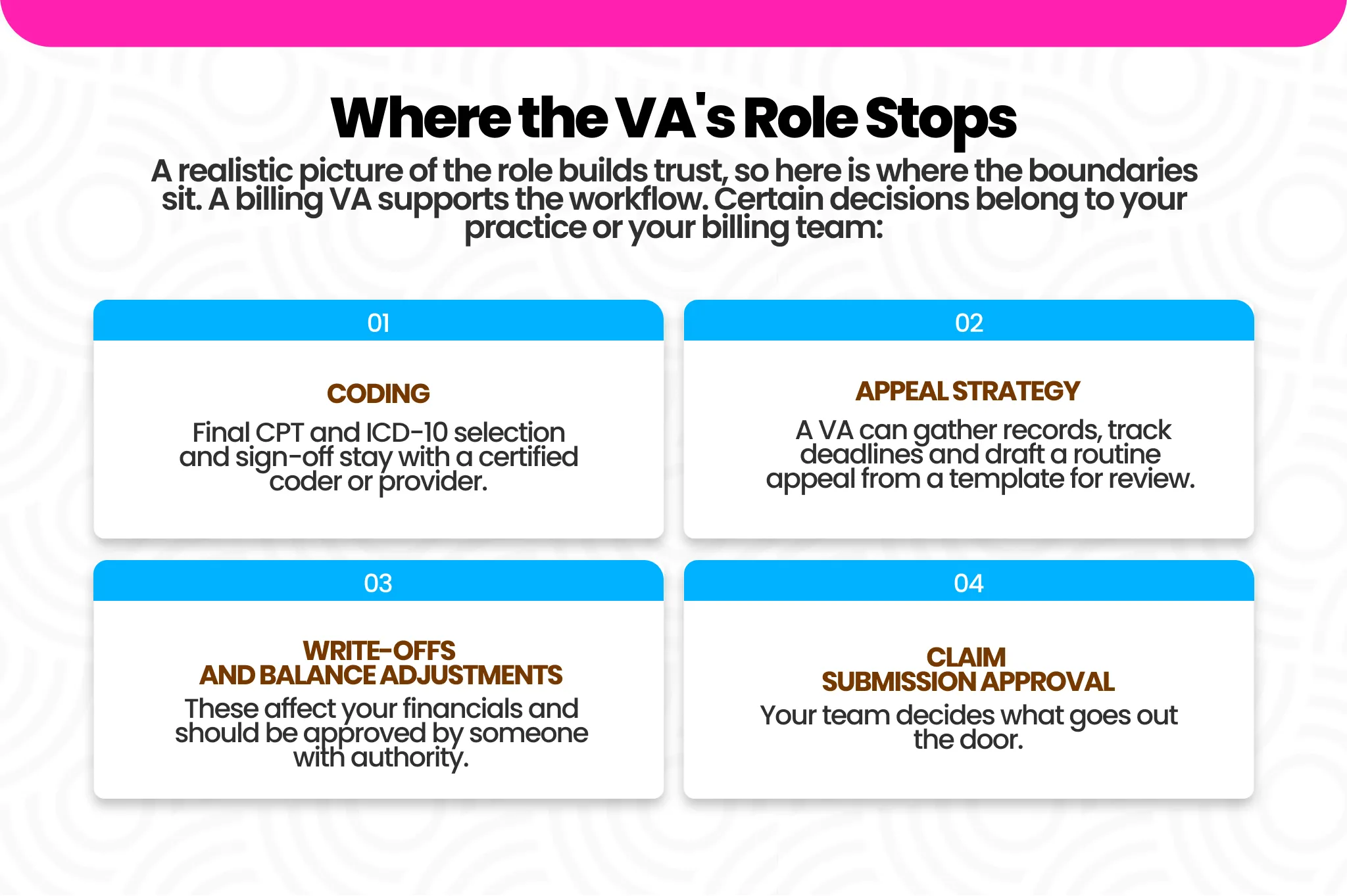
A realistic picture of the role builds trust, so here is where the boundaries sit. A billing VA supports the workflow. Certain decisions belong to your practice or your billing team:
- Coding. Final CPT and ICD-10 selection and sign-off stay with a certified coder or provider.
- Appeal strategy. A VA can gather records, track deadlines and draft a routine appeal from a template for review. Deciding whether to appeal, and on what argument, is a billing lead or provider decision.
- Write-offs and balance adjustments. These affect your financials and should be approved by someone with authority.
- Claim submission approval. Your team decides what goes out the door.
Can a VA write appeals?
A VA can gather the supporting records, track appeal deadlines and prepare a draft from an approved template for your team to review. Deciding whether to appeal, and on what argument, stays with your billing lead or provider, who also signs off on the final letter.
Setting these lines clearly at the start also helps you stay on the right side of compliance, since any VA handling patient information needs proper HIPAA safeguards in place.
If you are weighing this against hiring in-house or outsourcing to a billing company, our upcoming cost comparison post (Blog 4 in this series) breaks down how each option stacks up.
What KPIs measure revenue cycle speed?
Days in AR and AR over 90 days are the most direct measures of revenue cycle speed. First-pass resolution rate shows how much rework is slowing you down. Track all four KPIs from a starting month, record each number and compare after a quarter to see where to point your VA next.
A VA is an investment, so you should be able to see what it changes. Track a small set of numbers before you start and review them monthly. Do not rely on a promised percentage from anyone. Your own baseline is the only benchmark that matters at the beginning, and any outside figure should come from a named, dated source such as an HFMA or MGMA report.
| KPI | What it means | Why it matters |
|---|---|---|
| Denial rate | The share of submitted claims that a payer denies, usually counted by claim count or by dollar value | Shows whether front-end fixes are working |
| First-pass resolution rate | The share of claims paid correctly on the first submission without rework | Shows how many claims are a clean claim from the start |
| Days in AR | The average number of days it takes to collect payment after a service | Shows how quickly cash comes in |
| AR over 90 days | The portion of open receivables that is older than 90 days | Highlights stalled claims that need follow-up |
Pick a starting month, record each number, and compare after a quarter. If the denial rate is falling but days in AR are not, your problem may sit in back-end follow-up. If days in AR improves but the denial rate stays flat, front-end tasks need more attention. The KPIs tell you where to point your VA next.
Ready to build your denial prevention workflow?
If your team is buried in follow-up and denials keep repeating, a dedicated assistant may be the practical fix. You can learn more about our Medical Virtual Assistant support for front-end tasks, or explore our Collections Virtual Assistant for AR follow-up.
FAQs
Can a VA write appeals?
A VA can gather the supporting records, track appeal deadlines and prepare a draft from an approved template. Your billing lead or provider decides whether to appeal and signs off on the final letter.
How quickly will denial rates change?
There is no fixed timeline, and anyone who promises one is guessing. Front-end changes tend to show up in your denial rate once newly checked visits reach adjudication, while AR metrics may take longer to move. Record a baseline and review monthly to see your own trend.
Does a VA need payer portal access?
For eligibility checks, claim status and authorization tracking, yes. Access should be set up with individual logins where the payer allows it, limited to what the role needs, and covered by HIPAA safeguards and a business associate agreement where required.
What is the difference between a denial and a rejection?
A rejection fails basic edits and never gets processed. A denial is a processed claim the payer declined to pay as billed. Rejections are corrected and resubmitted, while denials are worked or appealed.
Final thoughts
Most practices do not have a denial problem so much as a consistency problem. The tasks that prevent denials are well known, but they take steady attention that busy teams struggle to give. A virtual assistant for medical billing gives you that attention at the points where it counts: before the visit, before the deadline and after the denial. Combined with clear boundaries and a short list of KPIs, it is a practical way to reduce claim denials and speed up revenue cycle results without changing how your team makes its core billing decisions.
To start, talk to Virtual Mojoe about a Medical Virtual Assistant or a Collections Virtual Assistant for your practice.
Also Read
Sources
- CMS, Medicare Claims Processing Manual (timely filing and claim requirements): cms.gov/medicare/regulations-guidance/manuals/internet-only-manuals-ioms
- X12, Claim Adjustment Reason Codes: x12.org/codes/claim-adjustment-reason-codes
- HFMA and MGMA publish denial benchmarks each year; check the latest edition before quoting any figure.