
When coders encounter chart entries for severe episodic headaches, selecting the right code requires analyzing specific clinical qualifiers. The G43.909 ICD-10 code represents an unspecified migraine condition that lacks detailed clinical qualifiers like aura, intractable status, or status migrainosus.
According to the official CMS and CDC ICD-10-CM release, the official G43.909 description reads: "Migraine, unspecified, not intractable, without status migrainosus."
Quick answer: G43.909 is a billable default code for a migraine documented without aura, intractability, or status migrainosus. If the record specifies aura, chronicity, or treatment-resistant status, use the higher-specificity G43 code instead — and never use R51.9 (headache, unspecified) when a migraine is documented.
What Does G43.909 Mean?
The code category G43 covers a wide spectrum of migraine disorders. Code G43.909 serves as a specific billable diagnosis code within this category when a physician documents a migraine but leaves certain clinical attributes unspecified.
This code contains three important clinical qualifiers that define its exact scope:
- Unspecified Type: The provider did not specify whether the migraine is with or without aura, or another distinct sub-type.
- Not Intractable: The migraine is not documented as pharmacologically refractory or treatment-resistant.
- Without Status Migrainosus: The attack is not documented as a debilitating migraine attack lasting over 72 hours.
| Field | Detail |
|---|---|
| ICD-10-CM Code | G43.909 |
| Official Label | Migraine, unspecified, not intractable, without status migrainosus |
| Category & Section | G43 (Migraine) / Diseases of the Nervous System (G00–G99) |
| Code Status | Billable / Specific HIPAA code |
| Applicable Release | Current Fiscal Year ICD-10-CM Guidelines |
| Claim-Use Caveat | Represents a default non-intractable code without status migrainosus; does not establish chronicity or intractable status by itself. |
G43.909 vs Related Migraine and Headache Codes
Selecting the wrong code during clinical billing can lead to claim denials or requests for additional medical records. It is important to distinguish this code from related migraine entries, as outlined in official references like the AAPC G43.909 Code Guide.
| Code | Diagnosis / Qualifier | Required Documentation | Selection Caution |
|---|---|---|---|
| G43.909 | Unspecified migraine, not intractable, without status migrainosus | Migraine documented without specifying aura, intractability, or status | Default code when detail is missing; avoid if specifics are documented. |
| G43.901 | Unspecified migraine, intractable, with status migrainosus | Migraine documented as treatment-resistant AND lasting over 72 hours | Requires provider documentation of both intractability and status. |
| G43.919 | Unspecified migraine, not intractable, with status migrainosus | Migraine not treatment-resistant, but documented as lasting over 72 hours | Do not assign if the episode resolves within normal timeframes. |
| R51.9 | Headache, unspecified | Generic facial or head pain without a diagnosed migraine clinical origin | Excludes true migraine diagnoses; do not use if migraine is confirmed. |
Documentation Needed for Code Selection
To select the most accurate diagnosis code, coders must audit the medical chart for six key elements:
- Migraine vs General Headache: Verify the provider documented "migraine" rather than a non-migrainous tension or cluster headache.
- Presence of Aura: Look for sensory, visual, or speech disturbances preceding the headache.
- Chronicity: Check if the condition occurs 15 or more days per month for more than three months (chronic) or sporadically (episodic).
- Intractability: Check if the physician documented the condition as intractable, treatment-refractory, or pharmacologically non-responsive.
- Status Migrainosus: Look for explicit notes indicating a severe, continuous attack exceeding 72 hours.
- Treatment Response: Do not infer intractability solely because a patient received abortive IV medications in an emergency setting; it must be stated by the provider.
Acute, Chronic and Unspecified Migraine
A common question among coders is whether G43.909 is acute or chronic. The code itself represents an unspecified presentation that defaults to a non-intractable, non-status condition. It does not automatically establish a chronic migraine diagnosis.
When a physician documents an acute attack of a recurring migraine without detailing the aura or refractory status, G43.909 is frequently assigned. However, if the medical record explicitly specifies "chronic migraine without aura" (G43.709) or "chronic migraine with aura" (G43.E09), coders must assign those higher-specificity codes instead.
Two Illustrative Documentation Scenarios
Scenario A: Standard Unspecified Record (Hypothetical)
A patient presents to an urgent care facility reporting a throbbing, unilateral headache with light sensitivity. The provider performs an examination, rules out secondary causes, and documents: "Assessment: Acute migraine episode. Patient given oral abortive medication with partial relief."
- Primary Coding: G43.909 (Migraine, unspecified, not intractable, without status migrainosus)
- Rationale: The record specifies a migraine without documenting aura, intractability, or status migrainosus.
Scenario B: Detailed Record Requiring Specific Code (Hypothetical)
A patient visits a neurologist with a history of recurrent headaches preceded by visual flashing lights. The note states: "Classic migraine with aura, non-responsive to standard sumatriptan."
- Coding Action: Query or assign G43.119 (Migraine with aura, intractable, without status migrainosus) instead of G43.909.
- Rationale: The provider explicitly documented visual aura and lack of treatment response (intractable status).
Common Errors and Checklist
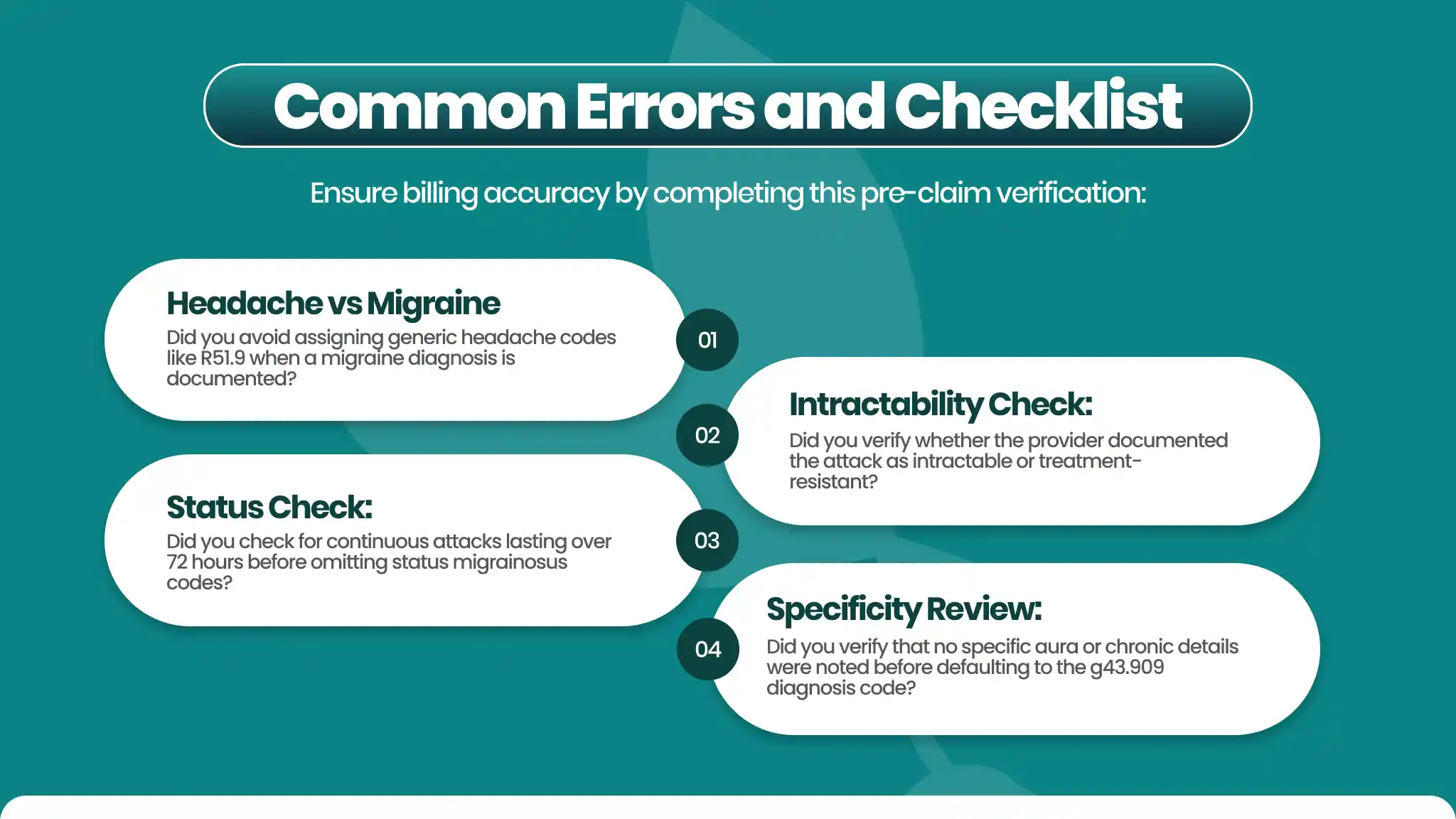
Ensure billing accuracy by completing this pre-claim verification:
- Headache vs Migraine: Did you avoid assigning generic headache codes like R51.9 when a migraine diagnosis is documented?
- Intractability Check: Did you verify whether the provider documented the attack as intractable or treatment-resistant?
- Status Check: Did you check for continuous attacks lasting over 72 hours before omitting status migrainosus codes?
- Specificity Review: Did you verify that no specific aura or chronic details were noted before defaulting to the G43.909 diagnosis code?
Also read
Coding Support and Documentation Review
Maintaining compliance across complex neurological documentation requires thorough chart audits. Need help reviewing migraine documentation and coding? Explore specialized coding support services at GreenSense Billing to optimize revenue cycle accuracy.