
Dementia care is complex, and the coding is not much simpler. Between severity levels, behavioral symptoms, and risk adjustment rules, even experienced coders pause before selecting a dementia code.
This guide covers F03.90 ICD-10, when it applies and how to document and bill it with confidence.
What Is F03.90?
F03.90 is the code for unspecified dementia, unspecified severity, without behavioral disturbance, psychotic disturbance, mood disturbance, or anxiety. People searching for the unspecified dementia ICD-10 code will usually land here.
It applies when a provider documents dementia but does not identify the type or the severity and the patient shows no behavioral or psychological symptoms at that encounter. Dementia is a form of neurocognitive disorder and the code reflects ongoing cognitive decline and memory loss without more detail.
F03.90 vs F03.91
The F03.90 vs F03.91 distinction centers on symptoms. F03.90 reports no behavioral disturbance. F03.91 reports unspecified dementia with behavioral disturbance.
Behavioral disturbance covers things like behavioral disturbance (agitation, wandering, psychosis). The ICD-10-CM code set separates these into more precise options using F03.91 and 5th-character specifiers. For example, a sixth character can show agitation or other behavioral disturbance, while other subcategories cover psychotic, mood, and anxiety symptoms. Severity also has its own options, such as mild, moderate and severe.
The pattern is simple: the more the provider documents, the more specific the code can be. Wandering, when documented, can also be reported with an additional code, since it is not captured inside the dementia code itself.
Dementia ICD-10 Codes List
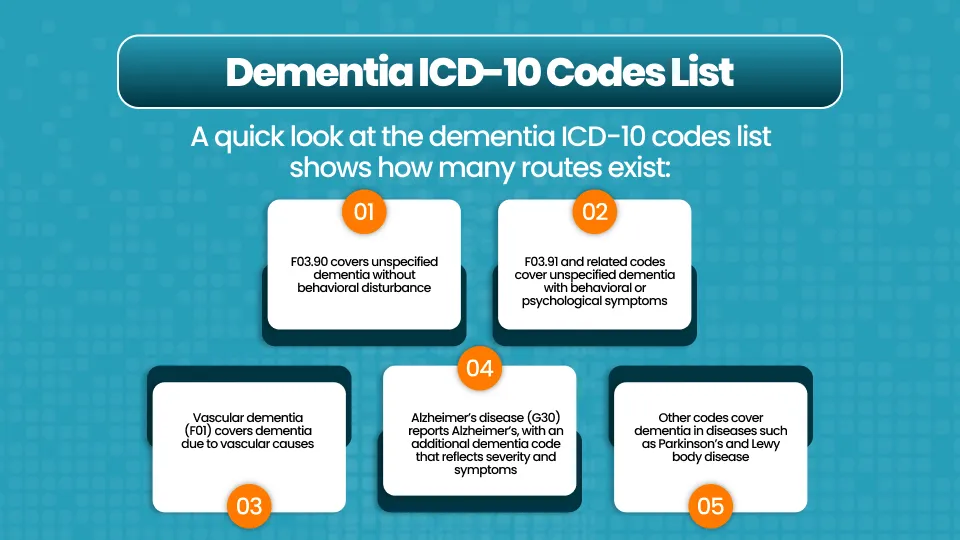
A quick look at the dementia ICD-10 codes list shows how many routes exist:
- F03.90 covers unspecified dementia without behavioral disturbance
- F03.91 and related codes cover unspecified dementia with behavioral or psychological symptoms
- Vascular dementia (F01) covers dementia due to vascular causes
- Alzheimer’s disease (G30) reports Alzheimer’s, with an additional dementia code that reflects severity and symptoms
- Other codes cover dementia in diseases such as Parkinson’s and Lewy body disease
When the type is documented, the specific code should replace the unspecified one. Using F03.90 when the chart names Alzheimer’s or vascular dementia understates the diagnosis.
F03.90 Billing and Documentation
Strong F03.90 billing and documentation begins with the note. Providers should record:
- The dementia diagnosis, in clear terms
- The type, if known, such as Alzheimer’s or vascular
- The severity, if assessed
- Whether behavioral or psychological symptoms are present
- Cognitive testing results and functional status
- The plan of care, including medications, safety measures, and follow-up
Caregiver documentation adds value here. Family members and care staff often notice changes that never appear in a short visit. When their observations are recorded, such as new wandering or sleep disruption, coders can choose a more accurate code.
Dementia Coding Compliance
Dementia coding compliance is not only about picking the right code. It is also about avoiding assumptions. Coders should never assign a type or severity unless the provider documents it. They should also avoid reporting dementia from a problem list alone, without evidence it was evaluated or managed at that visit.
Payers and auditors review dementia diagnoses closely because they affect reimbursement.
A few steps help:
- Audit samples of dementia claims regularly
- Educate providers on specificity
- Use queries when documentation is unclear
- Keep an updated reference for annual code changes
Risk Adjustment and HCC
F03.90 risk adjustment HCC is a common search, and for good reason. Dementia diagnoses can map to a category in HCC risk adjustment models, which influence payments for certain Medicare Advantage plans. Which category applies, and whether a specific code maps at all, depends on the model version in use, so confirm against the current mapping.
What stays constant is the need for accurate, supported documentation. The diagnosis must be evaluated and recorded at a face-to-face encounter within the required period, and the note should show how the condition affects care. Over coding creates compliance risk, and under coding leaves care underfunded. Neither is a good outcome.
Billing in Long-Term Care Settings
Memory care and long-term care billing brings its own challenges. Residents often have multiple conditions, frequent care changes, and several providers contributing to the record. Clear communication between facility staff and billing teams keeps diagnoses consistent across claims.
For dementia care billing more broadly, practices should confirm that services match the documented diagnosis, whether that is a cognitive assessment, care planning, or a routine follow-up. Reviewing denials by diagnosis often reveals where documentation falls short.
Frequently Asked Questions
What does F03.90 mean?
F03.90 is the ICD-10-CM code for unspecified dementia, unspecified severity, without behavioral disturbance, psychotic disturbance, mood disturbance, or anxiety.What is the difference between F03.90 and F03.91?
F03.90 reports no behavioral disturbance, while F03.91 reports dementia with behavioral disturbance, such as agitation.When should I use a more specific dementia code?
Use one whenever the provider documents the type, severity, or specific symptoms, such as Alzheimer’s disease or vascular dementia.Does F03.90 affect risk adjustment?
It can map to an HCC category depending on the model version, so confirm the current mapping and document the diagnosis at a qualifying visit.How do I code wandering in a patient with dementia?
Report the dementia code and add a separate code for wandering when the provider documents it.Conclusion
F03.90 is a fair starting point when dementia is documented without detail, but it should rarely stay the final answer. Better notes lead to better codes and better codes protect both patient care and compliance.
If your team wants to strengthen dementia documentation or review risk adjustment accuracy, a focused audit is a good first step. Contact a coding or billing specialist to get started.