The California Official Medical Fee Schedule sits at the center of nearly every workers’ compensation payment a provider receives in the state. Also known as the California OMFS, it sets the maximum reasonable fee that payers follow for most treatment of work-related injuries.
That means the amount on your claim is rarely the amount that gets paid. For practices, this gap shapes cash flow, appeals, and follow-up workload. Understanding how the fee schedule affects OMFS medical billing helps teams code correctly, expect adjustments, and protect revenue. This guide explains what the OMFS is, how it works and how to bill against it with fewer surprises.
What Is California’s Official Medical Fee Schedule (OMFS)?
The California Official Medical Fee Schedule (OMFS) is the set of rules and maximum payment amounts that governs what employers and insurers pay for medical services in California workers’ compensation. It is the state’s official California workers’ compensation fee schedule.
The Division of Workers’ Compensation (DWC), the state agency that oversees the workers’ comp system, administers the OMFS. Its legal basis is Labor Code section 5307.1, which directs the administrative director to adopt the schedule and, for many categories, align it with Medicare payment systems.
Each category has its own Official Medical Fee Schedule billing rules, so providers and billing teams need to know which section applies before a claim goes out. You can review the schedule on the California DWC OMFS page.
How Does OMFS Affect Workers’ Compensation Medical Billing?
Think of the fee schedule as a ceiling. Whatever charge appears on a bill, the payer’s obligation is generally tied to the maximum reasonable fee for that service under the applicable section. Billed charges are not automatically payable.
Medical codes drive the outcome. Each procedure, supply, or service code maps to a payment methodology, so a wrong code can change the California medical reimbursement rates applied or trigger a denial. Modifiers matter too, because they can adjust, reduce, or support separate payment for a service. Documentation has to support every code and modifier billed. When it does not, payers may reduce or deny lines, and the provider is left to dispute the difference.
This is why billed and paid amounts often differ. The gap usually reflects fee schedule limits, bundling edits, and medical claim adjustments, not necessarily an error. Accurate California workers’ comp reimbursement starts with billing correctly against the schedule from the first submission.
Which Medical Services Are Covered Under California OMFS?
The OMFS is not a single table. It is a collection of fee schedules, each with its own methodology and ground rules:
- Physician and non-physician practitioner services, based on the physician fee schedule
- Inpatient hospital reimbursement
- Hospital outpatient departments, under the hospital outpatient fee schedule
- Ambulatory surgical centers (ASC)
- Pharmaceuticals
- Pathology and clinical laboratory services
- Durable medical equipment reimbursement, along with prosthetics, orthotics, and supplies
- Ambulance services
Because the methodologies differ, a rule that works for an office visit may not apply to a hospital outpatient claim or a piece of equipment. Always confirm the correct section first.
How Is the OMFS Reimbursement Amount Determined?
Several factors can shape the final amount, and which ones apply depends on the category:
- Procedure or service code: the starting point for any payment lookup.
- Relative value units (RVUs): used where the physician methodology applies.
- Conversion factors: turn relative values into dollar amounts.
- Geographic adjustments: reflect regional cost differences.
- Facility or non-facility setting: where the service was performed can change the payable amount.
- Modifiers and ground rules: adjust or limit payment under the schedule.
Not every OMFS category uses the physician RVU formula. Hospital, pharmacy, laboratory, and equipment sections follow their own approaches. The schedule also changes often. In 2026, DWC adopted quarterly Medicare-based updates to the physician fee schedule, and facility-side pricing moves on a similar clock. Using an outdated reference is one of the easiest ways to misjudge expected payment, so confirm effective dates for every date of service. asprcmsolutions
Common OMFS Billing Challenges for Healthcare Providers
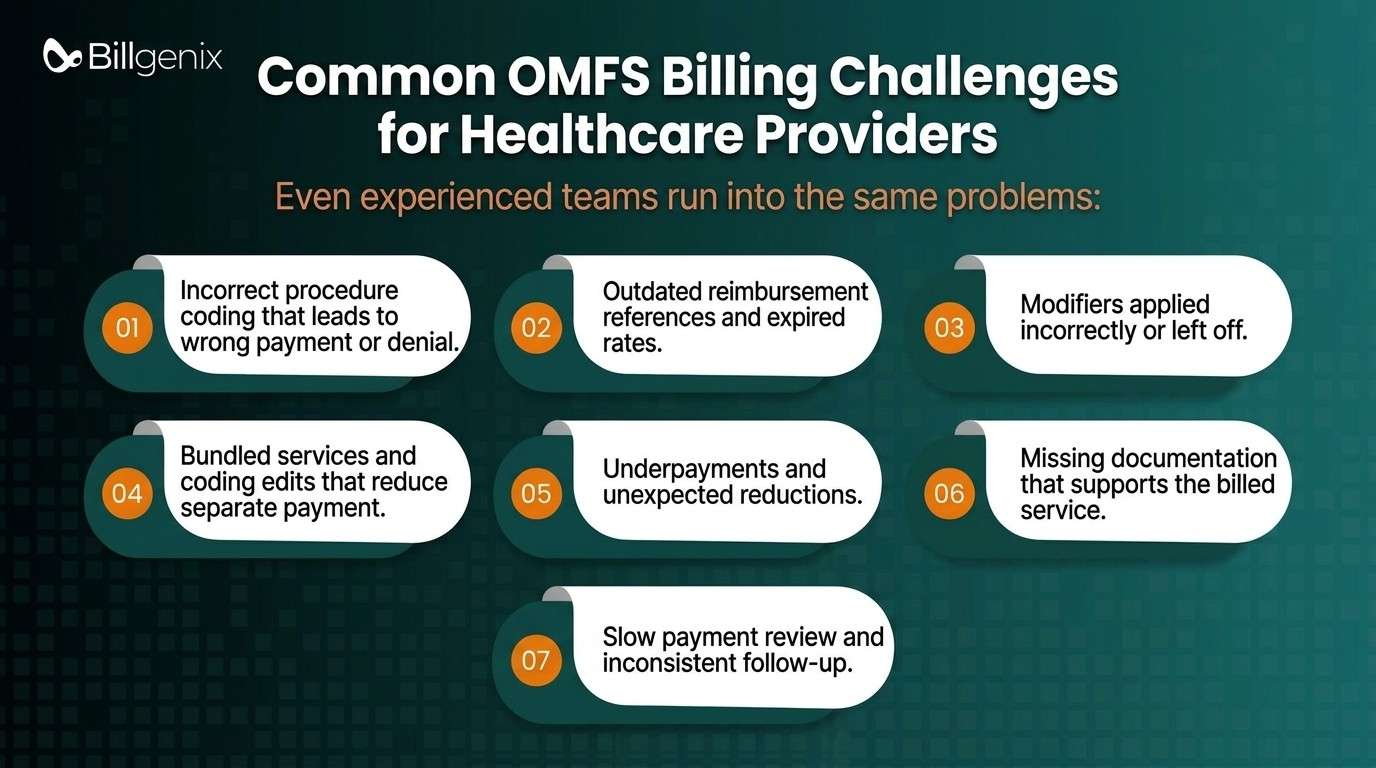
Even experienced teams run into the same problems:
- Incorrect procedure coding that leads to wrong payment or denial
- Outdated reimbursement references and expired rates
- Modifiers applied incorrectly or left off
- Bundled services and coding edits that reduce separate payment
- Underpayments and unexpected reductions
- Missing documentation that supports the billed service
- Slow payment review and inconsistent follow-up
None of these are rare. Together they quietly erode collections, especially when small underpayments go unchallenged. The DWC’s Medical Billing and Payment Guide is a useful reference for understanding how bills should be submitted and how payers are expected to respond.
How Can Providers Improve OMFS Billing Accuracy?
Accuracy improves when the process is consistent:
- Verify which fee schedule section applies to the service.
- Use current coding and reimbursement references for the date of service.
- Review modifiers and documentation before submission.
- Monitor payment adjustments and explanations on every remittance.
- Investigate underpayments instead of writing them off.
- Keep an organized denial and follow-up process with clear owners.
Many practices find this difficult to sustain in house. That is where specialized workers’ compensation billing services help. Billgenix supports California providers with workers’ compensation billing services built around fee schedule rules, along with medical billing services, denial management services, and revenue cycle management services. Strong revenue cycle management turns fee schedule knowledge into cleaner claims, faster follow-up, and more predictable payment.
Frequently Asked Questions
What does OMFS stand for in California workers’ compensation?
OMFS stands for Official Medical Fee Schedule. It is the set of maximum reimbursement rules for medical services in California workers’ compensation.Who establishes California’s Official Medical Fee Schedule?
The Division of Workers’ Compensation, through its administrative director, adopts and updates the schedule under Labor Code section 5307.1.Does OMFS apply to all workers’ compensation medical services?
It covers many categories, including physician, hospital, outpatient, laboratory, pharmacy, equipment, and ambulance services. Each category has its own methodology and rules.Why is the amount paid sometimes lower than the billed charge?
Payment is generally limited to the maximum reasonable fee under the schedule. Bundling edits, modifiers, and adjustments can also reduce the amount.How can medical billing teams improve OMFS reimbursement accuracy?
Use current references, code and modify carefully, keep documentation complete, review every adjustment and follow up on underpayments consistently.Conclusion
Understanding the OMFS helps providers bill with confidence. Accurate coding, current references and attention to California-specific rules reduce avoidable adjustments and delays. No billing approach can guarantee payment, but a disciplined process gives your claims the best chance of being paid correctly. To strengthen your workers’ compensation billing, schedule a demo with Billgenix and see how our team can support your revenue cycle.