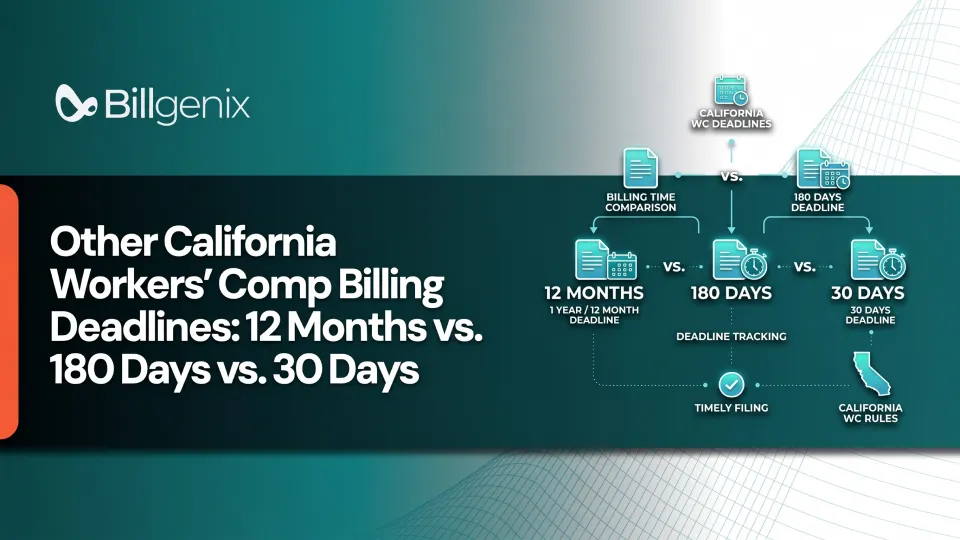
California workers' comp billing deadlines come in three sizes, and they are not interchangeable. The general rule gives providers 12 months to submit a covered medical treatment bill. A shorter 30-day period applies to specified services exempt from prospective utilization review, and a 180-day period applies to emergency services rendered in a general acute care hospital. Which one governs a bill depends on the type of service and the statutory provision behind it.
That is why the first step is never calculating a date. It is identifying the category. A team that applies the 12-month rule to everything will eventually miss a 30-day bill, and a team that grabs the 180-day period whenever a bill feels urgent will eventually miss a deadline it was not entitled to.
The key takeaway is simple. The 12-month period is the general rule for covered medical treatment bills, while the 30-day and 180-day periods apply to specified categories under California Labor Code 4610. This guide shows how to tell them apart, how to track them, and how to keep the evidence you will need if timeliness is ever questioned.
The three deadlines at a glance
This table is an overview, not a substitute for reviewing the applicable statutory provisions.
Deadline | General application | Trigger date | Key caution |
12 months | Covered medical treatment services under Labor Code 4603.2 | Date of service; date of discharge for inpatient facility services | General rule for covered services, not a universal rule for every bill |
30 days | Specified services exempt from prospective review under Labor Code 4610(b) | Date of service | Confirm that the service qualifies under the statutory provision |
180 days | Emergency services rendered in a general acute care hospital under Labor Code 4610(d)(2) | Date of service | Do not automatically apply to every emergency-related or hospital bill |
Understanding California Workers' Compensation Bill Submission Deadlines
Why California has multiple filing deadlines
Different kinds of care move through the workers' compensation system in different ways. Some services are subject to prospective review before they happen, while others are exempt from that review and emergency hospital care raises its own practical issues. The Legislature built separate time limits into the statutes to reflect those differences.
How the service type affects the deadline
The workers' compensation bill submission deadline follows the service category, not the provider's preference or the date the bill was created. Before you set any date, ask what kind of service was provided, where and under which statutory provision it is billed.
Why a billing deadline is different from a payment deadline
This article focuses on the deadline for providers to submit medical treatment bills. It does not cover the claims administrator's deadline to pay, review or dispute a bill once it is submitted. Those timelines are separate and a later section explains how.
The 12-Month Workers' Comp Billing Deadline
What California Labor Code 4603.2 says
The 12-month workers' comp billing deadline is found in California Labor Code 4603.2. For covered services provided on or after January 1, 2017, the request for payment, with an itemization of services and the charge for each, generally must be submitted within 12 months. The statute says a request for payment is barred unless it is timely submitted, subject to the applicable law and any valid exception.
How the service date determines the filing period
For most outpatient and professional services, the 12 months run from the date of service. A visit on March 10, 2026, starts the period that day. The date you coded the chart or entered the bill into your system does not move the starting point.
How the rule applies to inpatient facility bills
For inpatient facility services, the period runs from the date of discharge rather than the admission date. Using the wrong date for a facility bill is a common and avoidable mistake.
What happens if a bill is submitted late
A late bill can be barred, and a payer may deny it on that basis. The statute does refer to exceptions, but a billing team should investigate whether one might apply rather than assume a late bill will be accepted. Our articles on the 12-month workers' compensation billing window and good-cause exceptions to the billing deadline explain the general rule and the legal uncertainty around exceptions in detail.
The 30-Day Billing Deadline for Specified Services
The 30-day medical billing deadline California providers sometimes face is the one most likely to catch teams off guard, because it is much shorter than the general rule.
Which services are covered by Labor Code 4610(d)(1)?
The 30-day deadline applies to bills for services that are exempt from prospective review under the specified provision of Labor Code 4610(b). It is tied to that category, not to every bill.
Understanding services exempt from prospective review
Prospective review is the process in which a request for certain treatment is evaluated before the care is provided. Some services are exempt from that process. Those exempt services are the ones that fall under the 30-day billing rule. Because the list of exempt services depends on the statute and its implementing rules, do not assume a service is exempt without checking the actual provision.
Do not turn this into a rule that every workers' compensation bill must be filed within 30 days of the injury or the service. It is not.
How to flag these bills before the deadline
The safest approach is to categorize each bill when it is created. Add a field for the deadline category, set a short internal target for any bill that may be exempt from prospective review, and have someone confirm the category before the bill moves on. Verify the service category and the applicable statutory language before assigning the deadline.
Common errors when applying the 12-month rule
The typical mistakes are assuming that 12 months applies by default, failing to ask whether a service is exempt from prospective review, and relying on a default deadline that was set when the bill was created. Each of these can quietly turn a 30-day bill into a missed one.
The 180-Day Deadline for Emergency Hospital Services
The 180-day workers' comp billing deadline is narrower than it sounds. It is not a general allowance for urgent or emergency-related bills.
What emergency services qualify under the statute?
The 180-day period applies to emergency services rendered in a general acute care hospital under Labor Code 4610(d)(2). The statute defines the category, so check the precise language rather than relying on a general sense of what counts as an emergency.
The general acute care hospital requirement
The provision is tied to a particular kind of facility. An emergency service delivered somewhere else, such as an urgent care center, does not automatically qualify. Confirm the facility category before you rely on the longer period.
How to distinguish qualifying emergency services from other bills
Avoid assuming that all emergency-related services, urgent care visits or hospital bills automatically qualify. A hospital can also bill for services that are not emergency services, and those may fall under the general 12-month rule. Review the specific service and facility before choosing the deadline.
What documentation billing teams should retain
Keep records that show the nature of the service, the facility type, the dates of service or discharge, and how the bill was categorized. If you later need to show why you used the 180-day period, those records are what support the decision.
12 Months vs. 180 Days vs. 30 Days: Key Differences
Compare the trigger date and service category
All three periods generally begin with the date of service, with the main exception being inpatient facility bills under the general rule, which begin at discharge. What really separates the three is the service category.
Identify the rule before calculating the deadline
The order of operations matters. Identify the category first, then the trigger date, then do the math. Starting with the longest period and working backward is how mistakes happen. Never assume the longest period applies when the service category is uncertain. If you cannot tell which rule governs, treat that as a reason to investigate, and err on the side of the shorter timeline while you confirm.
Use a deadline matrix to reduce errors
A matrix, like the table near the top of this article, gives staff a quick reference. Adapt it for your office and pair it with a requirement that someone confirms the category on every bill.
How to Calculate and Track a Workers' Comp Billing Deadline
A repeatable process supports California medical billing compliance better than good intentions.
Confirm the service date or inpatient discharge date
Verify the date against the clinical record. For inpatient facility bills, use the discharge date.
Verify the correct statutory category
Determine whether the bill falls under the general rule or a specified category, and record the answer.
Set an internal deadline before the legal deadline
Choose a cutoff well before the legal limit so a rejection or a missing document does not push you past it.
Track submission and receipt evidence
Keep the records that show when a bill was sent and whether it was received. For a deeper look at what counts, see our guide to proof of timely billing submission and receipt. Good proof of timely bill submission includes timestamps, confirmations, tracking information and payer acknowledgments.
Escalate incomplete bills and rejected submissions
Set a rule for when a stuck bill goes to a supervisor. Record every bill, its service date, the applicable deadline, the submission date, proof of receipt and any corrections or resubmissions.
A practical deadline checklist
Use this list for each bill.
- Confirm the service category. Determine whether the bill falls under the general rule or a specified statutory category.
- Verify the correct trigger date. Use the service date or, for covered inpatient facility bills, the discharge date.
- Calculate the applicable deadline. Apply the correct statutory period and verify how the deadline is calculated.
- Review bill completeness. Check itemization, required reports, provider details and other applicable documentation.
- Submit before the internal cutoff. Set a buffer before the legal deadline to allow corrections or transmission issues.
- Save proof of submission and receipt. Keep confirmations, timestamps, tracking information and any payer acknowledgments.
- Monitor responses and exceptions. Follow up on rejections, incomplete bills, disputes or potential deadline issues.
Submission Deadlines vs. Payer Payment Deadlines
The paper medical treatment bill payment timeline
The deadline to submit a bill is not the same as the payer's deadline to pay or respond. DWC describes separate timelines for payment of complete medical treatment bills. For paper bills, one of those is a 45-day period.
The electronic billing payment timeline
For specified uncontested electronic bills, DWC describes a period of 15 working days. Different rules and exceptions may apply, so confirm the current requirements in the DWC resources before relying on either figure. Our article on California workers' compensation billing deadlines looks at these timelines alongside the filing rules.
When incomplete or contested bills require follow-up
If a bill is incomplete or contested, the payment clock may not work the way you expect. Follow up promptly, keep a record of every communication, and track the payer's response against the applicable rules. Our guide to California workers' compensation billing provides additional background on the full billing cycle.
Common Billing Deadline Mistakes to Avoid
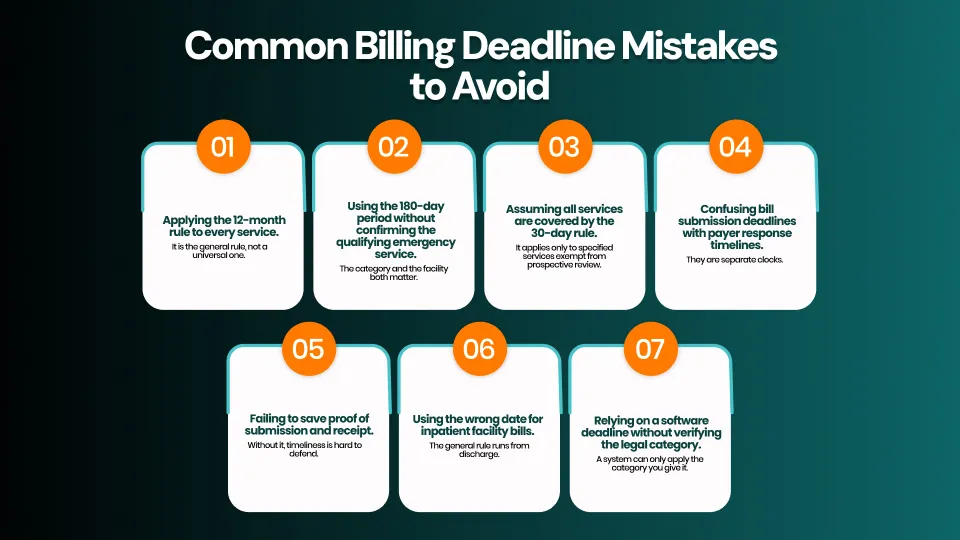
- Applying the 12-month rule to every service. It is the general rule, not a universal one.
- Using the 180-day period without confirming the qualifying emergency service. The category and the facility both matter.
- Assuming all services are covered by the 30-day rule. It applies only to specified services exempt from prospective review.
- Confusing bill submission deadlines with payer response timelines. They are separate clocks.
- Failing to save proof of submission and receipt. Without it, timeliness is hard to defend.
- Using the wrong date for inpatient facility bills. The general rule runs from discharge.
- Relying on a software deadline without verifying the legal category. A system can only apply the category you give it.
How Billing Software Can Support Deadline Management
Spreadsheets can work for a small practice, but they get fragile as volume grows. When evaluating workers' compensation billing software, look for workflow capabilities such as the ones below. These are things to evaluate, not claims about any particular product.
Categorizing bills by service type
A system that lets staff tag each bill with its service and deadline category makes it harder for a default to slip through.
Tracking service and discharge dates
Central records for service dates and discharge dates reduce the chance of a wrong trigger date.
Setting deadline alerts and escalation rules
Alerts and escalation rules can help staff act before a deadline passes, especially for the shorter periods.
Preserving submission evidence and audit history
A clear audit history gives you something concrete to point to if a payer questions whether a bill was timely.
Software supports your process, but it cannot decide the legal category for you.
Frequently Asked Questions
Is the California workers' comp billing deadline always 12 months?
No. Twelve months is the general rule for covered medical treatment bills under Labor Code 4603.2, but 30-day and 180-day periods apply to specified categories under Labor Code 4610. Identify the service category before setting a deadline, and confirm the applicable statutory language.
Which workers' compensation bills have a 30-day deadline?
The 30-day deadline applies to bills for specified services exempt from prospective review under Labor Code 4610(b), as provided in 4610(d)(1). It is not a rule for every bill. Confirm that the service qualifies under the statutory provision before assigning this deadline.
Which emergency services have a 180-day deadline?
The 180-day deadline applies to emergency services rendered in a general acute care hospital under Labor Code 4610(d)(2). It does not automatically cover every emergency-related service, urgent care visit or hospital bill, so verify the service and facility category before relying on it.
Does the 12-month deadline for inpatient bills run from the service date or discharge date?
For inpatient facility services, the general 12-month period runs from the date of discharge. For other covered services, it runs from the date of service. Record the correct date at intake, and confirm any other applicable requirements for the bill.
Are bill submission deadlines the same as payment deadlines?
No. Submission deadlines govern when a provider must submit a bill. Payment timelines govern when a claims administrator must pay or respond, and DWC describes separate periods, such as 45 days for complete paper bills and 15 working days for specified uncontested electronic bills. Exceptions may apply.
What should a billing team do if a deadline may have been missed?
Act quickly. Confirm the correct category and trigger date, gather the submission and acknowledgment records, and submit or correct the bill where appropriate. Do not assume a late bill will be accepted, and ask a qualified California workers' compensation professional to review deadline-sensitive cases.
Build a More Reliable California Workers' Comp Billing Workflow
The most useful habit is also the simplest: verify the service category early, keep a deadline log, and preserve your submission records. When your team decides the category before the date, the rest of the process gets easier. If you are building out the rest of your process, our guide to medical-legal billing deadlines covers a different set of rules that should never be confused with these.
Stay Ahead of California Workers' Comp Billing Deadlines
Reduce deadline confusion by building a consistent workflow for service-date tracking, bill documentation, submission follow-up, and billing exception management. Explore whether BillGenix fits your workers' compensation billing operations.