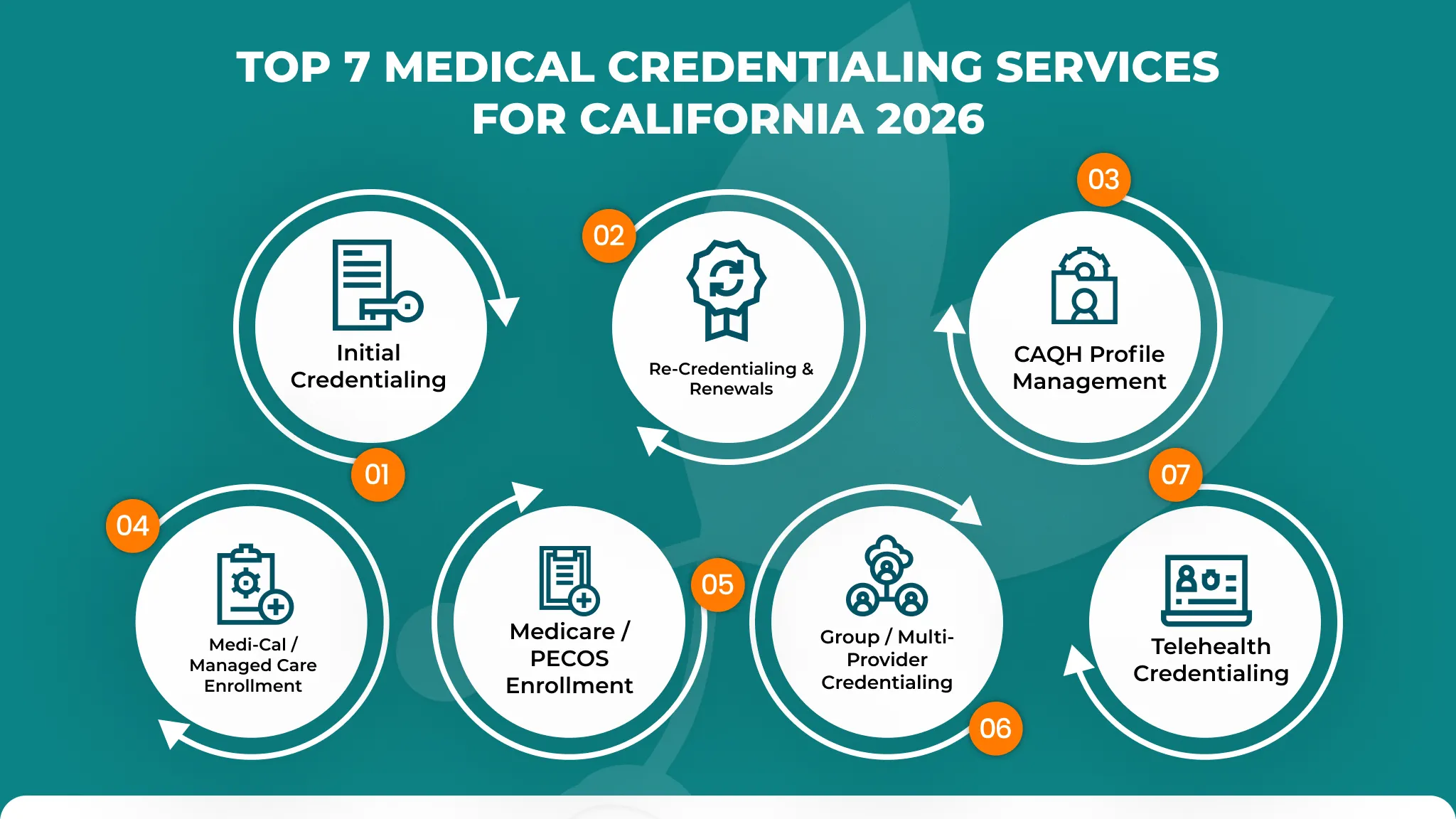
Quick answer: The top 7 medical credentialing services California practices need in 2026 are: Initial Credentialing (commercial + HMO panel setup), Re-Credentialing and Renewals (NCQA-aligned, every 2–3 years), CAQH Profile Management (re-attestation every 120 days), Medi-Cal / Managed Care Plan Enrollment (county MCO applications via PAVE), Medicare / PECOS Enrollment (federal CMS-855 forms), Group / Multi-Provider Credentialing (bulk roster onboarding), and Telehealth Credentialing (multi-state virtual care payer enrollment). GreenSense Billing handles CAQH profile management and initial credentialing for California practices.
Navigating California’s healthcare reimbursement landscape is notoriously complex. With high HMO market penetration, strict delegated credentialing rules, and a massive network of Medi-Cal Managed Care Organizations (MCOs), obtaining and maintaining payer approval requires far more than basic form-filling.
Rather than treating medical credentialing as a single administrative task, successful California practices treat it as a combination of distinct specialized services. Understanding which specific credentialing services your practice needs, and selecting partners that specialize in those specific areas, is the fastest way to avoid billing suspensions, eliminate administrative bottlenecks, and protect your practice's cash flow.
Below is an executive guide to the top medical credentialing services for California, structured around the specific functional solutions California healthcare practices require in 2026.
Quick Comparison: Key Credentialing Services in California
|
Service |
Why It Matters in California |
Recommended Provider |
Typical Timeline |
Evidence / Source |
|
Initial Credentialing |
Crucial for new practices entering California's heavy HMO/commercial markets. |
Credex Healthcare |
60–150 days (commercial); 3–6 months (full panel) |
Credex Healthcare, 2026 |
|
Re-Credentialing & Renewals |
NCQA guidelines enforce tight primary source verification windows (90–120 days). |
EZ MD Solutions |
Every 2–3 years (ongoing monitoring) |
EZ MD Solutions, 2026 |
|
CAQH Profile Management |
Profiles lapse every 120 days, halting multiple enrollment pipelines at once. |
Green Sense Billing |
Ongoing (attestation every 120 days) |
Green Sense Billing, 2026 |
|
Medi-Cal / Managed Care Enrollment |
County-by-county MCO networks require individual enrollment applications. |
Practolytics |
90–180 days |
Practolytics, 2026 |
|
Medicare / PECOS Enrollment |
Mandatory federal step; institutional enrollment carries a $750 fee in 2026. |
Maverick Health Innovations |
30–60 days |
Maverick Health Innovations, 2026 |
|
Group / Multi-Provider Credentialing |
Multi-specialty practices must handle staggered onboarding across complex rosters. |
Practolytics |
90–120 days |
Practolytics, 2026 |
|
Telehealth Credentialing |
Out-of-state virtual care requires licensure and payer approval where the patient sits. |
Practolytics |
60–120 days per state |
Practolytics, 2026 |
The Top 7 Medical Credentialing Services for California
Service 1: Initial Credentialing
What it is:
Initial credentialing is the foundational process of verifying a provider's education, training, licensure, and background checks to gain approval for billing commercial and government insurance networks.
Why it matters specifically in California:
California’s commercial market is dominated by large health plans, such as Blue Shield of California, Anthem Blue Cross, and Kaiser Permanente, alongside regional HMOs and independent practice associations (IPAs). Navigating these overlapping entities simultaneously requires localized administrative tracking to ensure primary source verification moves forward without delays.
What to look for in a provider of this service:
Seek out providers that offer dedicated account managers, direct follow-up protocols with payer contracting departments, and expertise across both fee-for-service and managed care contracting.
Typical timeline in California:
60 to 150 days for commercial payers; 3 to 6 months to establish a complete, multi-payer panel.
Who does it well:
- Credex Healthcare: Documented for structured end-to-end management of initial commercial payer panels.
- Green Sense Billing: Known for full-service enrollment support designed to speed up initial commercial onboarding for independent providers.
Service 2: Re-Credentialing and Renewals
What it is:
The periodic re-verification of a provider’s credentials, typically required every two to three years, to maintain active participation status within insurance networks.
Why it matters specifically in California:
As of July 2025, the NCQA tightened primary source verification windows down to 90–120 days. A single missed deadline can lead to temporary de-credentialing, delayed claims, or unexpected billing suspensions. Because many practices treat credentialing as a one-time event, re-credentialing remains one of the most common points of revenue disruption.
What to look for in a provider of this service:
Look for automated deadline tracking systems, proactive primary source re-verification, and ongoing license/DEA renewal monitoring.
Typical timeline in California:
Proactive management begins 120–180 days prior to the expiration date to ensure continuous network coverage.
Who does it well:
- EZ MD Solutions: Known for maintaining structured renewal workflows that align with updated NCQA standards.
Service 3: CAQH Profile Management
What it is:
The ongoing setup, maintenance, document uploading, and quarterly re-attestation of a provider’s CAQH ProView database profile.
Why it matters specifically in California:
CAQH ProView is the primary credentialing repository used by nearly all major commercial payers operating in California. Profiles require formal re-attestation every 120 days. In California’s dense market, an un-attested or outdated CAQH profile immediately halts active enrollment processes across multiple commercial plans at once.
What to look for in a provider of this service:
Continuous document maintenance (attestation, malpractice updates, license renewals) bundled into broader administrative or provider credentialing packages.
Typical timeline in California:
Profile setup takes 5–10 business days; re-attestations occur every 120 days.
Who does it well:
- Green Sense Billing: Provides continuous CAQH profile maintenance, automated document updates, and timely re-attestations to prevent profile lockouts.
Service 4: Medi-Cal / Managed Care Plan Enrollment
What it is:
The process of enrolling a provider or group with the California Department of Health Care Services (DHCS) and establishing contracts with county-specific Medi-Cal Managed Care Organizations (MCOs).
Why it matters specifically in California:
California’s Medi-Cal system relies heavily on managed care structures that vary significantly by county. Enrolling in traditional Medi-Cal is only the first step; practices must also credential with individual MCOs;such as L.A. Care, Health Net, Molina Healthcare, Blue Shield Promise, Inland Empire Health Plan (IEHP), and CalOptima. Experienced California credentialing services must understand these regional MCO requirements.
What to look for in a provider of this service:
Deep familiarity with PAVE (Provider Enrollment, Analysis and Validation) portal submissions and direct experience handling individual county MCO contracting workflows.
Typical timeline in California:
90 to 180 days, depending on the county and specific MCO contract capacity.
Who does it well:
- Practolytics: Highly experienced in navigating California-specific Medi-Cal MCO enrollment networks and regional payer variations.
Service 5: Medicare / PECOS Enrollment
What it is:
Submitting provider enrollment applications through the federal Provider Enrollment, Chain, and Ownership System (PECOS) for original Medicare, alongside commercial Medicare Advantage plan enrollment.
Why it matters specifically in California:
California has one of the highest Medicare Advantage penetration rates in the nation. Getting approved through PECOS grants basic Medicare billing rights, but practices must also secure enrollment with commercial carriers managing local Medicare Advantage HMO/PPO plans. Additionally, institutional providers face a $750 federal enrollment fee in 2026.
What to look for in a provider of this service:
Precise handling of CMS-855A, 855B, and 855I forms, coupled with expertise linking individual rendering providers to group NPIs.
Typical timeline in California:
30 to 60 days for standard PECOS processing; longer if documentation re-submissions are required.
Who does it well:
- Maverick Health Innovations: Recognized for streamlined handling of federal PECOS enrollment and Medicare Advantage network linking.
Service 6: Group / Multi-Provider Credentialing
What it is:
A specialized service tailored to multi-specialty practices, medical groups, and clinics that need to onboard multiple clinicians simultaneously while managing group tax IDs, facility enrollments, and delegated credentialing contracts.
Why it matters specifically in California:
Large medical foundations and expanding multi-provider groups across California face constant provider turn. Onboarding multiple physicians or mid-level providers with staggered start dates requires a centralized coordination system to prevent billing delays for new hires.
What to look for in a provider of this service:
Bulk roster management, scalable tracking dashboards, and experience managing delegated credentialing arrangements with health plans.
Typical timeline in California:
90 to 120 days for multi-provider roster integrations.
Who does it well:
- Practolytics: Offers robust group credentialing capabilities suited for expanding medical practices and large clinician rosters.
Service 7: Telehealth Credentialing
What it is:
Securing payer enrollment and network participation for virtual care providers delivering care to patients across different geographic locations.
Why it matters specifically in California:
Telehealth adoption remains high across California. Out-of-state clinicians treating California residents—or California-based clinicians offering cross-border virtual care—must be licensed and credentialed with insurance networks in the state where the patient sits during the visit.
What to look for in a provider of this service:
Multi-state licensing support, cross-border payer enrollment strategies, and expertise in virtual-only practice guidelines.
Typical timeline in California:
60 to 120 days per target state.
Who does it well:
- Practolytics: Explicitly offers dedicated telehealth enrollment support and multi-state payer strategies.
Which Services Does Your California Practice Need?
Not every medical practice requires all seven services at once. Identifying your current administrative stage helps determine where to focus your resources:
- Starting a New Practice: Focus on Services 1, 3, and 5 (Initial Credentialing, CAQH Management, and PECOS Enrollment) to build your core payer panel.
- Expanding Medi-Cal Patient Acceptance: Prioritize Service 4 (Medi-Cal Managed Care Enrollment) to target specific county MCOs.
- Established Practices Running Smoothly: Invest in Services 2 and 3 (Re-Credentialing and CAQH Profile Management) to protect existing cash flow and maintain compliance.
- Growing Group Practices: Utilize Service 6 (Group Credentialing) to streamline onboarding for new hires.
- Virtual Care Providers: Leverage Service 7 (Telehealth Credentialing) for multi-state payer participation.
To maintain continuous cash flow and avoid billing delays, practices must combine precise Provider Credentialing and upfront Eligibility Verification with end-to-end Revenue Cycle Management and dedicated medical billing service support. Understanding these specific needs allows you to select a partner equipped to solve your actual administrative challenges.
Simplify Your California Credentialing Process
Managing complex payer applications while running a medical practice creates unnecessary administrative overhead. Partnering with a dedicated service provider ensures your applications remain compliant, deadlines are met, and your practice stays focused on delivering patient care.
To streamline your network enrollment and safeguard your cash flow, explore Green Sense Billing's provider credentialing services today.
Disclosure: This article is published by GreenSense Billing, a provider of medical credentialing services. GreenSense Billing is mentioned as a recommended provider for specific services based on its documented capabilities. No other company paid for placement in this guide.