Not every bill in a California workers’ compensation claim is paid the same way. The Official Medical Fee Schedule has several parts and each part has its own rules for a different type of provider and service. Understanding California OMFS fee schedules matters most for hospitals, surgery centers and billing teams, because a bill sent under the wrong category can be reduced or delayed.
This guide covers the California medical fee schedule categories, explains how inpatient reimbursement methodology differs from outpatient and ASC payment and shows how to pick the right schedule before a bill goes out.
What Are the Different California OMFS Fee Schedules?
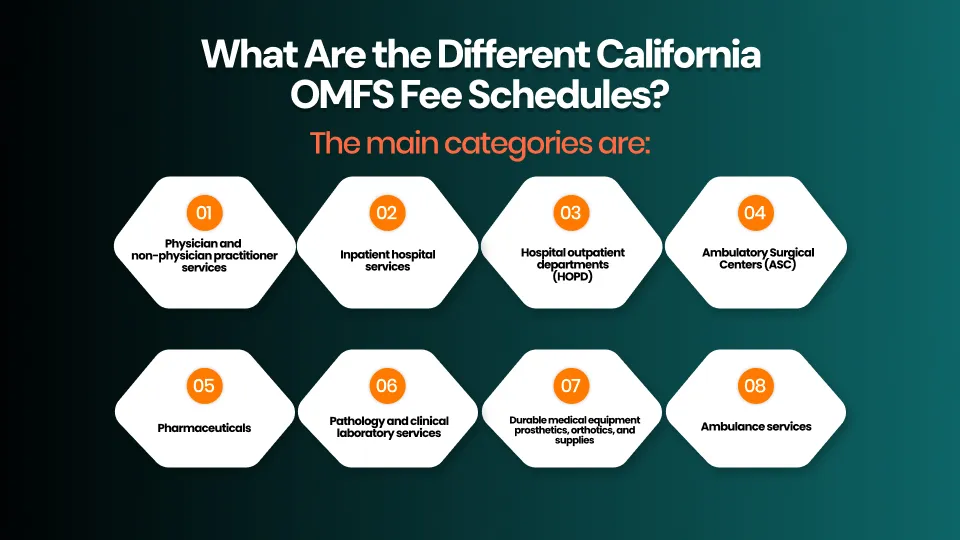
The California Division of Workers’ Compensation (DWC) publishes the OMFS with separate reimbursement provisions for different kinds of care. The main categories are:
- Physician and non-physician practitioner services
- Inpatient hospital services
- Hospital outpatient departments (HOPD)
- Ambulatory Surgical Centers (ASC)
- Pharmaceuticals
- Pathology and clinical laboratory services
- Durable medical equipment (DME), prosthetics, orthotics, and supplies
- Ambulance services
Each category follows its own methodology. A rule that works for one category should never be assumed to work for another.
California OMFS Inpatient Hospital Fee Schedule Explained
The California inpatient hospital fee schedule applies when a patient is formally admitted to a hospital. Payment is built around the facility’s stay, not around individual professional services, so it works very differently from a physician bill. The physician RVU formula does not apply to inpatient facility charges and treating it as if it does is one of the most common errors.
Because the stay is classified as a whole, workers’ compensation hospital billing for inpatient care depends heavily on clean records. Admission and discharge dates, diagnoses, procedures performed and the final classification of the stay all affect how the bill is processed. If any of that information is wrong or missing, the payer may adjust the payment or request more documentation. Check the current regulations on the DWC website for the exact classification and payment rules that apply to your date of service.
California OMFS Outpatient Hospital Fee Schedule Explained
The California outpatient hospital fee schedule covers services delivered through hospital outpatient departments when the patient is not admitted. That includes outpatient procedures, diagnostic testing, emergency department visits that do not result in admission and similar services.
Outpatient reimbursement relies on service classifications and payment groupings, so procedure codes carry real weight here. The code on the bill determines how the service is grouped and the grouping drives payment. Billing documentation must support each coded service and payment adjustments built into the methodology can change the final amount.
As with inpatient care, outpatient facility payment follows its own OMFS rules and should not be calculated with the physician formula. For OMFS hospital billing, always confirm which rules were in effect on the date of service.
What Is the California ASC Fee Schedule?
The California ASC fee schedule applies to eligible surgical procedures performed in a qualifying ambulatory surgical center. ASC billing covers the facility side of the procedure, such as the operating room, nursing and supplies, while the surgeon bills separately for professional services.
Not every procedure is eligible, so providers should confirm that the procedure is listed and classified correctly under the ASC rules. Coding accuracy and documentation requirements are just as strict as in the hospital setting. Most importantly, ASC reimbursement should not be treated as hospital outpatient reimbursement. The two settings can perform similar procedures, but the methodologies are different and applying one to the other is a reliable way to end up with a payment dispute.
Other OMFS Fee Schedules Healthcare Providers Should Know
Beyond facility billing, several other categories need their own review:
- Physician services: Professional evaluation, treatment and procedures, billed under the physician and non-physician practitioner provisions.
- Pharmaceutical fee schedule: Reimbursement rules for medications dispensed in workers’ comp claims.
- DMEPOS: Durable medical equipment, prosthetics, orthotics, and supplies, each with defined billing requirements.
- Pathology and laboratory fees: Rules for diagnostic and laboratory services.
- Ambulance reimbursement: Ground transportation and applicable emergency transport services.
These categories are separate from the hospital and ASC schedules and they should be checked individually. A hospital bill may include several service types, so billing teams need to know where each line item belongs.
Comparing Inpatient, Outpatient, and ASC Reimbursement
Feature | Inpatient Hospital | Hospital Outpatient (HOPD) | ASC |
Patient status | Formally admitted | Not admitted | Not admitted, surgical setting |
Bill type | Facility | Facility | Facility |
Payment focus | Classification of the full stay | Service classifications and payment groupings | Eligible surgical procedure classifications |
Key documentation | Admission and discharge records | Procedure codes and service records | Procedure codes and operative records |
Does the physician formula apply? | No | No | No |
Always confirm current details in the DWC’s published rules rather than relying on this summary.
How to Identify the Correct OMFS Fee Schedule for a Medical Bill
A short checklist keeps bills on the right track:
- Identify the provider and facility type.
- Decide whether the bill is for professional or facility services.
- Confirm inpatient, outpatient, or ASC status.
- Identify the service and procedure codes on the claim.
- Check the date of service against the current DWC fee schedule.
- Review the reimbursement rules and the documentation required to support payment.
Following California DWC billing rules in this order helps catch problems before submission instead of after a denial.
Common Fee Schedule Selection and Billing Mistakes
Most disputes trace back to a handful of avoidable errors:
- Applying the wrong fee schedule category
- Confusing professional and facility charges
- Classifying a patient as inpatient or outpatient incorrectly
- Using outdated reimbursement references
- Entering incorrect procedure codes
- Leaving out supporting documentation
Any of these can lead to payment adjustments, disputes, or delays and each one adds rework for your billing team. A short pre-bill review is far cheaper than an appeal.
Frequently Asked Questions
What fee schedules are included in California OMFS?
The OMFS covers physician services, inpatient hospital, hospital outpatient, ASC, pharmaceuticals, pathology and laboratory, DMEPOS, and ambulance services.What is the difference between inpatient and outpatient hospital reimbursement?
Inpatient payment is based on the classification of an admitted patient’s stay. Outpatient payment is based on service classifications and procedure codes for patients who are not admitted.How does the ASC fee schedule differ from the hospital outpatient schedule?
Both cover non-admitted care, but the ASC schedule applies to eligible surgical procedures in qualifying surgery centers and uses its own methodology.Does the physician OMFS formula apply to hospital facility bills?
No. Hospital facility services follow their own inpatient or outpatient rules.Where can providers find the current California OMFS fee schedules?
The DWC publishes them on its OMFS page. You can also review the DWC website and the California Title 8 Regulations.Conclusion
Choosing the right fee schedule is the first step to getting paid correctly. Inpatient, outpatient, ASC and the other categories each follow their own rules, so accurate coding, complete documentation and verification against current DWC sources all matter. If your team wants help keeping facility and professional bills on the right schedule, explore Billgenix’s workers’ compensation billing services or book a demo to see how it can support your revenue cycle.