When reviewing medical charts for weight-related clinical conditions, coders often land on category E66. However, submitting E66 ICD-10 codes requires expanding beyond the three-character category. Category E66 is not a valid, billable claim code by itself; it serves as a parent heading that requires a specific subcode to capture the underlying cause, class, or severity.
According to the official ICD-10-CM Tabular List provided by CMS and the CDC, category E66 is titled "Overweight and obesity". To process a valid claim, coders must select a complete, actionable subcode alongside any relevant secondary codes.
Quick answer: E66 alone is never billable. Select the subcode the provider documented (E66.01, E66.3, E66.811–E66.813, or E66.9), pair it with a Z68 BMI code when documented, and never code obesity from a BMI value alone.
What Does the E66 Code Family Cover?
The E66 category encompasses conditions related to excessive weight and caloric intake. It spans general overweight, drug-induced obesity, morbid obesity, and specified obesity classes.
Because ICD-10-CM E66 is an unbillable category, claims submitted with just "E66" will trigger immediate billing edits and denials. Coders must identify the appropriate subcode based on explicit physician documentation.
Failing to properly pair valid E66 subcodes with supporting Z68 secondary codes is a leading trigger for preventable claim denials and delayed reimbursements.
| Field | Detail |
|---|---|
| ICD-10-CM Category | E66 |
| Category Title | Overweight and obesity |
| Block & Section | Endocrine, Nutritional and Metabolic Diseases (E00–E89) |
| Code Status | Non-billable parent header (requires 4th or 5th characters) |
| Instructional Notes | Code first underlying cause if applicable; use additional code for Body Mass Index (BMI) (Z68.-) |
| Claim-Use Caveat | Must be supported by a documented clinical diagnosis from a provider. BMI alone cannot establish the condition. |
Common E66 Subcodes Compared
Selecting the correct code within the E66 family requires careful evaluation of the patient's record. The table below outlines key subcodes commonly used in clinical practice, including options found on official references like the AAPC E66 Code Guide.
| Code | Meaning | Required Documentation | Coding Caution |
|---|---|---|---|
| E66.01 | Morbid (severe) obesity due to excess calories | Explicit provider documentation of "morbid obesity" or "severe obesity" | Do not code based solely on a high BMI without the physician's diagnostic statement. |
| E66.3 | Overweight | Provider documentation specifying "overweight" status | Different clinical threshold than obesity; pair with correct Z68 overweight subcode. |
| E66.811 | Obesity, class 1 | Provider diagnosis of "Class 1 obesity" | Typically corresponds to BMI 30.0–34.9; requires physician confirmation. |
| E66.812 | Obesity, class 2 | Provider diagnosis of "Class 2 obesity" | Typically corresponds to BMI 35.0–39.9; requires explicit class designation. |
| E66.813 | Obesity, class 3 | Provider diagnosis of "Class 3 obesity" | Represents high-severity obesity; do not report alongside E66.01 unless directed. |
| E66.9 | Obesity, unspecified | General diagnosis of "obesity" without class or etiology | Use only as a last resort when further clinical detail cannot be queried. |
Documentation and BMI Coding
Understanding how diagnostic statements interact with objective vitals is crucial for accurate risk adjustment and compliant billing.
Provider-Documented Diagnosis
Under Official Coding Guidelines (Section I.B.14), coders can use weight measurements and secondary staff documentation to report BMI codes (Z68 series). However, the underlying diagnosis of overweight or obesity must be explicitly documented by a licensed clinician (such as the physician, nurse practitioner, or physician assistant). A coder cannot calculate a BMI, look at a chart, and assign an E66 ICD-10 code entry without the provider writing the diagnosis down in the record.
BMI and Z68 Reporting
Once the provider documents obesity or overweight, coders should assign a secondary code from category Z68 to capture the specific numerical measurement alongside the E66 clinical diagnosis.
- Adults (20 years and older): Use codes Z68.1 through Z68.45 to report specific numerical BMI figures.
- Pediatrics (2 to 19 years): Use codes Z68.51 through Z68.54 to report BMI percentiles appropriate for age and sex.
Selecting the Appropriate Specific Code
To select the correct subcode within the E66 category, follow a structured review process:
- Verify the Diagnosis: Confirm the physician has documented a clinical condition such as "overweight", "obesity", "class 2 obesity", or "morbid obesity".
- Determine the Etiology: Check if the condition is due to excess calories, a specific drug, or an underlying medical disorder (such as morbid obesity with alveolar hypoventilation, coded to E66.2).
- Cross-Reference Instructional Notes: Pay attention to Excludes1 and Excludes2 notes. For instance, adiposogenital dystrophy (E23.6) and Prader-Willi syndrome (Q87.11) are excluded from category E66.
- Append the Secondary BMI Code: Code the corresponding Z68 entry to report the objective BMI measurement alongside the primary E66 selection.
Never convert a standalone BMI value into a diagnosis code like E66.9 or E66.01 without clear, supporting clinical text in the assessment and plan.
Two Documentation Scenarios
Scenario A: Fully Supported Obesity Coding (Hypothetical)
A physician documents: "45-year-old patient here for annual exam. Diagnosis: Severe morbid obesity due to excess calories. BMI calculated at 42.1."
- Primary Code: E66.01 (Morbid [severe] obesity due to excess calories).
- Secondary Code: Z68.41 (Body mass index [BMI] 40.0-44.9, adult).
- Rationale: The provider explicitly stated "morbid obesity", justifying E66.01, and the secondary BMI code accurately captures the quantitative vital sign.
Scenario B: BMI-Only Record Requiring Clarification (Hypothetical)
A clinic intake note lists height and weight resulting in a calculated BMI of 32.4. However, the physician's assessment only lists "Essential hypertension" with no mention of obesity or weight management in the impression.
- Coding Action: Do not assign an E66 ICD-10 code or a Z68 BMI code. Query the provider if weight management influenced the encounter.
- Rationale: A coder cannot infer a diagnostic condition solely from vital signs or automated EHR calculators without explicit clinician documentation.
Common Errors and Pre-Claim Checklist
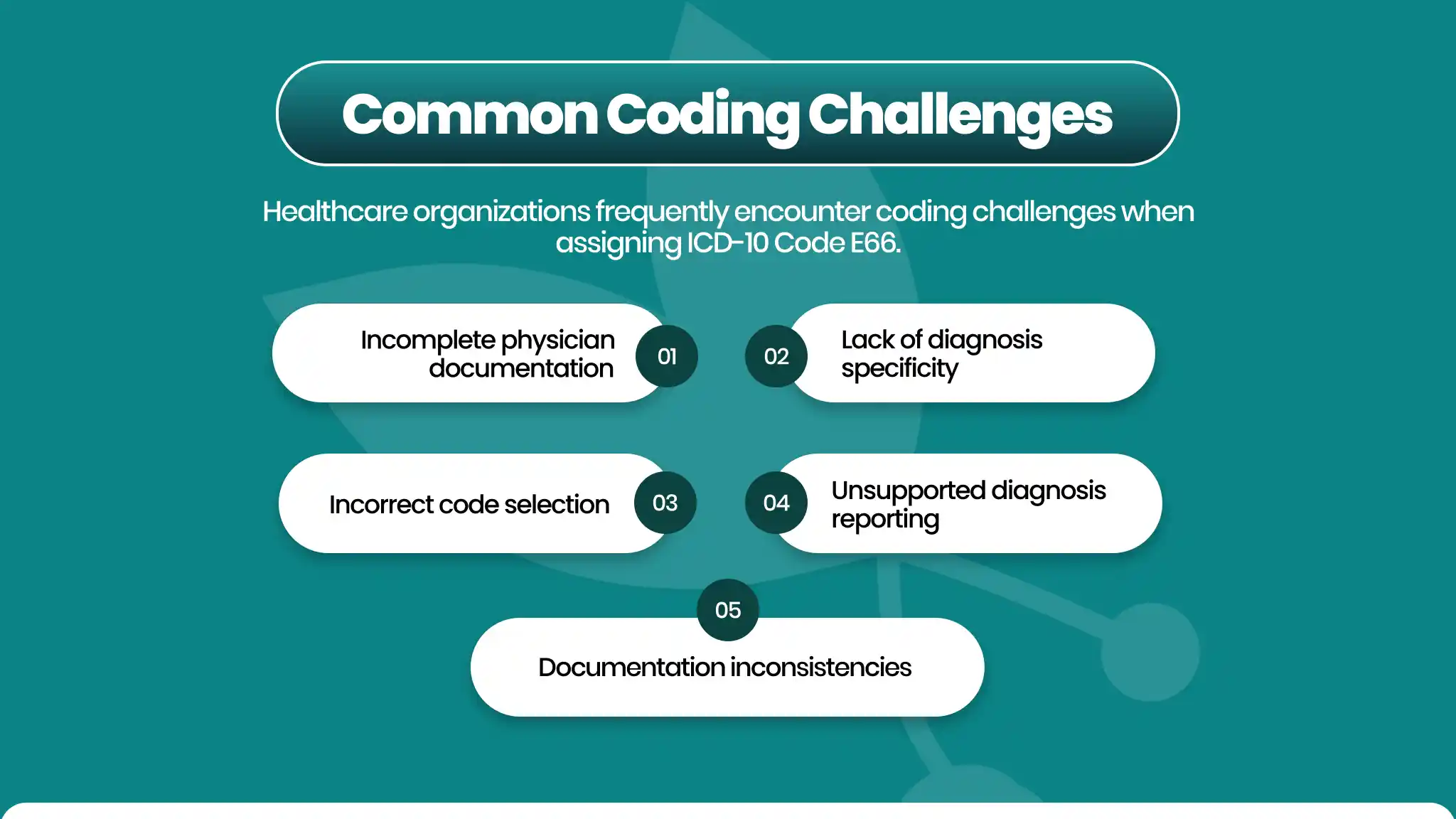
Avoid standard claim rejections by completing these pre-submission documentation checks:
- Category Completeness: Did you avoid reporting generic E66 alone by appending a valid 4th or 5th character?
- Clinician Support: Is there an explicit provider diagnosis of overweight or obesity in the medical record?
- Secondary BMI Verification: Did you assign a secondary Z68 code to report the supporting adult BMI or pediatric percentile?
- Specific Code Choice: Did you review specific options like E66.811, E66.812, or E66.813 when the class of obesity is documented?
Integrating strict documentation checks at the point of charge capture strengthens overall revenue cycle performance by reducing pre-bill edits and costly downstream appeals.
Also read
Coding Support and Documentation Review
Maintaining compliance across complex clinical documentation requires consistent auditing practices. Review your obesity coding documentation with professional coding support services at GreenSense Billing to optimize revenue cycle accuracy.