
Payroll rarely gets credit when it goes right and gets blamed loudly when it goes wrong. That imbalance is exactly why so many businesses stick with outdated processes long after they have become a drag on time and money.
The truth is simpler than most HR teams realize. Payroll software is not just a convenience upgrade. It is one of the highest return investments a growing business can make, and the savings show up in places most owners never think to look. Here are seven ways it happens.
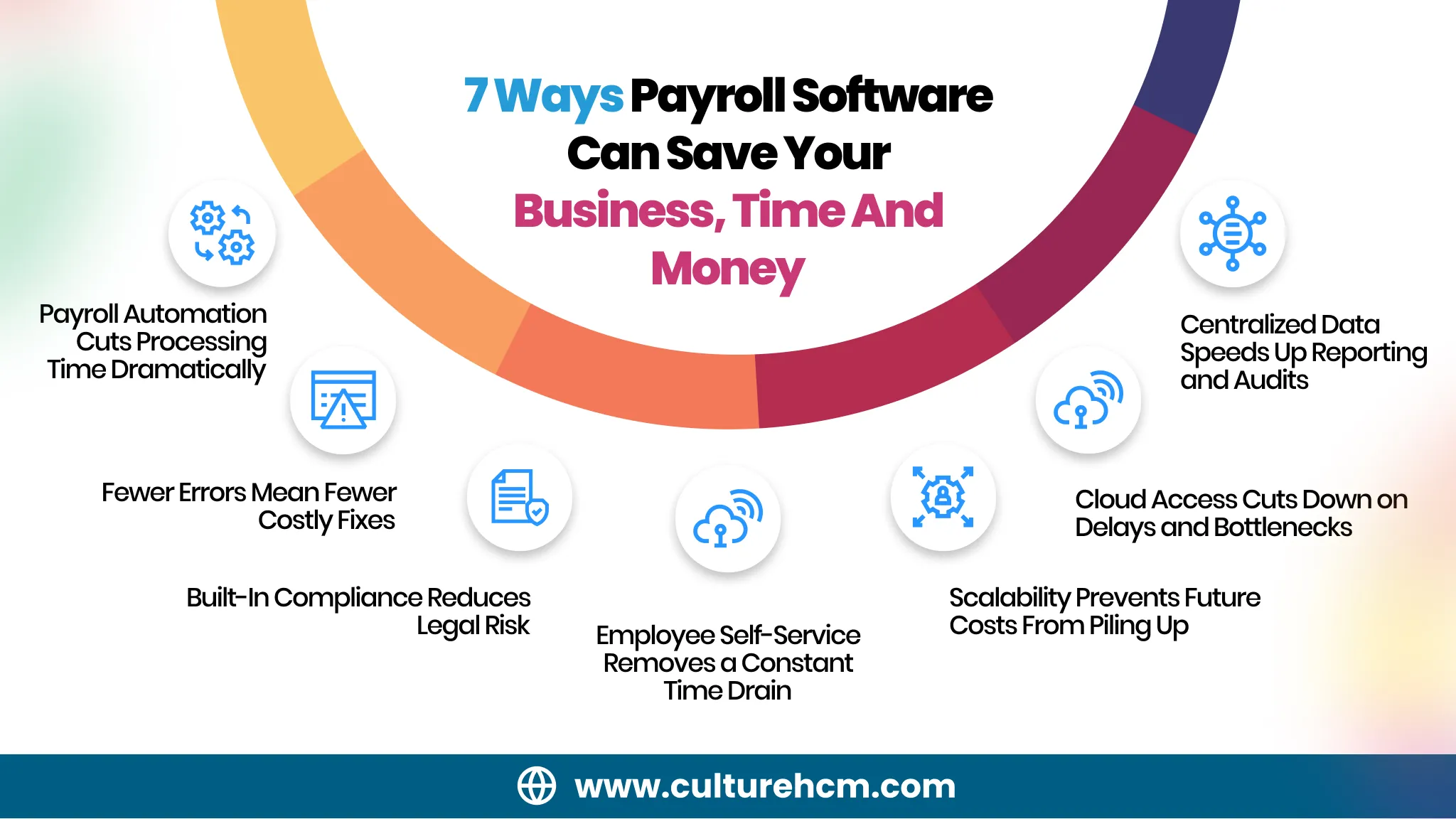
1. Payroll Automation Cuts Processing Time Dramatically
Calculating salaries by hand means recalculating tax deductions, overtime, leave adjustments, and allowances for every employee, every cycle. What takes a finance team three or four days manually can often be done in a few hours with payroll automation.
That is not a small efficiency gain. Over a year, it adds up to weeks of staff time freed up for higher-value work like recruitment, performance management, or strategic planning instead of repetitive number crunching.
2. Fewer Errors Mean Fewer Costly Fixes
Every payroll mistake costs more than the original error. A missed deduction has to be corrected, explained to the employee, and sometimes reported to tax authorities. A miscalculated tax bracket can trigger penalties.
Automated payroll processing applies the same rules consistently across every employee, every time. There is no fatigue, no copy-paste error, no outdated formula sitting unnoticed in row 47 of a spreadsheet. This is one of the most immediate payroll automation benefits businesses notice once they switch.
3. Built-In Compliance Reduces Legal Risk
Tax slabs change. EOBI contribution rates get updated. Labor law requirements shift depending on the province or sector. Keeping up with all of this manually means someone on your team has to actively monitor regulatory news and update formulas accordingly, and that rarely happens consistently.
Payroll management software is generally built to reflect current tax and compliance requirements, applying updates system-wide rather than requiring someone to catch every change individually. That difference alone can prevent fines, back payments, and the reputational cost of a compliance failure.
4. Employee Self-Service Removes a Constant Time Drain
Think about how often HR gets asked for a copy of a payslip, a tax certificate, or a leave balance. Each request seems small, but multiplied across dozens or hundreds of employees, it becomes a real drain on HR bandwidth.
An employee payroll system with self-service access lets staff pull their own payslips, tax documents, and history whenever they need them. HR stops being the bottleneck for basic information requests and gets that time back for actual HR work.
5. Centralized Data Speeds Up Reporting and Audits
Ask a manual payroll team for a year-end summary broken down by department, tax bracket, and benefit type, and expect to wait days for an answer, if it can be produced accurately at all.
HR payroll software, sometimes called HR and payroll software when it spans the full employee lifecycle, keeps everything in one connected system. Reports that used to take days of manual compilation can be generated in minutes, which matters enormously during tax season, audits, or year-end planning. This kind of visibility is one of the clearest examples of what modern payroll software in Pakistan is built to solve for growing companies.
6. Cloud Access Cuts Down on Delays and Bottlenecks
Manual payroll often depends on one person having the right spreadsheet, on the right computer, at the right time. If that person is on leave or unreachable, payroll processing stalls.
A cloud-based payroll software platform removes that single point of failure. HR and finance teams can review, approve, and process payroll from anywhere, which matters especially for businesses managing multiple branches or remote staff. Nothing sits waiting on one desktop that only one person can access.
7. Scalability Prevents Future Costs From Piling Up
A spreadsheet-based process that works for 10 employees will not work cleanly at 50 and will actively cost you money at 200 through errors, overtime spent fixing mistakes, and slower onboarding of new hires into payroll.
Payroll software scales with the business. Adding new employees, new pay structures, or new locations does not require rebuilding the entire system from scratch. The cost of switching later, after years of accumulated manual workarounds, is almost always higher than adopting the right system early.
Payroll Software vs. Manual Processing: The Bottom Line
Impact Area | Manual Payroll | Payroll Software |
Time per cycle | 3 to 5 days | A few hours |
Error correction cost | Recurring, unpredictable | Minimal, rules applied consistently |
Compliance tracking | Manual monitoring required | Built into the system |
Reporting speed | Days | Minutes |
Employee requests | Handled individually by HR | Self-service |
Scalability | Breaks down with growth | Grows with the business |
How CultureHCM Helps Businesses Save Time and Money
CultureHCM brings payroll, attendance, and HR data into one cloud-based platform built for businesses in Pakistan. The Payroll and Finance module automates salary calculations, tax deductions, and disbursement, while real-time dashboards give HR and finance teams visibility without chasing spreadsheets.
For companies still processing payroll by hand, the shift to automation is usually less about adopting new technology and more about finally reclaiming the hours and budget that manual processes have quietly been costing them for years.
Conclusion
The time and money payroll automation saves rarely show up as one dramatic number. They show up gradually, in fewer errors, faster reporting, less time spent on repetitive tasks, and a system that keeps up with compliance instead of falling behind it. Businesses that make the switch early tend to look back and wonder why they waited.
If manual payroll is still costing your team hours every month, it may be worth seeing what automation actually looks like in practice. Book a free demo with CultureHCM and find out how much time your business could get back.
Frequently Asked Questions
How does payroll software actually save money, not just time?
It reduces the cost of correcting errors, avoids compliance penalties from missed tax or EOBI updates, and cuts down on the staff hours spent on repetitive manual calculations, all of which have a direct financial impact even though they are not always tracked as payroll costs.
Is payroll automation only useful for large companies?
No. Smaller businesses often benefit the most, since they typically have fewer people available to catch manual errors before they affect an employee or trigger a compliance issue.
What is the difference between payroll software and an employee payroll system?
The terms are often used interchangeably. Generally, payroll software refers to the calculation and processing engine, while an employee payroll system includes the broader experience, such as self-service payslips, leave integration, and reporting.
How long does it take to switch from manual payroll to payroll software?
This varies by business size and data complexity, but most platforms are designed for a structured onboarding process involving data migration and configuration, typically completed within a few weeks.
Does cloud-based payroll software work for businesses with multiple locations?
Yes. Cloud access means HR and finance teams can manage payroll across branches or remote teams from a single system, without depending on files stored on one local computer.